



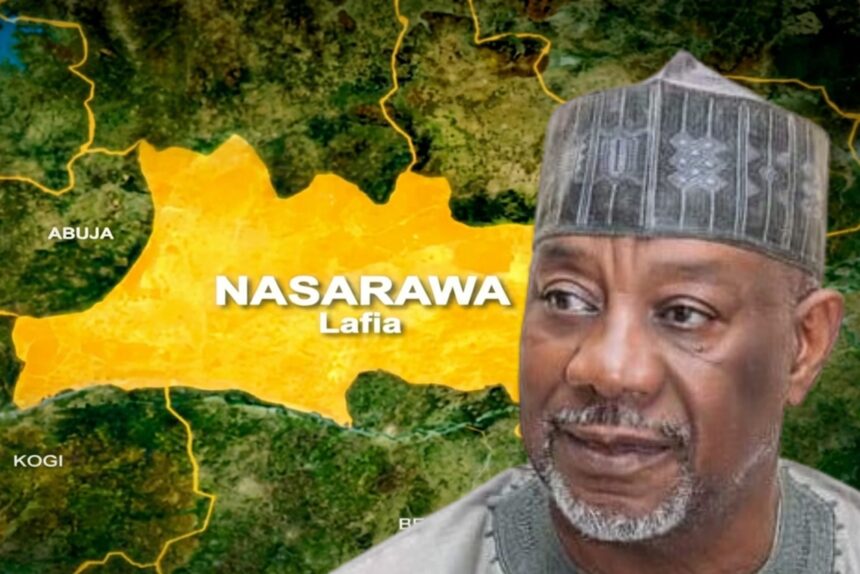
In Nasarawa State, Nigeria’s Middle Belt, where agriculture is the backbone of the economy with the state capital, Lafia, having the potential to become Nigeria’s major hub for agribusiness and commerce, Sen. Mohammed Onawo stands as an ideal gubernatorial candidate to move the needle.
With a legislative career spanning over 2 decades, the Nigerian lawmaker demonstrated capacity in governance, representing Nasarawa South in the State House of Assembly and later in the Federal Senate.
From Abuja, the country’s seat of power, he drove national policies on renewable energy that led to solar projects powering 15 communities and directly impacting over 5,000 households.
Analysts draw similarities between the state and Qatar, a country in the Middle East with similar population size of approximately 3 million people. While Qatar in the space of 30 years (from 1995) has become a global energy powerhouse, boasting a per capita GDP of $71,650, Nasarawa State’s per capita GDP is significantly lower at $4,099 despite its founding in 1996, as a breakout from western Plateau.
Despite being the 5th largest state in Nigeria, and a treasure trove of rich agricultural land and natural resources, Nasarawa State faces significant development challenges.
Onawo believes the state’s potential can be unlocked with the right plan, structure, and political will, giving the abundance of fertile land, a hardworking people, and a strategic location.
The governorship aspirant under the African Democratic Congress (ADC) is not new to pushing progressive efforts. As a legislator, he championed laws boosting education, healthcare, and infrastructure, including a 35% budget increase for agriculture that benefited farmers in the state.
Political analysts familiar with the candidate notes that Onawo is leveraging this experience to mobilise resources in the development of the state where promising innovation-driven governance and tech-led development tops the priority.
The 1-million-dollar question is: Will Nasarawa’s voters push for change, and will they choose a leader with proven legislative prowess and a vision for the future?
Who is Mohammed Onawo?
Born in Doma, Nasarawa State, Onawo’s early life was shaped by modest beginnings, an experience that would later define both his politics and his public service ethos.
In an era where governance is increasingly defined by innovation, data, and adaptability, he stands out as part of a new generation of Nigerian leaders seeking to bridge the gap between traditional politics and future-facing governance.
His experience as Chairman of the House of Representatives Committee on Industries (2011-2015) and Chairman of the House of Representatives Committee on ICT (2015-2019) gives him a unique perspective on driving growth and development.
Representing Nasarawa South Senatorial District, Onawo has built a reputation not just as a politician, but as a forward-thinking policymaker with an eye on technology, economic reform, and institutional development.
His approach reflects a broader shift within Nigeria’s political landscape, where citizens, particularly young people, are demanding more responsive, transparent, and digitally enabled governance structures.
Early Education and Career
Onawo’s educational trajectory reflects persistence and continuous self-improvement. Beginning at LGEA Primary School, Doma, he proceeded to Government Secondary School, Lafia before training as a teacher at Government Teachers’ College, Jos, where he earned a Grade II certificate.
His pursuit of knowledge did not stop there. He attended Advanced Teachers’ College, Akwanga, and later obtained a Higher National Diploma in Business Administration from Ramat Polytechnic, Maiduguri.
In a move that underscores his commitment to lifelong learning, he earned a Postgraduate Diploma in Management from Nasarawa State University, Keffi, and a Master’s degree from the National Defence Academy, Kaduna, where he is also pursuing a PhD.
Professionally, his early career spanned teaching, sales, and corporate management, working with companies such as Hilltop Bottling Company, Standard Breweries, and Pioneer Milling Company. These roles exposed him to both grassroots realities and corporate systems, shaping his pragmatic approach to governance.
His Political Rise from Grassroots to Speaker
Onawo’s entry into politics in 2003 marked the beginning of a defining chapter. Elected to represent Doma North Constituency in the Nasarawa State House of Assembly, he distinguished himself through leadership and consensus-building.
Within months, he was unanimously elected Speaker of the House on June 6, 2003, an uncommon feat that spoke to his credibility among peers. He served as Speaker from 2003 to 2007 and was re-elected for a second term in 2007, during which he chaired the House Committee on Urban Development.
His tenure at the state legislature was marked by stability and institutional strengthening, laying the groundwork for his transition to national politics.
Onawo went on to serve two terms in Nigeria’s House of Representatives, where he chaired the Committees on Industry and Information and Communication Technology (ICT).
These roles positioned him at the intersection of economic policy and technological development, an alignment that continues to shape his legislative priorities today.
Currently serving as Senator representing Nasarawa South Senatorial District, he has maintained a reputation as an active lawmaker, contributing meaningfully to debates and policy discussions within the National Assembly.
Ridwan Adelaja, a development strategist and former media aide to the Minister of Interior, Olubunmi Tunji-Ojo, praised the senator, saying he embodies the spirit of service and leadership that Nasarawa State needs.
As a seasoned administrator, he understands governance and knows how to get things done. I’m impressed by his commitment to people-centric policies and his ability to build bridges across diverse communities.
“With Onawo, Nasarawa gets a leader who’ll drive development, not just discuss it,” media personality noted.
Technology as a Governance Tool
One of the most distinguishing aspects of Onawo’s leadership is his emphasis on technology as an enabler of governance. While many politicians reference digital transformation rhetorically, Onawo has backed this with tangible interventions.
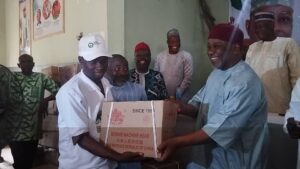
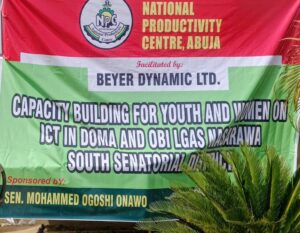
In 2025, the senator distributed 152 laptops to participants across the five local government areas of Awe, Doma, Lafia, Keana, and Obi as part of an ICT training initiative, an effort aimed at widening digital access and skills.
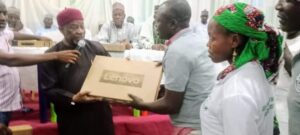
“We must maximize the positive impact of technology and industry convergence on employment and businesses. We must get everyone involved,” Senator Onawo said, underscoring his belief in inclusive digital growth.
Tech experts say this kind of intervention signals more than symbolic engagement, it reflects a growing recognition that digital literacy and access are foundational to economic participation in today’s world.
Zulqarinain Suhaib, a computer scientist and public analyst, reinforces this perspective.
“Sen. Onawo’s approach to governance is refreshingly tech-savvy and forward-thinking. He’s a leader who grasps the potential of technology to transform lives and economies.
His focus on innovation and accountability aligns perfectly with the aspirations of Nasarawa’s youthful population. He’s the kind of leader who’ll harness data and digital tools to solve real problems, from agriculture to healthcare.
“Nasarawa’s future is bright with Onawo at the helm,” Zulqarinain said.
In a state often overshadowed by larger economic centres like Lagos and Abuja, this focus is particularly significant. By promoting tech adoption, Onawo is positioning Nasarawa to participate more actively in Nigeria’s digital economy.
Driving Infrastructure and Economic Growth
Perhaps one of his most tangible achievements lies in infrastructure advocacy. Through legislative intervention, Onawo secured a ₦1.94 billion allocation in the 2024 Appropriation Act for the Lafia–Doma–Rutu–Bassa–Rafin Gabas–Nasarawa–Ara–Orozo road project, a critical but historically underfunded federal road.
In addition, he has facilitated construction of modern classroom blocks with solar power at Alago Unity Science and Technical College, and solar-powered boreholes to improve access to clean water.
Onawo’s governance model extends beyond infrastructure into human capital development. He has facilitated 18 federal employment opportunities and 2 political appointments for constituents, partnered with the University of Buckingham to train 50 teachers, awarding internationally recognised diplomas, and also sponsored vocational and technical training programmes for over 50 youths.
These initiatives reflect a deliberate strategy to build a future-ready workforce and address unemployment at the grassroots level.
Mikhail Adetola, a Lagos-based legal advisor and philanthropist, highlights another dimension of his leadership:
Sen. Mohammed Onawo’s philanthropic spirit and commitment to justice set him apart. As a member of the legislator, he understands the importance of fairness and equity in governance. His track record of community service and support for marginalized groups shows he’s a leader who genuinely cares about people’s welfare.
“With his legal acumen and compassionate approach, Onawo is poised to be a governor who’ll serve with integrity and put Nasarawa’s people first,” Mikhail said.
Key Legislative and Policy Achievements
A closer look at Onawo’s recent work in the Senate reveals a pattern of targeted, impact-driven interventions. Within his first year in the 10th Senate, he sponsored three significant bills:
- A bill to give legal force to resolutions passed by the National Assembly
- A bill to establish the Solid Minerals Producing Areas Development Commission, with headquarters proposed for Nasarawa State
- A bill to establish a National Eye Centre in Doma, aimed at improving specialised healthcare delivery and research
These bills reflect a blend of institutional reform, economic development, and healthcare expansion. Onawo has also demonstrated responsiveness to urgent issues, including:
- Co-sponsored a motion addressing poor road infrastructure and gully erosion across Nigeria
- Moved a motion calling for federal relief intervention following devastating windstorms in parts of Nasarawa South
In recognition of his contributions, Onawo has received several traditional titles, including Turakin Doma, conferred by the Andoma of Doma.
These honours reflect both cultural legitimacy and community acceptance, an important dimension of leadership in Nigeria’s socio-political context.
A Leadership Style Anchored in Vision and Pragmatism
Senator Mohammed Onawo’s political trajectory offers a glimpse into what the future of governance in Nigeria might look like, one that blends experience with innovation, and policy with practical outcomes.
Experts see his approach as part of a broader shift towards governance that is not only people-centred but increasingly enabled by technology, data, and strategic partnerships.
For Nasarawa South, industry leaders say his tenure signals a period of active representation and measurable intervention. For observers of Nigerian politics, it offers insight into how leadership can evolve to meet the demands of a rapidly changing world.
Whether through legislation, infrastructure, or social investment, analysts note Senator Mohammed Onawo’s imprint on Nasarawa’s political and developmental landscape is inspiring, and becoming increasingly the choice of the masses.
——————-
Bookmark Techparley.com for the most insightful technology news from the African continent.
Follow us on Twitter @Techparleynews, on Facebook at Techparley Africa, on LinkedIn at Techparley Africa, or on Instagram at Techparleynews.