



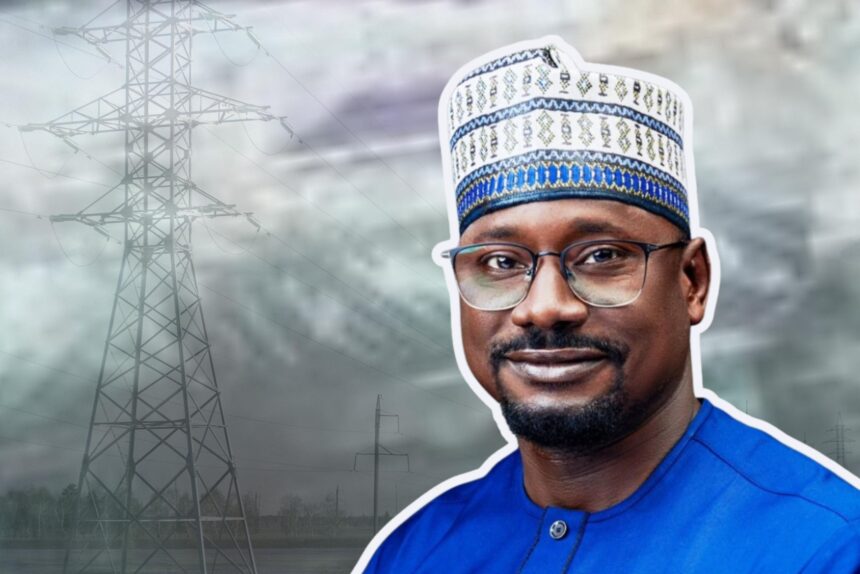
Nigeria’s rural power landscape is undergoing a transformation, and at the centre of this shift is Abba Abubakar Aliyu, the Managing Director of the Rural Electrification Agency (REA).
When President Bola Ahmed Tinubu appointed Abba Abubakar Aliyu as the Managing Director of the REA on 23 January 2025, it was widely seen as a vote of confidence in a technocrat whose leadership style blends technical discipline with a vision for decentralised energy.
Aliyu’s career shows a professional steeped in electrification projects. With over 20 years of experience in energy policy and organisational development, he served as General Manager at the Nigerian Bulk Electricity Trading Plc and as Senior Special Assistant to the Minister of Power on policy.
This background now shapes the REA’s shift towards scalable systems rather than demonstration projects. This helps explain why the REA under his watch has been positioned as a centerpiece of Nigeria’s energy future.
From Technical Specialist to National Energy Figure
Aliyu’s rise reflects a career rooted in the mechanics of energy delivery. Before leading the REA, he played key roles in the Nigeria Electrification Project (NEP), multilateral programmes, and donor-led interventions focused on distributed renewable energy.
He previously served as the Head of the Nigeria Electrification Project (NEP) at the REA, overseeing the implementation of a $550m facility from the World Bank ($350m) and AfDB ($200m).
His leadership resulted in securing approval for the $750m DARES (Distributed Access through Renewable Energy Scaleup) facility from the World Bank, building on the success of the NEP.
What distinguishes Aliyu is not only his grasp of engineering fundamentals but his insistence that Nigeria must build the human capital and manufacturing base required to own its energy future.
It is this philosophy that is redefining the REA’s place in Nigeria’s energy architecture and reshaping expectations about what rural electrification can achieve.
What You Need to Know
Aliyu often stresses that Nigeria cannot electrify by simply “installing hardware”; it must also build layered local capacity. This philosophy is evident in one of his public remarks.
“This requires more than infrastructure deployment. It calls for a new generation of young Nigerians who are technically trained in the operation, maintenance, and financing of renewable energy projects,” he said.
Under his leadership, the REA, through the Energising Education Programme (EEP) has already begun training 1,500 young Nigerians in solar installation, mini-grid management, battery systems, and renewable project operations.
He frames skills development as the foundation upon which long-term national energy sustainability rests.
What the REA Has Achieved Under Aliyu
Since Aliyu assumed substantive leadership, the REA has been active on several fronts, including:
1. New Waves of Private-Sector Partnerships
Since early 2024, the REA has secured significant private-sector partnerships, including multi-hundred-mini-grid agreements capable of reaching up to two million new beneficiaries.
These arrangements create predictable, commercially viable environments for distributed renewable companies. Aliyu describes the moment as a shift in mindset.
“It is no longer enough to talk about energy poverty. We must act by localising solutions through finance, infrastructure, talent, and manufacturing. The access gap is not just a burden; it is our opportunity to lead Africa’s energy future,” Aliyu said.
His framing is deliberate, rather than viewing rural electrification as a fiscal drain, he positions it as a new frontier for industrial opportunity.
2. Localisation of Manufacturing
One of the most ambitious components of Aliyu’s agenda is sweeping localisation. He argues that Nigeria cannot sustain a renewable rollout if every major component is imported.
He disclosed recently that operational plants now exist in Lagos, Abuja, and other parts of the country, with more expected in the near term.
For him, localisation is not merely patriotic rhetoric but an industrial policy.
“We are ensuring that components currently imported will soon be produced here in Nigeria, not only for domestic use but for export across Africa,” he said.
This includes solar panel frames, charge controllers, inverters, racking structures, and battery casings, parts that are often low-margin but essential for project viability.
3. Capacity Building and Youth Employment
Aliyu frequently argues that Nigeria must create a talent pipeline capable of servicing installations for decades. The EEP’s training of 1,500 renewable technicians, he says, is just the beginning of what should become a nationwide energy skills corps.
The REA is also building frameworks for rural energy entrepreneurs, young Nigerians who can own, manage or co-manage local distribution hubs, smart-metering clusters, and last-mile maintenance firms.
How the REA Can Further Boost Generation, Transmission and Distribution with Tech in Focus
Though the REA is not a grid generator or transmission company, its influence sits at the intersection of distributed generation, local distribution, and demand-side management.
Under Aliyu, the agency can deepen national electrification impact in several strategic ways:
1. Expand Modular Generation Through Scalable Mini-Grids
Mini-grids are the fastest route to rural power. To accelerate deployment, experts say Aliyu’s REA can continue standardising tariffs, RESCO (renewable energy service company) frameworks, power purchase templates, and community-ownership models.
This reduces negotiation time and enhances investor confidence, critical for rural commercialisation.
2. Unlock Interoperable Smart-Metering and Energy Data APIs
Nigeria’s tech hub is rich with fintechs, IoT startups, and data science companies. To harness this, industry leaders say mini-grids must use open APIs; metering data should be accessible to innovators; billing and revenue assurance tools must integrate with mobile wallets, POS terminals and digital banks.
For startups, this opens new markets in energy analytics, predictive maintenance, and smart billing.
3. Franchise Last-Mile Distribution to Local Operators
Aliyu’s REA can replicate telecom-sector logic, by creating incentives for micro-utilities and local operators to handle distribution. These operators can adopt remote monitoring tools, IoT-enabled maintenance systems, and mobile payment infrastructure.
This decentralises electricity delivery and turns communities into active stakeholders.
4. Build Financing Pipelines for Energy-Tech Startups
Nigeria’s energy-tech ecosystem is growing but underfunded. The REA can influence DFIs and local banks to create:
- blended finance windows,
- credit guarantees for energy hardware startups,
- R&D funds for storage and components,
- procurement frameworks that reward innovation.
Such pipelines ensure that Nigerian startups become not just installers but manufacturers, designers, and IP owners.
5. Encourage Renewable-Powered Tech Infrastructure
Tech hubs, incubators, data centres and AI labs require stable power. The REA can introduce incentives for:
- co-locating data centres with solar-hybrid microgrids,
- integrating storage solutions to support cloud workloads,
- building green energy clusters around innovation districts.
This approach supports Nigeria’s digital economy while reducing grid pressure.
Policy Levers Aliyu Can Champion
A national electrification push needs enabling policy. The REA under Aliyu could accelerate outcomes by advocating for:
- Regulatory clarity for mini-grids and RESCO tariffs that balance affordability with investor returns.
- Standard technical codes for mini-grids and interconnection to ensure safe, scalable deployment.
- Faster land-use approvals and right-of-way processes for distributed generation projects.
- Data-sharing mandates where government-funded projects must surface anonymised consumption data for innovators.
These changes do not require wholesale legislative rewrites, as many are administrative and can be advanced through coordinated federal-state action.
Despite momentum, the REA still faces funding gaps, supply-chain volatility for solar and storage, reluctance from legacy distribution companies, state-level regulatory inconsistencies, and community-level challenges around land and security.
Analysts say Aliyu’s long-term success will depend on balancing investor demands with community realities while ensuring political support for localisation.
Why This Matters to Nigeria’s Tech Ecosystem
Reliable, decentralised electricity is not just a development goal, it is an industrial enabler. For Nigeria’s startups and tech hubs, electrification means:
- Lower operating costs and less downtime for cloud-based services and labs.
- New markets for energy-management software, IoT-enabled maintenance tools and fintech billing products.
- Local manufacturing opportunities for balance-of-system components and storage.
Experts say Abba Abubakar Aliyu represents a new generation of Nigerian public-sector leadership. His insistence on youth training, and open collaboration with the tech ecosystem shows a leader attempting to create systems, not just deliver projects.
If Nigeria is to electrify millions sustainably and fuel the country’s growing digital economy, the REA’s role becomes even more pivotal. Under Aliyu, it has begun to look more like a national energy catalyst.
The coming years will determine whether this momentum translates into broad electrification for Nigerians, and whether the country’s tech ecosystem can convert electrification into entrepreneurial growth.
Talking Points
It is noteworthy that under Abba Abubakar Aliyu’s leadership, the Rural Electrification Agency (REA) is moving beyond isolated projects and embracing a more systemic approach to rural power delivery. His emphasis on skills development, local manufacturing, and partnerships signals an agency thinking long-term rather than chasing quick wins.
At Techparley, we see how this can reshape the clean-tech ecosystem, enabling startups, energy service companies, and rural entrepreneurs to build sustainable models rather than relying on external expertise.
There is also room for the REA to deepen collaboration with Nigeria’s tech ecosystem. Open data APIs for mini-grids, smarter metering systems, and digital tools for distribution management can unlock new markets for innovators building energy-tech solutions.
As the REA scales its partnerships and accelerates deployment across underserved communities, we see an opportunity for broader public-private alignment.
With the right strategic support, Aliyu’s approach could transform rural electrification into a catalyst for job creation, local innovation, and a stronger digital economy across Nigeria.
——————-
Bookmark Techparley.com for the most insightful technology news from the African continent.
Follow us on Twitter @Techparleynews, on Facebook at Techparley Africa, on LinkedIn at Techparley Africa, or on Instagram at Techparleynews.