



As Africa and the Middle East continue their digital transformation, the demand for reliable identity verification infrastructure has never been greater. Yet across much of the region, verification remains slow, and expensive. Morocco-based regtech startup Vove ID believes it has a solution.
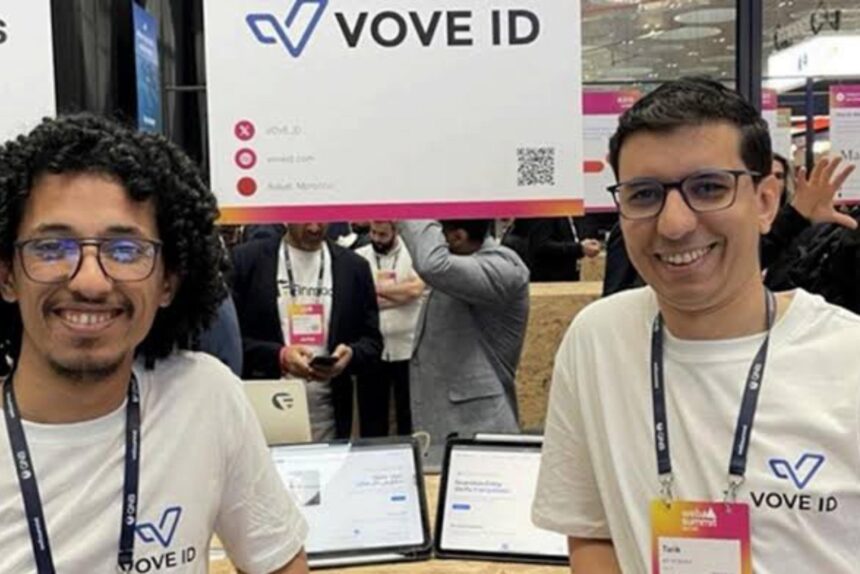
Founded in 2024 by Aoussar Khalid, Tarik Ait M’Barek, and Youssef Saber, Vove is building a verification stack tailored to Africa and the Middle East, combining speed, accuracy, and regional expertise to address one of the digital economy’s most persistent bottlenecks.
Several providers have attempted to modernise this space, but many global verification tools remain geared toward Western ID formats. Low pass rates, manual reviews, and slow integrations have left a gap for region-specific solutions.
“We’ve personally dealt with fragmented KYC providers and inconsistent verification for African and MENA users while building other products,” the company said. “We built Vove because we experienced the same problems our customers face today.”
What You Need to Know
Vove claims its verification system can confirm a user in under 60 seconds, with integration into production possible in less than five hours. Its coverage spans over 2,100 identity documents from more than 100 countries, with pay-as-you-grow pricing starting at $49 per month.
At the core of Vove’s technology is a hybrid onboarding flow combining 3D liveness detection, optical character recognition (OCR), and AI-powered document classification and anomaly detection.
The startup says the system can verify 95% of users on their first attempt. AI models are continuously retrained using regional datasets, edge cases, and client feedback to improve accuracy and detect fraudulent activity.
Lightweight web and mobile SDKs allow developers to integrate verification flows with minimal effort, supporting environments such as React Native and Flutter, even on low-end devices. Combined with an API-first architecture, these tools enable Vove’s rapid deployment times.
Combatting Fraud with AI
Vove’s platform incorporates multiple anti-fraud layers. Its liveness detection combines depth cues, active and passive signals, and behavioural checks. Suspicious sessions are blocked or escalated.
AI models monitor device consistency, behavioural anomalies, and recycled imagery. Rules and thresholds are regularly updated to reflect evolving fraud patterns.
Default settings maintain under 1% false acceptance and low single-digit false rejection rates, balancing security with a smooth user experience even on weak networks.
Vove extends its verification infrastructure to businesses, filling a crucial gap in the region’s digital economy. Using a combination of official registries, credit providers, public records, and document-driven verification, the platform can confirm business legitimacy, check sanctions, and flag cases for enhanced due diligence.
Its hybrid approach merges proprietary classifiers, templates, and a risk engine with third-party OCR and biometric engines, producing a single risk score for each entity. For regulated institutions, Vove offers on-premise deployments with GDPR-aligned compliance tooling, enabling complete control over verification and risk monitoring.
What This Means
Many SMEs in Africa and MENA struggle to access funding due to compliance barriers. Vove positions itself as a low-friction, SMS-first alternative with usage-based billing and rapid deployment, allowing small teams to implement verification flows in hours.
“We saw three big gaps,” Vove explained. “Most tools were global-first and only lightly adapted to African and MENA IDs, which led to low pass rates and manual review. Pricing and contracts weren’t friendly to early-stage players. And integrations took weeks.”
For more mature setups, Vove automates document extraction and basic AML checks, reducing manual review requirements. Onboarding times drop from hours to under a minute, with significant improvements in first-try completion rates.
Current customers span fintech, payments, crypto, mobility, HR, and marketplaces, including CreditChek (a Nigerian B2B platform for business credit and data) and Paylik (a Moroccan fintech platform).
Scaling a Regional Verification Stack
The global identity verification market was valued at $11.97 billion in 2024 and is projected to reach $39.82 billion by 2032, growing at 16.4% annually.
Within this, Africa and MENA’s digital identity solutions market alone is expected to grow from $2.74 billion in 2024 to $7.1 billion by 2030. Vove sees the opportunity as both massive and mission-critical.
Vove revealed it is preparing a seed round in the low seven figures to expand its KYB, AML, address verification, and risk orchestration capabilities. Funds will also support regulatory certifications, audits, and audits, alongside the expansion of go-to-market teams in Africa, MENA, and Europe.
Experts say the startup’s success will hinge on maintaining performance at scale, winning regulatory confidence, and proving that a region-first verification stack can outperform global incumbents.
Talking Points
It is impressive that Vove ID has built a KYC and KYB platform specifically designed for Africa and MENA, addressing a persistent challenge many fintechs and digital platforms face: slow, fragmented, and expensive verification.
This focus on regional ID formats, local languages, offline workflows, and low-end devices positions Vove as a practical solution for real business challenges, especially for startups and SMEs that struggle to comply with regulatory requirements while scaling operations.
At Techparley, we see how tools like this can accelerate digital onboarding and financial access across the region, helping millions of users and businesses participate in the digital economy.
The combination of fast verification, AI-driven fraud detection, and pay-as-you-grow pricing means companies can implement robust compliance without slowing growth. SMEs, in particular, can now prove legitimacy, access credit, and integrate digital services with the same confidence as larger enterprises.
As Vove scales, partnerships with fintechs, mobility platforms, marketplaces, and enterprise clients could accelerate onboarding and deepen its footprint across Africa and MENA. With the right strategic support, Vove has the potential to become the backbone of digital identity infrastructure in the region.
——————-
Bookmark Techparley.com for the most insightful technology news from the African continent.
Follow us on Twitter @Techparleynews, on Facebook at Techparley Africa, on LinkedIn at Techparley Africa, or on Instagram at Techparleynews.