



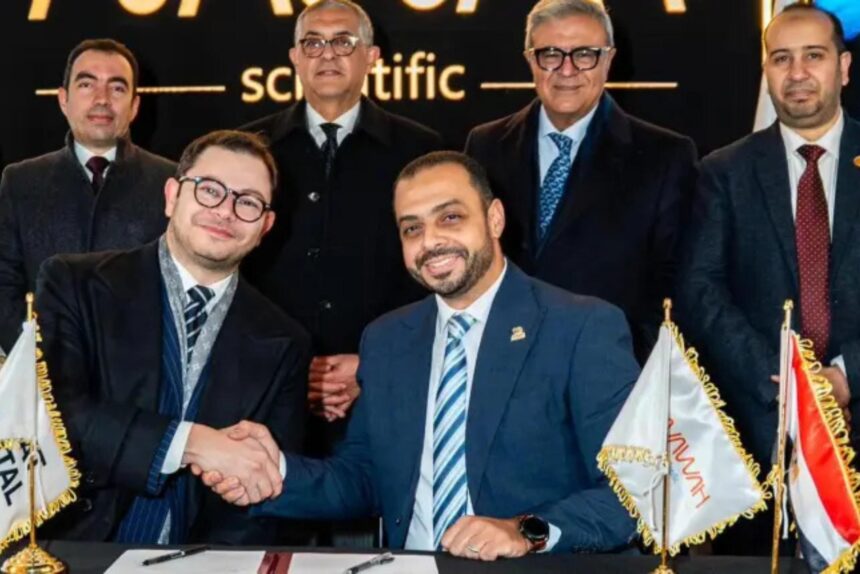
Nawah Scientific, an Egyptian research platform enabling scientists to conduct experiments remotely, has raised $23 million in a Series A funding round, marking one of the largest deeptech investments in the region’s life sciences sector to date.
The round, which combines equity and debt, was led by Life Ventures Holding, with participation from Den Venture, Empire M, AfricInvest and Elsewedy, alongside a consortium of regional banking partners.
Founded in 2015 by pharmaceutical scientist Dr Omar Shokry Sakr, Nawah was created to allow scientists, startups and corporations to access sophisticated lab capabilities without heavy capital investment.
“The successful close of this round reflects investor confidence in Nawah’s research-driven business model,” says Sakr. “Our focus in the coming phase is to expand regionally and internationally while continuing to build world-class scientific and technological infrastructure.”
How the $23m will be deployed
The startup says the fresh capital will be used primarily to expand Nawah’s physical footprint and geographic reach.
Plans include the launch of a new research hub in Rwanda, which will serve as the company’s entry point into East Africa and align with Kigali’s ambition to become a regional technology and innovation centre. Nawah expects initial operations at the Rwanda facility to begin by the third quarter of 2026.
In the Gulf, the company plans to double the capacity of its existing laboratories in Saudi Arabia, responding to rising demand for biotechnology and pharmaceutical services.
Operations in Egypt will also be expanded, with domestic lab capacity set to double to support growing demand from local drug manufacturers.
Inside Nawah’s ‘cloud lab’ model
At the heart of Nawah’s offering is its “cloud lab” model, which digitises the research process. Rather than owning or building their own laboratories, researchers and pharmaceutical companies send samples to Nawah’s central facilities.
The company’s in-house scientific teams analyse the samples using proprietary equipment and processes, with results delivered digitally to clients.
This approach is designed to solve chronic under-resourcing in scientific facilities across emerging markets.
Since launch, Nawah says it has processed more than one million samples for clients in 30 countries, spanning the pharmaceutical, food and agricultural sectors.
The funding was formally signed in Cairo at a ceremony attended by General Authority for Investment and Free Zones (GAFI) chief executive Hossam Heiba, who described Nawah as an example of Egypt’s private sector shift towards “value-added, technology-driven” enterprises.
Building credibility on the global stage
Over the past decade, Nawah has invested approximately $7 million into research and development and expanded into four core verticals: life sciences, pharmaceutical services, food and agriculture, and reference materials for quality assurance.
The company has also prioritised regulatory compliance to compete internationally. Notably, it became the first African research centre to receive accreditation from the US Food and Drug Administration for food analysis, enabling it to support exporters targeting the US market.
Before this Series A, Nawah received backing from Egypt Ventures and gained recognition from the Yale Africa Startup Review and the Jack Ma Foundation as one of Africa’s most promising startups.
As Nawah prepares to expand into new markets, industry leaders say its model reflects a broader shift in how scientific research is conducted in emerging economies.
If successful, experts say the company’s expansion could play a pivotal role in strengthening Africa’s research capacity, supporting pharmaceutical manufacturing, food security and agricultural innovation, while positioning Egypt as a hub for high-value scientific services in the region.
Talking Points
It is impressive that Nawah Scientific has built a “cloud lab” model that allows researchers to conduct experiments remotely, addressing a major barrier in the MENA region: limited access to high-quality scientific infrastructure.
This model alone positions Nawah as a practical solution for real research challenges, enabling pharmaceutical companies, food producers, and agricultural businesses to access world-class lab capabilities without heavy capital investment.
At Techparley, we see how solutions like Nawah’s can accelerate scientific innovation beyond traditional research hubs, bringing real value to emerging markets and supporting the growth of local biotech and life sciences industries.
As Nawah grows in Rwanda, Saudi Arabia, and Egypt, there is an opportunity to strengthen scientific ecosystems, support local pharmaceutical manufacturing, and foster deeptech innovation in Africa and the Middle East.
With the right strategic support, Nawah has the potential to become a leading hub for life sciences research in emerging markets.
——————-
Bookmark Techparley.com for the most insightful technology news from the African continent.
Follow us on Twitter @Techparleynews, on Facebook at Techparley Africa, on LinkedIn at Techparley Africa, or on Instagram at Techparleynews.