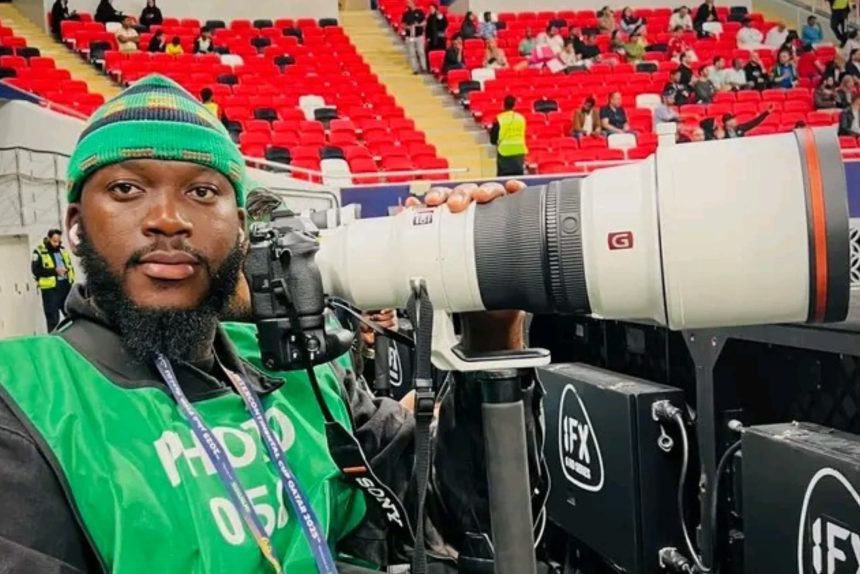
Have you ever experienced being mistaken for another person, especially fellows who are criminal-minded? Or your identity being manipulated by the masterminds to carry out such crimes? This is exactly how Taofeek Ibrahim Adeshina felt when he learnt that his identify has been altered to scam people.
For years, Taofeek Ibrahim Adeshina has built a career behind the camera, as he document elite football and athletics moments across continental and global stages. But in a disturbing twist of the digital age, the international sports photojournalist recently found himself pushed into the spotlight for a crime he never committed.
He learned this after scammers hijacked and AI-manipulated his personal photos to defraud unsuspecting women online. In a public Facebook statement, Adeshina laid bare the emotional toll of digital impersonation.
He admitted that “there are times I wish I never put my face out here on social media… and would rather remain anonymous and quietly do my thing.”
His account exposes a growing cybercrime trend where identity theft, artificial intelligence, and romance scams intersect, often leaving innocent professionals to fight for their reputations long after the fraud has occurred.
The Silent Dangers of Social Media
Social media has long blurred the line between visibility and vulnerability. For Adeshina, what began as harmless photo sharing slowly turned into a digital nightmare.
According to his account, the first red flag emerged in 2023 when someone created a Facebook account impersonating him. The profile used his real name and photos, projecting authenticity and trust.
Although the fake account was eventually reported and taken down with the help of vigilant followers, but the damage, unknown to Adeshina, did not end there
The journalist’s experience underscores a harsh reality, that once images are online, they can be copied, altered, and repurposed beyond the owner’s control.
As he reflected painfully, “There are times I wish I never put my face out here on social media.”
This statement captures the regret many victims of digital impersonation only feel after the harm is long done.
What Really Happened, and Why It Matters
The situation escalated dramatically when a woman contacted Adeshina with a troubling claim. She told him she believed he was her “lover”, a man who had emotionally manipulated her and scammed her out of money.
Of course, who wouldn’t be? She was confused, distressed, and reached out after recognizing his face online. What followed was a shocking revelation.
“She shared photos with me, and lo and behold, they were literally photos I had uploaded here,” Adeshina wrote.
But there was a catch. The images had been subtly altered.
“The unfortunate ‘lover’ had slightly manipulated my face, making it appear round and puffy.”
This detail is crucial. The scammer did not simply reuse his photos; they modified them just enough to create doubt, confusion, and plausible deniability. This is how AI-assisted scams thrive, by operating in the grey space between authenticity and fabrication.
The case matters not only because of Adeshina’s personal ordeal, but because it demonstrates how easily AI tools can be weaponized to destroy trust, exploit emotions, and falsely implicate innocent people.
Who Is Taofeek Ibrahim Adeshina?
Far from the caricature painted by scammers, Taofeek Ibrahim Adeshina is a respected international sports photojournalist with official CAF and FIFA tournament accreditation.
His professional work spans football and athletics, covering continental and global competitions for federations, clubs, athletes, and media platforms.
According to his professional profile, Adeshina specializes in match action photography, tournament documentation, athlete branding, and editorial storytelling. He often operates in high-pressure, high-credibility environments where trust and reputation are non-negotiable.
This context is essential, as a professional whose career depends on authenticity has everything to lose from accusations tied to online fraud. The impersonation was not just a scam, it was a reputational ambush, one that needs careful investigation and attention.
Real Pictures vs Fake Pictures: What the Face Reveals
 A closer analysis of the original and manipulated images provides compelling evidence of deliberate AI interference.
While clothing and backgrounds remained largely unchanged to maintain visual consistency, the most significant alterations occurred in the facial structure, the very element that defines personal identity.
In the original images as shown above, Adeshina’s face shows natural depth, such as visible skin pores, organic cheek volume, and a jawline shaped by real light and shadow.
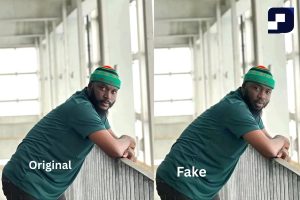
In the manipulated versions, these human details are erased. The cheeks appear smoothed and digitally slimmed, facial volume reduced, and the jawline sharpened into an unnaturally “perfect” contour.
Skin texture is replaced with a porcelain-like finish, stripping away pores, blemishes, and tonal variation. The beard, dense and fibrous in the authentic images, becomes softer and less defined, blending unnaturally into the skin.
In some instances, the eyes appear subtly brighter and slightly enlarged, altering the subject’s expression to seem more alluring and emotionally inviting.
These changes are not accidental; they reflect AI’s tendency toward digital homogenization, replacing individual identity with a generic, idealized version designed to attract trust in online romance settings.
The result is a face that looks convincing at a glance but fails under scrutiny, technically flawless, yet fundamentally untrue, especially when you take close looks at two versions.
Criminals Roaming in the Love Market
Romance scams thrive on emotional vulnerability, and AI has given fraudsters a powerful new advantage. By manipulating real faces, especially those belonging to professionals with public visibility, criminals can construct believable digital personas that bypass skepticism.
Adeshina revealed that the scammer claimed to be “a photographer with dual personalities residing in Osun State,” a fabricated backstory designed to reinforce credibility and emotional intrigue.
“I am putting this out here for the awareness of anyone who might become a victim of this unfortunate individual,” Adeshina warned.
He emphasizes that his decision to speak publicly was driven not by self-defense alone, but by a desire to protect others.
In today’s “love market,” where relationships are often initiated online, trust has become an expensive commodity, and scammers are exploiting it with surgical precision.
This case highlights how innocent individuals, especially public figures alike, can become collateral damage, forced to publicly clear their names while criminals hide behind algorithms and anonymity.
Talking Points
Taofeek Ibrahim Adeshina’s experience powerfully illustrates how the digital age has shifted risk from the shadows into plain sight, where visibility itself can become a liability.
What makes this case especially unsettling is not just the impersonation, but the calculated use of AI to subtly rewrite a human face, enough to deceive victims, yet close enough to reality to falsely implicate an innocent person.
It reveals how cybercrime has evolved beyond crude scams into psychologically sophisticated operations that exploit trust, emotion, and the credibility of real professionals.
More importantly, it underscores the asymmetry of harm, while scammers remain largely faceless and mobile, victims like Adeshina are forced into public self-defense, emotional labor, and reputational repair.
His decision to speak out is therefore both an act of self-preservation and public service, reminding us that in an era where technology can manufacture “truth,” vigilance, digital literacy, and collective accountability are no longer optional, they are essential safeguards of identity itself.
______________________
Bookmark Techparley.com for the most insightful technology news from the African continent.
Follow us on X/Twitter @Techparleynews, on Facebook at Techparley Africa, on LinkedIn at Techparley Africa, or on Instagram at Techparleynews