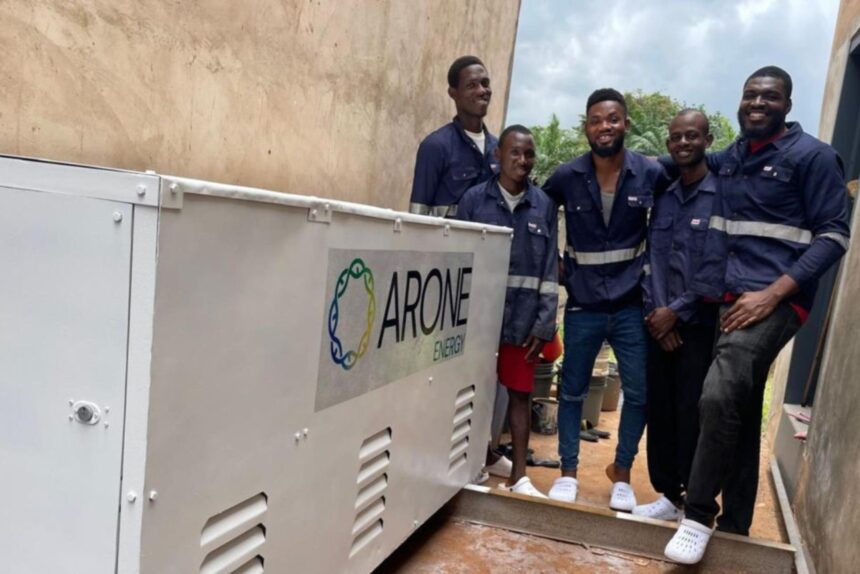
At a time when Nigeria continues to import most of its complex technology, from surveillance drones to solar storage systems, Arone Technologies, a startup in Enugu is building them locally. From autonomous cargo drones to modular solar energy systems, the company is betting that the country’s technological future will require factories as much as code.
That ambition has now received a major boost. Founded in 2018 by AI engineer Emmanuel Ezenwere, Arone Technologies, a Nsukka-based hard-tech startup has entered a ₦12.95 billion (approximately $9.52 million) partnership with the state-owned Institute of Management and Technology, Enugu (IMT).
Over the next four years, both partners plan to establish what they describe as Nigeria’s first tech manufacturing plant dedicated to defence, aerospace, robotics, artificial intelligence and renewable energy, an industrial hub embedded within the IMT campus.
“We’re building solutions that enable energy security and enable smart living,” Ezenwere told TechCabal. “Our primary focus is energy security and artificial intelligence.”
What You Need to Know
Arone, Ezenwere notes, was founded “way before AI became sexy”. Its original mission was grounded not in hype but in infrastructure gaps, particularly Nigeria’s persistent last-mile healthcare delivery challenge.
Arone’s early solution was the development of autonomous drones capable of transporting up to 5kg of medical supplies across distances of up to 200 kilometres. Through a network of autonomous vehicle ports, known as “Avports”, stationed at blood banks and distribution centres, drones could take off, deliver supplies to remote clinics and return without human intervention.
The company’s first major cargo drone, with a 20kg capacity, was among the earliest of its type developed in Nigeria. Its maiden flight in 2019 was successful. The next crashed.
The setback proved formative. Rather than pursue fully finished, capital-intensive systems, Arone shifted to a modular engineering approach, breaking down complex systems into manageable components, iterating gradually and reducing exposure to catastrophic losses.
That strategic pivot also pushed the company into commercially viable niches, including surveillance and security.
Today, Arone says it works with the Nigerian Defence Research and Development Bureau and the Nigerian Air Force, supplying drones for surveillance and security applications.
Manufacturing in Nigeria’s Tough Terrain
Building hardware in Nigeria presents structural challenges rarely encountered by software startups. Talent pipelines are thin, supply chains fragmented, foreign exchange volatility persistent, and access to patient capital limited.
Ezenwere explained that Arone does not claim complete vertical integration. Like most global hardware companies, it sources certain components externally. Motors and batteries are still imported. However, the company says more than 50 per cent of its drone systems are indigenous.
Airframes are designed and fabricated locally. Control systems and software are developed in-house. Its AI models are owned outright.
For its AI surveillance platform, QView AI, Arone maintains full ownership of the software stack. While the system incorporates open-source components, no third party retains ownership of the final product. For enterprise and government clients, deployments can be executed on-premise, scaling from modest computing requirements to terabyte-level infrastructure.
The localisation strategy is partly defensive. By manufacturing key components domestically, Arone reduces exposure to currency fluctuations and import mark-ups, though it does not eliminate them.
Cost competitiveness is central to its argument. According to Ezenwere, the company’s Aurora drone, equipped with thermal imaging for night surveillance, sells for roughly ₦3 million (about $2,190). Comparable foreign drones with similar capabilities can exceed $10,000.
When Power Constraints Sparked a Second Business
As Arone scaled its drone operations, it encountered another structural bottleneck: unreliable electricity.
That constraint led to the creation of its modular energy division. Its flagship product, Luminar 2.0, is a suitcase-sized portable solar energy system designed to power appliances and mission-critical equipment during outages.
The largest Luminar model delivers 3KVA and 2000 watt-hours, sufficient to power a microwave, television and fan, adequate for a medium-sized household. The systems use lithium iron phosphate (LiFePO4) batteries, integrated with smart thermal management technology capable of operating in temperatures up to 45°C, with an estimated lifespan of five to seven years.
By late 2025, Arone says it had deployed more than 1.35 megawatt-hours of modular energy systems across all 36 Nigerian states. Vaccine refrigerators are among the essential appliances powered during grid failures.
For Ezenwere, energy security and technological independence are inseparable.
“It’s a mission for us to build an ecosystem that will transform Nigeria from a consuming nation to a producing nation.”
The IMT Partnership: Scaling Production and Talent
Under the IMT partnership, Arone will provide intellectual property and product designs, while IMT contributes funding and infrastructure.
Production targets over the four-year roadmap are ambitious:
- 5,000 Aurora drones annually
- Over 30,000 Luminar energy systems per year
- More than 200 QView AI servers
Beyond output metrics, the collaboration aims to train more than 20,000 students, positioning the initiative as both an industrial and educational intervention.
Arone’s proximity to the University of Nigeria, Nsukka has long highlighted a paradox: engineering graduates often pivot to web development or unrelated software roles due to limited opportunities in hardware manufacturing.
Embedding manufacturing inside an academic institution could, if successful, create a pipeline where engineering degrees translate into tangible industrial output rather than migration into purely digital roles.
Implementation has already begun, with a detailed month-by-month execution plan spanning four years.
A Contrarian Bet on Factories Over Hype
Nigeria’s startup ecosystem has largely been defined by fintech, e-commerce and digital services. Hard-tech manufacturing remains rare, capital-intensive and high-risk.
Arone’s wager is that meaningful transformation, particularly in energy, defence and industrial capacity requires physical infrastructure.
If the plan succeeds, experts say Enugu could emerge as a hub for indigenous aerospace and renewable energy manufacturing. Security agencies and healthcare providers could reduce dependence on imported systems. Thousands of engineering students could gain hands-on industrial experience.
For Arone, however, the goal extends beyond company growth. In a country long accustomed to importing complex technology, Arone Technologies is attempting something more difficult: building it at home.
Talking Points
It is notable that Arone Technologies is betting on hard tech in an ecosystem that overwhelmingly favours software. In a market where capital typically flows to fintech and asset-light models, choosing to manufacture drones and modular energy systems locally signals long-term industrial ambition rather than short-term valuation optics.
The ₦12.95 billion partnership with the Institute of Management and Technology, Enugu is particularly significant. Beyond production targets, it introduces a university-linked manufacturing model that could bridge Nigeria’s persistent gap between engineering education and real industrial output.
At Techparley, we see this as more than a startup expansion story. If executed effectively, it could serve as a blueprint for decentralised industrial clusters outside Lagos, positioning Enugu as a credible node for aerospace, AI infrastructure and renewable energy manufacturing.
Arone’s modular approach to hardware development also reflects an important lesson for Nigerian builders: iterate within constraints. The company’s shift after its early drone setback demonstrates that sustainable hardware innovation in emerging markets must balance ambition with capital discipline.
With the right strategic alignment, Arone’s expansion could mark an inflection point, not just for one company, but for Nigeria’s broader industrial narrative. The real test will be whether factories, not just funding rounds, become part of the country’s startup success story.
——————-
Bookmark Techparley.com for the most insightful technology news from the African continent.
Follow us on Twitter @Techparleynews, on Facebook at Techparley Africa, on LinkedIn at Techparley Africa, or on Instagram at Techparleynews.