



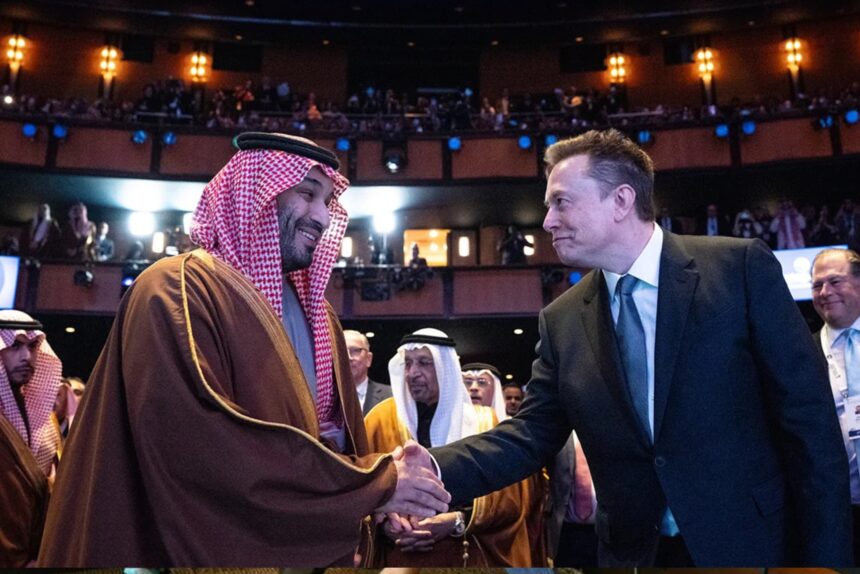
Saudi Arabia has made one of its boldest moves yet in the global artificial intelligence race. With its Public Investment Fund-backed AI company, HUMAIN, investing $3 billion into xAI in a late-stage Series E round, just ahead of xAI’s acquisition by SpaceX.
The transaction not only positions HUMAIN as a significant minority shareholder in Musk’s AI venture, but also converts its stake into SpaceX equity following the acquisition, effectively giving Saudi Arabia indirect ownership in one of the world’s most influential private technology companies.
The deal builds on a previously announced 500-megawatt AI infrastructure partnership between HUMAIN and xAI, designed to deploy Grok models within Saudi Arabia and expand large-scale AI capabilities locally.
Together, the investment and infrastructure agreement signal a deepening strategic alignment between Saudi capital and Musk’s expanding AI, space technology ecosystem.
A $3 Billion Bet on Transformational AI
HUMAIN’s $3 billion investment in xAI underscores Saudi Arabia’s growing ambition to become a dominant force in frontier technologies.
The funding came as part of xAI’s Series E round, prior to its consolidation under SpaceX, and represents one of the kingdom’s most consequential international AI bets to date.
“This investment reflects HUMAIN’s conviction in transformational AI and our ability to deploy meaningful capital behind exceptional opportunities where long-term vision, technical excellence, and execution converge,” said Tareq Amin, CEO of HUMAIN.
He further described xAI’s trajectory, particularly following its acquisition by SpaceX, as representing “the kind of high-impact platform we seek to support with significant capital.”
The language is telling, that’s, HUMAIN is not merely acting as a passive financial backer; it is positioning itself as a strategic capital allocator targeting platforms capable of redefining entire industries.
By entering at a late-stage funding round, HUMAIN signals confidence in xAI’s scalability, commercial prospects, and competitive edge in a crowded AI market increasingly dominated by well-capitalized players.
From xAI Shares to SpaceX Equity: Strategic Positioning in Musk’s Tech Empire
The timing of the investment proved pivotal. Shortly after HUMAIN participated in the Series E round, SpaceX acquired xAI in what has been described as one of the largest technology consolidations on record.
As a result, HUMAIN’s xAI holdings were converted into SpaceX shares, effectively embedding Saudi capital within Musk’s broader technology empire.
According to HUMAIN, the acquisition strengthens the underlying value of its investment, citing the merger as creating “a platform for accelerated growth, deep technological integration, and long-term value creation.”
The combination of xAI’s artificial intelligence capabilities with SpaceX’s infrastructure and engineering scale, the Saudi AI firm noted, enhances prospects for rapid deployment and expansion.
This structural shift is strategically significant. SpaceX is not just a rocket company; it operates one of the world’s most advanced satellite networks and maintains deep expertise in high-performance computing and mission-critical systems.
Integrating xAI into that ecosystem potentially allows AI model development, deployment, and data operations to scale far beyond traditional startup limitations. By extension, HUMAIN’s stake now rides on a vertically integrated AI, space infrastructure stack with global reach.
The 500MW AI Infrastructure Partnership in Saudi Arabia
Beyond equity stakes, the partnership between HUMAIN and xAI is anchored in physical infrastructure. In November 2025, during the U.S.-Saudi Investment Forum, both entities announced plans to jointly develop 500 megawatts of AI data center capacity in Saudi Arabia.
The scale of this initiative is substantial. A 500MW deployment positions Saudi Arabia among the emerging heavyweights in global AI compute infrastructure. The facilities are designed to deploy xAI’s Grok models locally, enabling sovereign AI capabilities while reducing reliance on foreign compute resources.
The investment announcement explicitly builds on this infrastructure agreement, reinforcing that the financial backing and physical deployment plans are interlinked components of a broader strategy.
By combining capital participation with domestic infrastructure expansion, HUMAIN ensures not only financial exposure to AI growth but also local technological capacity-building.
In essence, Saudi Arabia is not merely exporting capital into foreign AI ventures; it is importing the computational backbone necessary to anchor advanced AI development within its borders.
xAI’s $20 Billion Raise and the Global AI Arms Race
The HUMAIN investment follows a period of aggressive capital mobilization by xAI. In January, the company raised $20 billion in an upsized Series E round, with the explicit aim of ramping up deployment of new models and infrastructure to stay competitive against rivals such as OpenAI and Anthropic.
The infusion of capital was intended to accelerate model training, expand computing capacity, and deepen product rollouts in an AI market where scale is increasingly synonymous with survival.
One month after that fundraising milestone, Musk’s SpaceX moved to acquire xAI, consolidating artificial intelligence and aerospace capabilities under a single corporate umbrella.
The consolidation reflects a broader trend in the AI sector, vertical integration. As model development becomes increasingly compute-intensive and infrastructure-dependent, companies with control over hardware, energy, satellite networks, and advanced engineering are positioned to outpace competitors reliant on third-party infrastructure.
A Long-Term Strategy Beyond a Single Deal
HUMAIN has signaled that this investment is part of a wider roadmap. Looking ahead, the company intends to pursue additional investments across artificial intelligence, frontier technologies, and critical infrastructure.
The xAI–SpaceX transaction thus serves as both a strategic foothold and a template for future engagements. From a geopolitical and economic standpoint, the deal aligns with Saudi Arabia’s broader ambition to diversify its economy beyond oil and position itself as a global innovation hub.
By aligning with Musk’s high-impact technology ventures and anchoring AI infrastructure domestically, HUMAIN is effectively bridging financial investment, industrial capacity, and long-term strategic influence.
The $3 billion commitment is therefore more than a funding headline. It represents a calculated move in the global AI power contest, one that intertwines sovereign capital, advanced compute infrastructure, and one of the most ambitious technology ecosystems currently in operation.
Talking Points
Saudi Arabia’s $3 billion investment through HUMAIN into xAI, now converted into equity in SpaceX, is less a conventional venture bet and more a calculated geopolitical technology play.
Strategically, the deal gives the Kingdom exposure to one of the most vertically integrated tech ecosystems in the world, spanning AI models, launch infrastructure, satellite networks, and advanced engineering, while reinforcing its domestic 500MW compute ambitions.
However, the structure also concentrates risk: the value of HUMAIN’s position is now tied to the broader performance, governance dynamics, and capital intensity of SpaceX, not just xAI’s AI trajectory.
Moreover, while the integration promises “accelerated growth” and “long-term value creation,” it blurs operational boundaries between aerospace and AI in ways that may complicate transparency and valuation clarity.
From a competitive standpoint, the move signifies Saudi Arabia’s intent to leapfrog into the AI power league through capital deployment rather than organic model innovation, an approach that can rapidly buy influence but may not automatically translate into sovereign technological independence.
Finally, this is a high-stakes alignment with Elon Musk’s ecosystem, visionary in scope, strategically bold, but structurally dependent on the execution discipline and long-term coherence of a tightly controlled private tech empire.
__________________________
Bookmark Techparley.com for the most insightful technology news from the African continent.
Follow us on X/Twitter @Techparleynews, on Facebook at Techparley Africa, on LinkedIn at Techparley Africa, or on Instagram at Techparleynews