



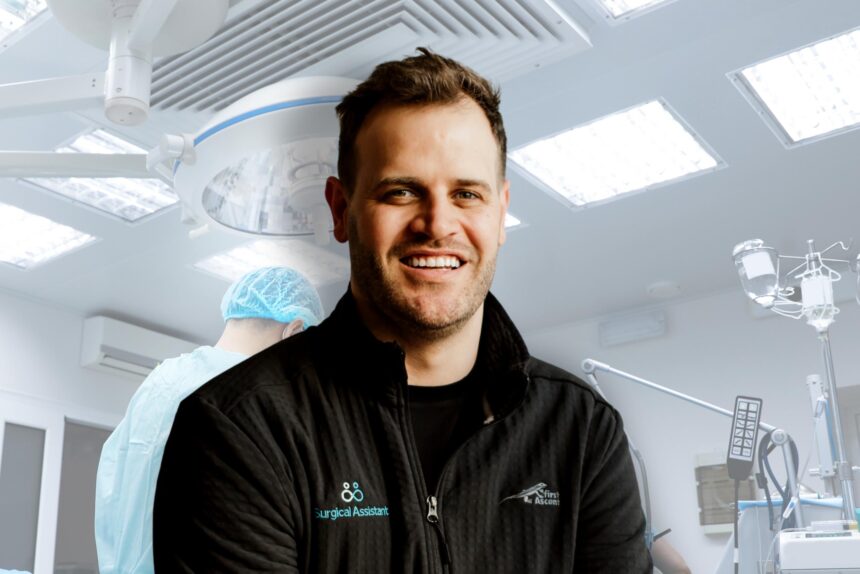
Operating theatres are among the most high-stakes environments in medicine, as every procedure requires a precisely coordinated team. Yet for years, surgeons in South Africa often struggle to find qualified medical officers (MOs) and general practitioners (GPs) to assist in theatre. For Le Roux Viljoen, the founder of The Surgical Assistant, and SurgiFlow, the inefficiencies were impossible to ignore.
In an exclusive interview with Techparley Africa, Viljoen, a former Orthopaedic Medical Officer with experience in both public and private hospitals, said he realised that by formalising theatre assistance through a digital platform, he could reduce inefficiencies, improve access for underutilised clinicians, and create a system of trust, transparency, and accountability.
That vision gave birth to The Surgical Assistant, a service connecting surgeons to vetted assistants, and later, SurgiFlow, its digital platform designed to streamline scheduling, matching, and credential verification.
“Theatre time is expensive and highly scheduled. Yet the process of securing appropriately skilled assistance was manual, fragmented, and opaque,” Viljoen told Techparley Africa. “That coordination gap was the genesis of The Surgical Assistant. SurgiFlow was the evolution – taking what started as manual matching and translating it into structured infrastructure.”
What Problem Is the Surgical Assistant Solving?
The inefficiency TSA addresses is not medical, but operational and logistical. Theatre time is expensive, schedules are tight, and every assistant matters. Yet, for decades, finding a qualified assistant in South Africa has relied on informal networks and personal connections, often leaving capable clinicians idle while surgeons scramble.
In public hospitals, this problem manifested as underemployment of trained doctors. Post-community service doctors and medical officers often waited months for registrar posts, volunteering or working unpaid. In private hospitals, surgeons lacked a transparent mechanism to find qualified assistants at short notice.
Viljoen summarises the gap:
- No transparent availability tracking
- No centralised credential verification
- No structured indemnity coverage
- No scalable matching logic based on skill or case complexity
“TSA and SurgiFlow don’t just make things convenient, they formalise trust and reliability in a historically fragmented system,” Viljoen says.
How SurgiFlow Works
According to the founder, SurgiFlow functions as both a marketplace and operational support system, but with one crucial difference from typical gig-economy platforms. It is designed for trust, governance, and patient safety.
Every assistant undergoes credential-first onboarding, submitting HPCSA registration, medical degrees, references, and a detailed surgical experience profile.
“Once an assistant is vetted, they meet the administrative standards to work in theatres nationally,” Viljoen says.
This system mirrors the compliance requirements of South Africa’s major private hospital groups, including Mediclinic, Netcare, Life Healthcare, and Busamed.
The platform then uses structured matching algorithms to connect surgeons with assistants based on availability, skill, and case complexity. Last-minute cancellations, multi-hospital schedules, and emergency cases are built into the workflow. Unlike conventional marketplaces, SurgiFlow is engineered for highly dynamic, regulated environments where mistakes can be catastrophic.
Viljoen says indemnity coverage is another key feature. Partnerships with PPS Professional Indemnity allow assistants to operate under a structured umbrella policy, while pathways exist for transitioning to individual coverage as their careers progress. Surgeons retain full clinical discretion, ensuring that the platform enhances, rather than replaces, their authority.
Where the Innovation Fits in South African Healthcare
Healthcare adoption, particularly in surgical environments, is conservative for good reason. Trust, governance, and legal compliance are non-negotiable. Introducing a digital layer into operating theatres initially faced resistance.
Many surgeons questioned whether a platform could deliver the reliability of long-standing personal networks.
Hospitals and regulators wanted assurances that credentialing, compliance, and indemnity were airtight.
Viljoen emphasises that SurgiFlow addressed these concerns by integrating into existing hospital governance structures. Rather than operating outside the system as a “gig platform,” it became a tool that reduces administrative friction while maintaining patient safety and clinical trust.
“No clinician wants to introduce someone into theatre blindly. Adoption in healthcare is earned through governance, reliability, and consistency, not convenience alone.”
Technical Complexity and Operational Challenges
Translating the realities of theatre work into software required confronting both behavioural and technical challenges. Clinicians are inherently cautious. Surgeons are accustomed to coordinating assistance through trusted networks. Convincing them to shift habits was a human challenge, while coding the platform to handle real-time theatre dynamics was technical.
Viljoen notes that SurgiFlow had to account for:
- Variable case durations, which rarely align perfectly with scheduled slots
- Surgeons operating across multiple theatres and hospitals in the same day
- Last-minute emergencies and cancellations
- Skill-specific requirements, including robotic, spinal, arthroplasty, and microsurgical procedures
“Unlike ride-sharing platforms, we coordinate credentialed clinicians where patient safety is directly implicated,” Viljoen explains.
According to him, the platform includes structured confirmation workflows, escalation protocols, and reliability safeguards to ensure commitments are met consistently.
He added that, before expanding geographically, SurgiFlow ran a six-month pilot to stress-test its operational model, a necessary step in an environment where scale without dependability is not growth, it’s risk.
Future Vision and Scaling
Looking forward, Viljoen sees SurgiFlow evolving beyond scheduling into a comprehensive theatre infrastructure platform. Potential integrations include theatre management systems, credential databases, billing and reimbursement layers, and continuous professional development tracking.
Scaling internationally is possible but requires careful adaptation. Regulatory frameworks, hospital partnerships, and local workforce analysis must guide expansion.
“We are building infrastructure first, geography second,” Viljoen says. “However, scaling responsibly demands attention to each health system’s governance and operational context.”
The Broader Impact on Healthtech
Medical practitioners say SurgiFlow is solving more than logistical problems, it’s unlocking systemic inefficiencies in South Africa’s medical workforce.
By connecting underutilised clinicians with private-sector demand, the platform creates structured exposure for young doctors, predictable income streams, and career progression opportunities.
Hospitals benefit from reduced administrative burden, smoother theatre scheduling, and improved staff utilisation. For surgeons, the platform transforms a historically opaque and stressful process into transparent, reliable operations, freeing them to focus on patient outcomes.
Industry leaders say Le Roux Viljoen has not only solved a logistical problem but is shaping a new model for healthcare operational excellence in South Africa and potentially beyond.
Talking Points
It is encouraging to see how The Surgical Assistant and its digital platform SurgiFlow are tackling a coordination challenge that has long existed within surgical environments but remained largely unaddressed through technology.
By formalising the process of connecting surgeons with qualified assistants, the platform introduces structure and transparency into a workflow historically dependent on informal networks.
At Techparley, we recognise the significance of solutions that unlock underutilised talent while improving system efficiency. SurgiFlow’s ability to connect skilled medical officers and general practitioners with private-sector surgical demand reflects a thoughtful response to workforce imbalances, creating opportunities for clinicians while reducing scheduling friction for surgeons.
The platform’s integration of availability tracking, structured matching, and indemnity coverage demonstrates how healthcare coordination can be digitised without compromising professional autonomy. Surgeons retain full discretion over their teams, while assistants gain visibility, predictable opportunities, and administrative support, a balance that is often difficult to achieve in healthtech marketplaces.
The startup represents a compelling example of clinician-led innovation translating frontline insight into digital infrastructure. Its progress highlights how targeted healthtech solutions can modernise operational layers of care delivery, an area often overlooked but essential to healthcare system performance.
——————-
Bookmark Techparley.com for the most insightful technology news from the African continent.
Follow us on Twitter @Techparleynews, on Facebook at Techparley Africa, on LinkedIn at Techparley Africa, or on Instagram at Techparleynews.