



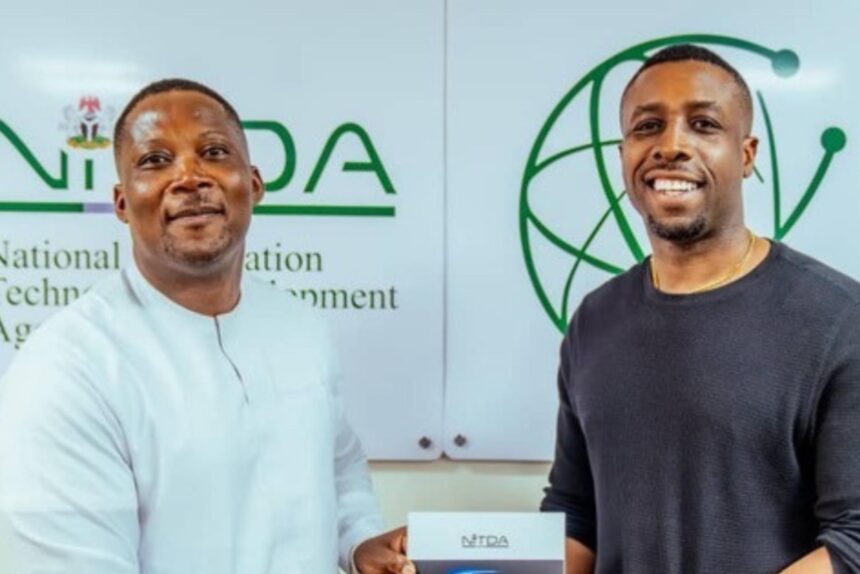
The Nigeria’s National Information Technology Development Agency (NITDA) has partnered NKENNEAi, an African language artificial intelligence platform, to accelerate the development of language technologies designed specifically for the continent’s linguistic diversity.
The collaboration aims to build scalable translation systems and AI-powered language infrastructure that can support services across government, healthcare, financial platforms, and other digital applications used by Nigeria’s multilingual population.
With more than 500 languages spoken across Nigeria, language remains one of the biggest barriers to digital inclusion. By developing AI models trained on African languages and their tonal structures, the partnership seeks to make digital technologies more accessible to a wider population.
“NKENNEAi is about building the infrastructure that allows African languages to exist, scale, and thrive inside artificial intelligence systems,” said Michael Odokara-Okigbo, Chief Executive Officer of NKENNEAi.
What you should know
NKENNEAi emerged from NKENNE, one of the fastest-growing African language learning platforms.
Originally founded to help preserve and teach African languages, NKENNE has grown into a global platform with over 400,000 users learning languages such as Igbo, Yoruba, Swahili, Hausa, Twi, Somali, and Nigerian Pidgin.
As the platform expanded, it generated a growing body of African language text and speech data, which eventually laid the groundwork for a broader technological ambition: building artificial intelligence systems capable of understanding African languages at scale.
This effort led to the creation of NKENNEAi, a multilingual AI platform focused on developing the infrastructure layer for African language artificial intelligence.
“NKENNE started as a cultural mission to help preserve and teach African languages,” Odokara-Okigbo said. “As our community grew to hundreds of thousands of learners, we realized the data and linguistic insights we were building could power something far bigger.
Rethinking how AI is trained for African languages
Many global AI models struggle to process African languages because they lack sufficient training data and the linguistic frameworks required to understand tonal variation, dialect differences, and contextual meaning.
NKENNEAi is attempting to solve this challenge by developing specialised data collection pipelines and language annotation systems tailored to African linguistic structures.
The platform is building extensive datasets that include bilingual sentence pairs for machine translation, annotated speech datasets for speech recognition, and tone-aware linguistic tagging designed to preserve meaning across dialects.
In addition, the company is incorporating community-driven validation processes, where native speakers help verify language accuracy and contextual usage.
By combining linguistic expertise with machine learning infrastructure, NKENNEAi aims to develop tonally sensitive AI models capable of understanding African languages with significantly greater accuracy than traditional translation tools.
The platform supports a range of technologies, including AI translation systems, speech-to-text transcription, text-to-speech voice synthesis, and multilingual AI APIs that developers and enterprises can integrate directly into digital platforms.
Currently, the system focuses on widely spoken languages such as Yoruba, Igbo, Hausa, Swahili, and Nigerian Pidgin, with plans to expand into additional African languages.
Backed by global research funding
NKENNEAi’s development has also received international research backing.
The project has secured multiple awards from the U.S. National Science Foundation (NSF) through its Small Business Innovation Research (SBIR) programme.
Funding was awarded to ESM Global Productions, the company behind NKENNEAi, to support the development of a multilingual African language AI translation platform.
In 2024, the company received a $1 million NSF Phase II award to expand its translation API and continue developing speech and language models specifically designed for tonal languages.
The funding is supporting work on multilingual translation models, speech-to-text systems trained on African speech datasets, text-to-speech voice technologies, and scalable APIs that enable African language integration into digital services.
Together, these efforts are contributing to the development of one of the largest structured datasets and training pipelines focused on African languages.
Supporting Nigeria’s national AI ambitions
The partnership with NITDA also aligns with Nigeria’s broader digital transformation agenda led by the Federal Ministry of Communications, Innovation and Digital Economy, headed by Dr Bosun Tijani, Nigeria’s Minister of Communications, Innovation and Digital Economy.
Before joining government, Tijani co-founded Co-Creation Hub (CcHUB), one of Africa’s most influential technology innovation centres.
Since assuming office, his ministry has launched several initiatives aimed at positioning Nigeria as a global hub for artificial intelligence and digital innovation.
Among these is the 3 Million Technical Talent (3MTT) programme, which seeks to train millions of Nigerians in digital and AI-related skills while strengthening the country’s technology ecosystem.
Through the collaboration with NKENNEAi, NITDA is exploring how locally developed AI infrastructure can better serve Nigeria’s multilingual population while building domestic expertise in artificial intelligence.
Building the workforce for African language AI
Beyond developing the technology itself, the partnership also aims to build the workforce needed to sustain African language AI systems.
Planned initiatives include training programmes for AI data annotators, natural language processing engineers, and technical teams within public sector institutions responsible for managing language datasets and deploying AI systems.
The goal, stakeholders say, is to ensure that African language AI is not only built for the continent but also built by people who understand its linguistic and cultural complexities.
Global technology companies are increasingly recognising the importance of African languages. Firms such as Google have begun expanding AI and search support for languages including Yoruba and Hausa, reflecting growing interest in the region’s linguistic diversity.
However, while global technology companies are beginning to incorporate African languages into their systems, NKENNEAi’s strategy is focused entirely on building AI infrastructure specifically designed for Africa’s linguistic complexity.
Building Africa’s language future
The partnership between NKENNEAi and NITDA marks an important step toward ensuring that African languages are fully represented in the global artificial intelligence ecosystem.
The initiative will be implemented through a phased deployment strategy, including pilot integrations with government agencies, expansion into additional languages, workforce training programmes, and the eventual creation of a broader national AI language infrastructure.
By combining government support with private-sector innovation, the collaboration aims to position Nigeria as a leader in African language artificial intelligence.
For NKENNEAi, the mission extends beyond technology.
It is about ensuring that African languages remain vibrant, accessible, and fully integrated into the digital systems shaping the future of global communication.
Talking Points
It is encouraging to see Nigeria taking deliberate steps to address one of the biggest blind spots in global artificial intelligence: the lack of support for African languages.
With more than 500 languages spoken in Nigeria alone, language remains a major barrier to digital access. Many digital platforms and AI systems are still built primarily for English-speaking users, leaving millions unable to fully participate in the digital economy.
The partnership between NITDA and NKENNEAi highlights the growing recognition that digital inclusion must go beyond internet connectivity and device access. Language accessibility is equally critical if technology is to serve diverse populations.
At Techparley, we see this collaboration as an important step toward building technology that reflects the realities of African societies. AI systems that understand indigenous languages can unlock new opportunities across sectors such as healthcare, education, government services, and financial technology.
NKENNEAi’s approach of developing datasets, speech models, and translation systems specifically designed for tonal African languages is particularly significant. Many global AI models struggle with these linguistic nuances, which means locally driven innovation will be essential.
If successfully implemented, initiatives like this could position Nigeria as a leader in African language artificial intelligence while ensuring that the continent is not just consuming AI technologies but actively shaping their development.
——————-
Bookmark Techparley.com for the most insightful technology news from the African continent.
Follow us on Twitter @Techparleynews, on Facebook at Techparley Africa, on LinkedIn at Techparley Africa, or on Instagram at Techparleynews.