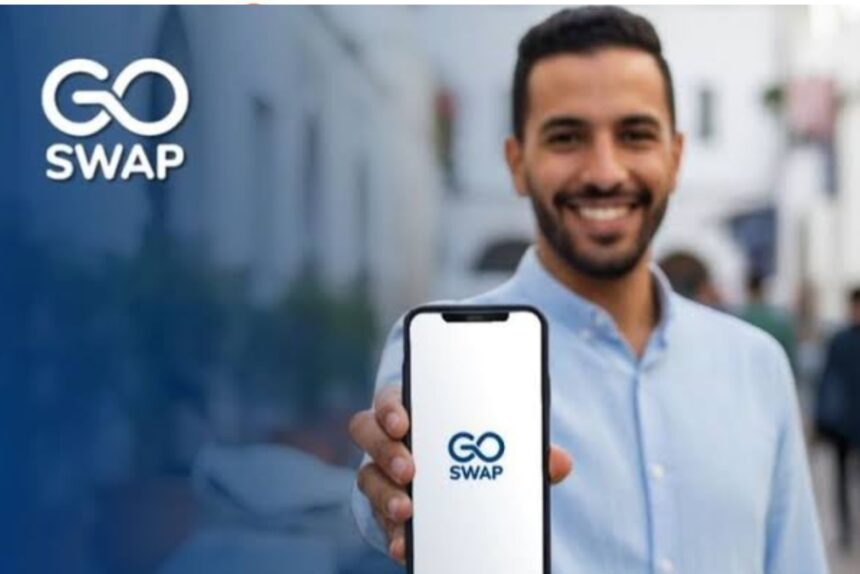
GoSwap, a Moroccan electric mobility startup, has secured its first round of funding from the Azur Innovation Fund, marking a significant step toward accelerating the adoption of electric transportation in North Africa.
The investment is set to fast-track the deployment of GoSwap’s automated battery swapping infrastructure, a system designed to eliminate one of the biggest bottlenecks in electric mobility, charging time.
By enabling riders to exchange depleted batteries for fully charged ones in under 10 seconds, the startup is positioning itself as a practical and scalable solution to rising transportation costs, urban congestion, and environmental concerns.
Founder Hamza Slimani described the funding as pivotal, noting that the company’s ambition is to “make electric mobility accessible to all by reducing the cost of acquiring and using electric motorcycles while increasing their range.”
What is GoSwap?
GoSwap is a Moroccan startup focused on transforming urban transportation through electric mobility solutions, specifically targeting motorcycles and scooters.
Founded by Hamza Slimani, the company is building a network-driven system that allows riders to bypass traditional battery charging altogether. Instead of waiting hours to recharge, users can instantly replace depleted batteries with fully charged ones at designated stations.
At its core, GoSwap is not just a hardware company but a service platform that integrates electric vehicles with smart infrastructure. Its model is designed to simplify adoption, making electric motorcycles more practical for everyday users and commercial operators alike.
What to Know About GoSwap Operations
GoSwap operates through a network of connected battery swap stations strategically placed across urban locations. These stations allow riders to exchange batteries seamlessly, reducing downtime and improving efficiency.
The company has already deployed 20 operational swap cabinets in Casablanca, located in high-traffic and accessible areas such as CashPlus retail outlets and fuel stations operated by Petrom and Shell. This placement strategy ensures convenience, enabling users to integrate battery swapping into their daily routines without disruption.
The process itself is designed for speed and simplicity. Riders approach a station, remove their discharged battery, and replace it with a fully charged unit, all in less than 10 seconds.
This near-instant turnaround represents a significant improvement over conventional charging systems and is particularly valuable for high-frequency users such as delivery riders.
How GoSwap Plans to Use the New Money
The funding from the Azur Innovation Fund will primarily be used to scale GoSwap’s infrastructure and expand its reach. The company plans to accelerate the rollout of its battery swapping network within Casablanca while extending its operations to other cities across Morocco.
Additionally, the investment will support the integration of new electric motorcycle models compatible with GoSwap’s system. This move is crucial for broadening the ecosystem and ensuring that more users can adopt the technology without compatibility constraints.
Slimani emphasized the broader vision behind this expansion, stating that, “As traffic and transportation costs have become major issues, offering an economical and reliable solution is becoming essential to contribute to cleaner cities.”
Market Capacity, Traction and Milestones
GoSwap is entering a market with significant untapped potential. Across Africa, tens of millions of two-wheelers are used daily for personal mobility, logistics, and delivery services. Electrifying even a fraction of this segment presents a massive opportunity for both economic and environmental impact.
The company’s early traction in Casablanca, with 20 operational swap stations and active partnerships with retail and fuel distribution networks, demonstrates proof of concept and scalability. These initial milestones highlight the viability of its model in dense urban environments where speed and convenience are critical.
Adnane Filali, Managing Partner at Azur Innovation Management, underscored this opportunity, noting that “with tens of millions of two-wheelers on the continent, the electrification of these users represents a major challenge for African cities.”
He added that GoSwap’s approach stands out because “it is not limited to one vehicle, it offers a complete battery swapping service, capable of supporting both urban mobility and new uses related to digital commerce and delivery.”
Why This is Important
GoSwap’s model addresses multiple structural challenges facing urban transportation in Africa. First, it eliminates the time barrier associated with charging electric vehicles, making them more practical for daily and commercial use.
Second, it lowers the total cost of ownership by reducing reliance on expensive fuel and improving operational efficiency.
Beyond economics, the environmental implications are equally significant.
By promoting electric mobility, GoSwap contributes to reducing carbon emissions and urban air pollution, an increasingly urgent issue in rapidly growing cities.
Moreover, the company’s focus on infrastructure rather than just vehicles positions it as a key enabler of a broader mobility transition. Its system supports not only individual riders but also businesses operating in logistics and e-commerce, sectors that depend heavily on two-wheelers.
As Filali noted, it is this ability “to meet economic, operational and environmental needs” that makes GoSwap a compelling investment and a potentially transformative player in Africa’s mobility landscape.
Talking Points
GoSwap’s model is compelling and timely, yet its long-term success depends on how well it navigates infrastructure economics, user adoption, and operational complexity.
The battery swapping approach directly solves a critical barrier in electric mobility, charging time, making it especially attractive for high-frequency users like delivery riders. However, scaling such a network is capital-intensive and requires dense station coverage to be truly convenient.
While GoSwap has demonstrated early traction in Casablanca, replicating this success across other cities will demand strong partnerships, consistent power supply, and standardized battery systems across multiple motorcycle brands, an area that has historically challenged similar models globally.
Additionally, affordability remains a key question, that’s, while the company aims to reduce costs, the upfront ecosystem investment and pricing model for battery access will ultimately determine adoption at scale. That said, backing from the Azur Innovation Fund showcases confidence in both the market potential and execution strategy, particularly given Africa’s massive two-wheeler economy.
If GoSwap can balance expansion with operational efficiency and ecosystem integration, it could emerge as a foundational player in Africa’s transition to electric mobility; if not, it risks being constrained by the very infrastructure demands it seeks to solve.
_______________________
Bookmark Techparley.com for the most insightful technology news from the African continent.
Follow us on X/Twitter @Techparleynews, on Facebook at Techparley Africa, on LinkedIn at Techparley Africa, or on Instagram at Techparleynews