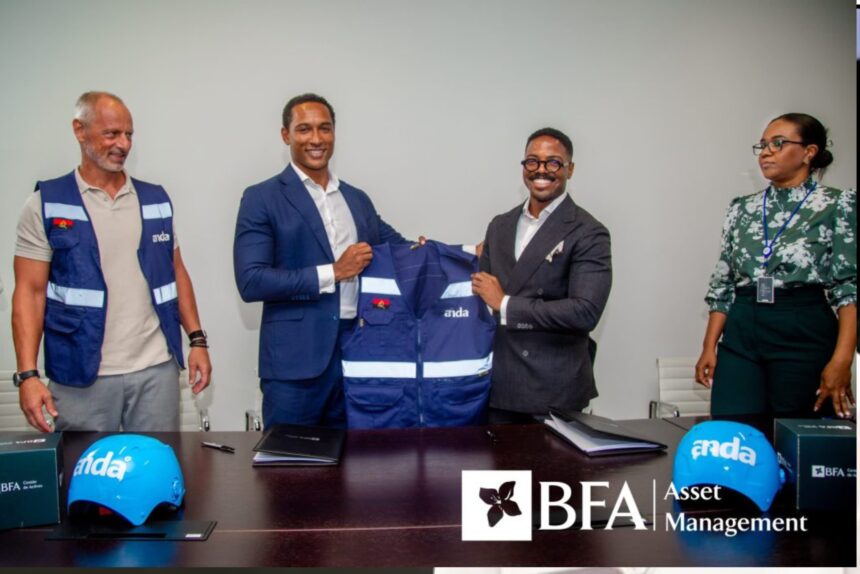
Angolan mobility startup ANDA has secured US$1.2 million in fresh funding from private credit impact fund BFA Asset Management (BFAAM), marking another significant step in its rapid growth journey and ambition to reshape urban transportation.
The investment, channelled through BFAAM’s Kimbo Fund, comes just months after the company raised US$3.4 million in seed funding, underscoring growing investor confidence in its innovative “drive-to-own” model. Designed to empower drivers of two-, three-, and four-wheeled vehicles, ANDA combines asset financing, training, and operational support within an integrated mobility and logistics ecosystem.
With the new capital, the startup aims to expand its fleet, integrate electric vehicles, and scale its logistics infrastructure nationwide, while also deploying advanced technologies such as artificial intelligence to enhance service delivery.
“We are excited about our strategic partnership with BFA Asset Management, a key milestone in the expansion of our mobility and fintech offering,” said co-founder Sergio Tati, adding that the investment “will drive the growth of our multi-asset fleet and the development of cutting-edge technology, as we use artificial intelligence to better serve our customers at scale.”
What ANDA is
Founded in 2022 by Sergio Tati and Joerg Nuehrmann, ANDA is a fast-growing Angolan startup focused on professionalising urban transport systems through a structured and technology-driven approach.
At its core, the company addresses one of the biggest barriers in the mobility sector, access to vehicle ownership, by introducing a flexible model that enables drivers to earn while gradually paying for their vehicles.
This approach not only lowers entry barriers for drivers but also contributes to building a more organised and efficient transport ecosystem. By positioning itself at the intersection of mobility and fintech, ANDA is redefining how transport operators access and manage productive assets in emerging markets.
What to Know About ANDA’s Services
ANDA offers a comprehensive suite of services that goes beyond simple vehicle financing. The startup provides asset financing solutions tailored to drivers, alongside structured training programmes aimed at improving professionalism and operational efficiency.
In addition, it operates designated “safe stops,” which serve as support hubs where drivers can access assistance, rest, and other essential services.
This holistic approach ensures that drivers are not only equipped with vehicles but are also supported with the knowledge, infrastructure, and resources needed to succeed in a competitive urban mobility environment.
By integrating these services, ANDA creates a more reliable and sustainable ecosystem for both drivers and the customers they serve.
How the Startup Operates
Central to ANDA’s model is its “drive-to-own” system, which allows drivers to acquire vehicles without the burden of upfront payment. Instead, drivers use the vehicles for income-generating activities such as transportation and logistics services, making incremental payments over time until they achieve full ownership.
This model is particularly impactful in markets where access to traditional financing is limited or inaccessible to many workers in the informal sector. By aligning income generation with asset ownership, ANDA reduces financial risk for drivers while ensuring consistent utilisation of its fleet.
The company’s operations are further strengthened by its integrated logistics framework, which connects drivers to business and institutional demand, thereby enhancing earning potential and service efficiency.
What ANDA Plans to Use the Money For
The newly secured US$1.2 million investment will play a pivotal role in accelerating ANDA’s expansion strategy. The startup plans to scale and modernise its fleet to meet rising demand, with a particular focus on accommodating electric vehicles as part of a broader sustainability push.
Additionally, the funds will be used to strengthen logistics infrastructure, enabling the company to deliver more efficient and reliable services to businesses and institutions across Angola.
Tati emphasised that the investment would also support technological advancement, noting that ANDA is leveraging artificial intelligence to optimise operations and improve customer experience at scale.
These developments signify a forward-looking approach that combines growth with innovation and environmental consciousness.
Why This is Uniquely Important
ANDA’s growth highlights a broader shift in how mobility and financial inclusion are being addressed in emerging markets. By offering an alternative to traditional financing models, the startup is unlocking economic opportunities for individuals who would otherwise be excluded from vehicle ownership.
This is particularly significant in the transport and logistics sector, where access to productive assets directly impacts income generation and economic mobility.
BFA Asset Management CEO Rui Oliveira underscored this point, stating that the investment reflects a commitment to “supporting key growth sectors of the economy, such as transport and logistics,” while noting that ANDA has shown “resilience, operational discipline and a clear growth trajectory.”
He added that the Kimbo Fund focuses on opportunities “where the data shows intrinsic value and scalable potential, particularly in segments where traditional financing remains structurally limited,” describing the deal as “a strong example of that thesis in action.”
In essence, ANDA’s model represents more than just a business innovation; it is a scalable solution to systemic challenges in urban mobility and financial access. As the company continues to expand, its success could serve as a blueprint for similar initiatives across Africa, where the demand for inclusive, technology-driven transport solutions remains both urgent and immense.
Talking Points
ANDA’s model is compelling and clearly addresses a real structural gap in African urban mobility, limited access to asset financing for drivers, but its long-term success will depend on how well it manages the inherent risks of its capital-intensive approach.
The “drive-to-own” system is powerful in promoting financial inclusion and job creation, especially in informal economies, yet it also exposes the company to repayment defaults, asset maintenance costs, and operational inefficiencies as it scales.
While the integration of logistics, training, and “safe stops” strengthens its ecosystem and differentiates it from simpler asset financiers, execution complexity could become a bottleneck if growth outpaces operational capacity.
Additionally, the planned expansion into electric vehicles is forward-looking but may face infrastructure and cost challenges in markets where charging networks and policy support are still evolving.
On the investor side, the interest from BFAAM signals confidence in ANDA’s scalability, particularly in underserved financing segments, but it also reflects a broader trend where impact-driven capital is betting on high-growth, high-risk mobility solutions.
Ultimately, ANDA’s success will hinge on its ability to balance rapid expansion with strong risk management, maintain high asset utilisation, and prove that its model can remain profitable while delivering social impact at scale.
________________________
Bookmark Techparley.com for the most insightful technology news from the African continent.
Follow us on X/Twitter @Techparleynews, on Facebook at Techparley Africa, on LinkedIn at Techparley Africa, or on Instagram at Techparleynews