



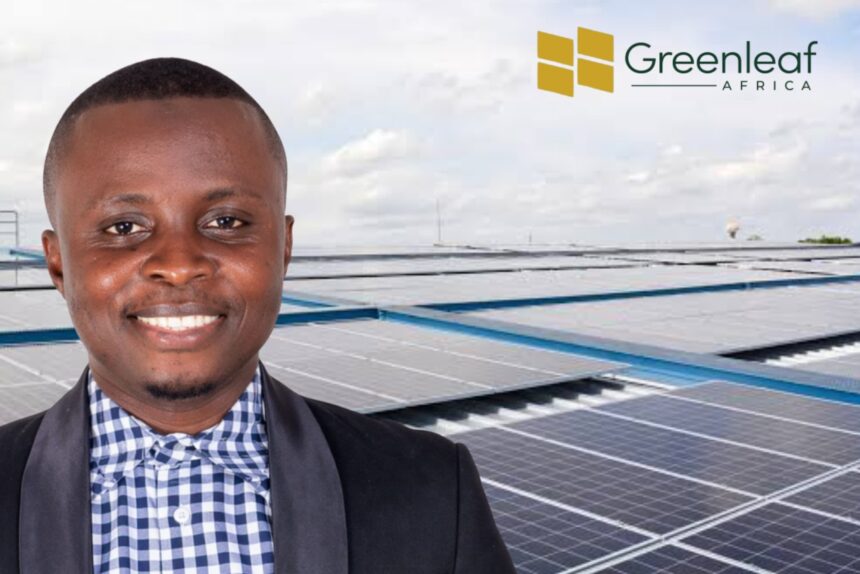
In Nigeria’s fast-growing but uneven solar market, a familiar pattern has quietly eroded confidence, systems are installed with high expectations, only for performance to decline while installers vanish, leaving businesses and homeowners stranded with underperforming assets.
It is this cycle, of broken promises, weak execution, and absent accountability, that Muhammed Oladimeji, Chief Operations Officer of Greenleaf Africa, says has cost the industry more than money.
“It costs them trust,” he notes. Now, the company is stepping forward with a different proposition, one that reframes solar not as a product to be installed, but as a system to be continuously managed.
“Today we’re launching something different at Greenleaf. Not another solar company built on panels and promises. A reliability-first energy partner built on performance, accountability, and long-term stewardship,” Oladimeji states, speaking of a strategic shift that mirrors a broader transformation in Africa’s energy narrative.
What to Know About the Problems Greenleaf Africa is Solving
Across Nigeria and much of Africa, the promise of solar energy has often collided with the realities of poor implementation. For many businesses, especially those dependent on uninterrupted power, hospitals, factories, hospitality outfits, the issue has never been access to solar technology itself, but rather the reliability of what is delivered.
Systems are frequently undersized, poorly designed, or installed without adequate consideration for real energy demands.
Oladimeji captures this systemic flaw succinctly when he said, “The real problem in this market was never access to solar tech. It was weak design. Sloppy execution. And no one taking responsibility after the handover.”
The result is a fragmented ecosystem where clients are left to navigate declining performance, rising maintenance costs, and, in many cases, complete system failure.
This breakdown has not only financial implications but also undermines trust in renewable energy solutions at a time when the continent urgently needs them.
How Greenleaf Is Taking It Head-On
Greenleaf Africa’s response is rooted in a fundamental rethinking of how energy solutions are conceived and delivered. Rather than starting with installation, the company emphasizes a survey-driven, intelligence-led approach that begins long before any panel is mounted.
“Exceptional solar outcomes do not start with installation. They start with survey-driven design, intelligent energy planning, and continuous performance management,” the company states.
This philosophy translates into a structured process where systems are designed around actual load requirements, risk exposure, and performance expectations, not generic specifications.
Oladimeji reinforces this shift, “We measure before we recommend. We design around your actual load, risk profile, and performance needs, not brochure specs.”
By anchoring its model in data and engineering discipline, Greenleaf seeks to eliminate the guesswork that has historically plagued solar deployments in the region.
Beyond Installation: Building a Lifecycle Energy Model
At the heart of Greenleaf’s strategy is a commitment to lifecycle ownership, a stark departure from the industry’s prevalent “install-and-exit” model. The company integrates monitoring, maintenance, and optimization into its service offering, ensuring that systems continue to perform long after deployment.
“We install with engineering discipline and real quality control. And we stay with the asset, monitoring, maintaining, and optimizing for the life of the system,” Oladimeji explains.
This approach positions Greenleaf not merely as a service provider, but as a long-term partner accountable for outcomes. Such a model reflects a growing recognition that energy infrastructure in Africa cannot be treated as a one-off transaction.
Instead, it must be managed as a dynamic system requiring continuous oversight and adaptation to changing conditions.
Redefining the Product: From Solar Panels to Uptime
Perhaps the most compelling aspect of Greenleaf’s positioning lies in how it reframes the very concept of what it sells. In a market saturated with hardware-focused narratives, the company shifts the conversation toward performance.
“Serious clients aren’t buying ‘solar.’ They’re buying uptime. Predictability. Protection from blackouts, bad sizing, and disappearing vendors,” Oladimeji asserts.
This reframing aligns closely with the needs of businesses operating in high-risk power environments, where downtime can translate directly into lost revenue and operational disruption.
By focusing on uptime and reliability, Greenleaf taps into a deeper value proposition, one that resonates with Africa’s economic realities, where consistent power remains a critical enabler of growth and productivity.
Rebuilding Trust in Africa’s Renewable Energy Ecosystem
Trust, once lost, is difficult to regain. For many in Nigeria’s solar market, past experiences with unreliable providers have created skepticism that extends beyond individual companies to the sector as a whole.
Greenleaf’s model, therefore, is as much about rebuilding credibility as it is about delivering energy solutions.
“If power reliability matters to your home, business, or development, this isn’t just about who can install. It’s about who will still answer the phone five years from now,” Oladimeji says, underscoring the importance of long-term accountability.
This emphasis on sustained engagement could prove narrative in restoring confidence among clients who have grown wary of short-term operators. It also shows a maturation of the market, where success is increasingly defined not by installation volume, but by sustained performance and client satisfaction.
Energy as Intelligent Infrastructure
Greenleaf Africa’s approach reflects a broader shift in how energy is conceptualized across the continent. No longer viewed solely as a commodity, energy is increasingly being treated as intelligent infrastructure, a system that integrates data, analytics, and continuous optimization.
Through services such as energy audits, load analysis, preventive maintenance, and remote monitoring, the company embeds intelligence into every stage of the energy lifecycle. This positions it at the intersection of renewable energy and digital innovation, a space that is rapidly gaining relevance as Africa accelerates its transition to sustainable power.
In this context, Greenleaf’s model offers a glimpse into the future of energy delivery in Africa, one where reliability, accountability, and performance take precedence over mere access. As the continent continues to grapple with power challenges, such approaches may well define the next phase of its energy evolution.
Talking Points
Greenleaf Africa’s reliability-first model is a timely and necessary intervention in a market long undermined by poor execution and weak post-installation accountability, but its success will depend less on positioning and more on consistent delivery at scale.
The emphasis on survey-driven design, lifecycle ownership, and performance monitoring directly addresses the structural gaps that have eroded trust in Nigeria’s solar ecosystem. However, these commitments are operationally intensive and may prove difficult to maintain across diverse client segments, especially in cost-sensitive markets where upfront pricing often outweighs long-term value.
While the company’s reframing of solar as “uptime” rather than hardware is conceptually strong, it will require clear performance metrics, transparent reporting, and enforceable service-level agreements to truly differentiate from competitors who may adopt similar language without matching execution.
Additionally, sustaining long-term engagement with assets demands robust technical infrastructure, responsive customer support, and financial resilience, areas where many firms struggle as they grow.
For Greenleaf, the real test lies in bridging its strong narrative with measurable outcomes over time, proving that reliability and accountability can move from promise to industry standard rather than remain a compelling but difficult-to-scale ideal.
______________________
Bookmark Techparley.com for the most insightful technology news from the African continent.
Follow us on X/Twitter @Techparleynews, on Facebook at Techparley Africa, on LinkedIn at Techparley Africa, or on Instagram at Techparleynews