



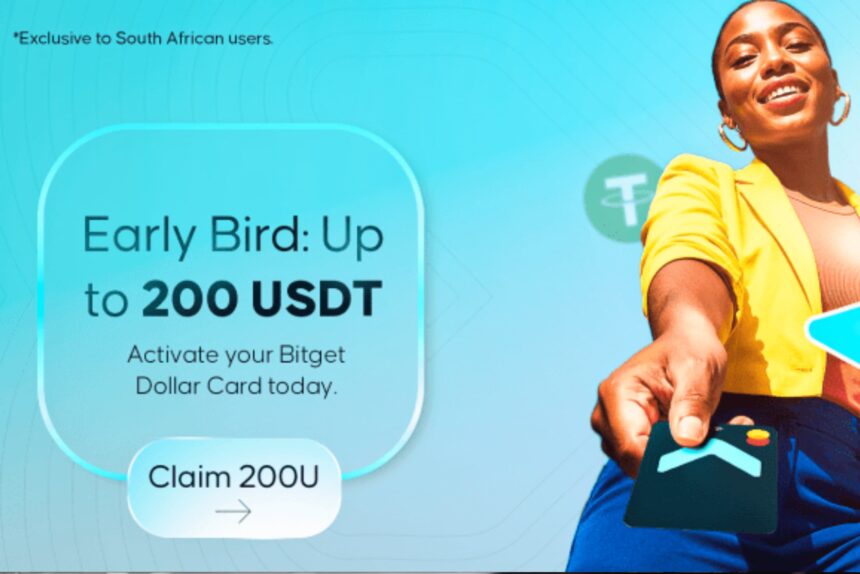
Bitget Wallet has opened pre-registration for its new Bitget Dollar Card in South Africa, offering early adopters a mix of financial incentives and access to a borderless payment solution. The move underscores the growing role of digital currencies in everyday finance across Africa,
The early bird campaign, which began on April 24 and runs until May 6, is designed to attract initial users ahead of the card’s full rollout. The first 500 applicants will benefit from waived activation fees and a randomized reward ranging from 2 to 200 USDC, potentially worth up to approximately R3,700 at current exchange rates.
Positioned as a bridge between crypto holdings and everyday spending, the card allows users to pay for goods and services globally while holding funds in stable digital dollars.
What is Bitget Wallet and What Does It Do?
Bitget Wallet is a global crypto finance platform built to simplify how users interact with digital assets in their daily lives. With a user base exceeding 90 million worldwide, the platform offers an integrated ecosystem where individuals can send, receive, trade, and store cryptocurrencies and stablecoins.
Unlike traditional financial institutions, Bitget Wallet operates as a self-custodial wallet, meaning users retain full control over their funds, private keys, and transaction approvals.
This structure aligns with the broader philosophy of decentralized finance, where users act as their own custodians. Transactions are signed by the user and executed on public blockchains, ensuring transparency and autonomy.
The platform also supports global on- and off-ramps, enabling users to move funds between crypto and traditional financial systems with relative ease, all backed by a $300 million user protection fund.
What is the Early Bird Offer and What Do Users Get?
The early bird initiative serves as both a promotional strategy and an onboarding incentive. During this limited window, the first 500 eligible users who pre-register for the Bitget Dollar Card will have their activation fees waived, removing an initial barrier to entry.
In addition, participants will receive a randomized reward between 2 and 200 USDC, distributed within three days of the draw.
This reward mechanism introduces an element of excitement while also encouraging early adoption. Although the exact reward varies, the upper limit represents a meaningful financial bonus, particularly in emerging markets where access to stable currencies can be limited.
Beyond the one-time reward, users will also earn ongoing cashback on transactions made with the card, adding a long-term incentive for continued usage.
Who Can Apply for the Bitget Dollar Card?
Eligibility for the card is clearly defined to ensure compliance and security. Applicants must be South African residents aged 18 or older and must complete
Know-Your-Customer (KYC) verification within the Bitget Wallet app. Additionally, users must not have previously applied for or held any other card linked to their Bitget Wallet account.
The application process is fully digital, allowing users to register directly through the mobile app. Once approved, the virtual card can be issued within minutes and integrated into mobile wallets, enabling immediate use for both online and in-store purchases.
How Does the Card Function?
The Bitget Dollar Card is a USD-denominated virtual payment card that connects crypto holdings to global payment networks. Users fund their transactions using USDC, a stablecoin pegged to the US dollar. When a purchase is made, the system automatically converts the USDC into the local fiat currency at the point of sale.
This seamless crypto-to-fiat conversion allows users to spend digital assets just like traditional money, without requiring merchants to handle or even recognize cryptocurrency.
The card is accepted at hundreds of millions of merchants worldwide, making it suitable for everyday expenses such as groceries, travel bookings, and digital subscriptions.
As described in the announcement, the card “allows users to spend crypto directly from a self-custodial wallet… through seamless crypto-to-fiat conversion,” effectively removing one of the biggest barriers to mainstream crypto adoption, usability in real-world transactions.
Why Is This Important for Africans?
The introduction of a crypto-linked payment card carries significant implications for African markets, where financial challenges such as currency volatility and high cross-border transaction costs are common.
Stablecoins like USDC offer an alternative store of value, helping users hedge against local currency depreciation while maintaining access to global financial systems.
Alvin Kan, COO of Bitget Wallet, highlighted this relevance, stating that, “Across many African markets, stablecoins are becoming a practical way to store and move value. Where cross-border payments are costly and currencies volatile, the ability to hold digital dollars and spend them seamlessly can make a real difference.”
This perspective reflects a broader trend across the continent, where digital financial tools are increasingly filling gaps left by traditional banking infrastructure.
By linking self-custodied crypto assets to global payment rails, the Bitget Dollar Card enables users to move “between onchain finance and everyday commerce,” effectively merging decentralized finance with real-world economic activity.
Talking Points
Bitget Wallet is clearly positioning its Dollar Card as a bridge between crypto and everyday finance, but the ambition deserves both recognition and scrutiny.
On one hand, enabling users to hold value in USDC and spend seamlessly addresses real African pain points, currency instability, expensive cross-border payments, and limited access to global financial systems.
That is a meaningful innovation. However, the narrative risks oversimplifying adoption barriers. Crypto usability is not just about conversion at the point of sale; it is about trust, regulatory clarity, digital literacy, and infrastructure reliability, areas where many African markets still face constraints.
The “self-custodial” model, while empowering, also shifts full responsibility to users who may not be equipped to manage private keys securely, exposing them to loss without recourse.
Moreover, reliance on stablecoins still ties users indirectly to the US dollar system, raising questions about true financial independence. In essence, Bitget’s move is strategically smart and directionally relevant, but its real impact will depend less on technology and more on how well it navigates user education, regulation, and risk in complex emerging markets.
_____________________
Bookmark Techparley.com for the most insightful technology news from the African continent.
Follow us on X/Twitter @Techparleynews, on Facebook at Techparley Africa, on LinkedIn at Techparley Africa, or on Instagram at Techparleynews