



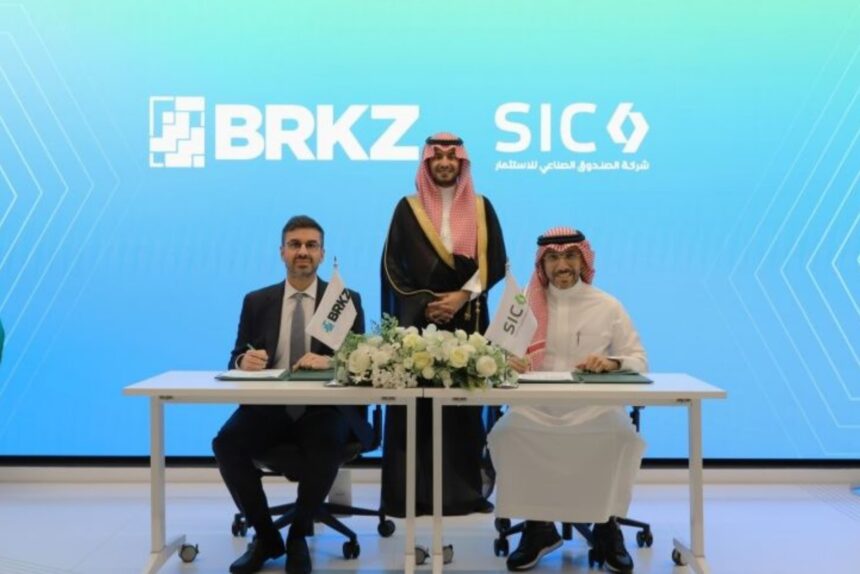
The Saudi Industrial Investment Company (SIC), the investment arm of the Saudi Industrial Development Fund (SIDF), announced a strategic direct investment in BRKZ, a fast-rising Saudi construction and industrial technology platform. This move strengthens the Kingdom’s push to build a world-class industrial economy under Vision 2030.
The deal marks a significant endorsement of BRKZ’s ambition to transform from a procurement marketplace into a full industrial supply chain enabler powered by artificial intelligence, cloud manufacturing, and financing solutions.
Already serving more than 350 small and medium-sized enterprises (SMEs) through a network of approximately 1,600 suppliers and over 7,300 stock keeping units (SKUs), BRKZ is positioning itself at the centre of Saudi Arabia’s industrial digitalisation drive.
The investment ceremony was attended by HH Prince Sultan bin Khalid Al Saud, CEO of SIDF and Vice Chairman of SIC, alongside SIC CEO Fahad Al-Naeem and BRKZ Founder and CEO Ibrahim Manna, underscoring the strategic importance attached to the partnership.
What is BRKZ and What Does It Do?
Founded in 2023 by Ibrahim Manna, BRKZ operates as a business-to-business (B2B) construction and industrial technology platform that connects buyers with a wide network of suppliers, materials, and industrial inputs.
Rather than forcing contractors, manufacturers, or SMEs to negotiate separately with multiple vendors, BRKZ centralises sourcing on one platform and offers multiple delivery and payment options.
Its ecosystem combines procurement services with operational support tools designed to reduce delays, improve price transparency, and simplify purchasing decisions.
According to the company, the platform also supports upstream manufacturers through certification assistance, off-take financing, and cloud manufacturing capabilities. Manna said BRKZ’s broader mission goes beyond transactions.
“At BRKZ, we believe factories are a primary engine for economic growth. We support them through value-added services tailored to their needs.”
The company’s model reflects a growing trend in emerging markets where startups are using technology to solve deep-rooted industrial inefficiencies rather than focusing solely on consumer-facing products.
How Important is This Investment?
The investment by SIC carries significance because it comes from one of Saudi Arabia’s most influential industrial development institutions. SIDF has historically played a central role in financing factories and industrial projects, making SIC’s backing a strong vote of confidence in BRKZ’s business model.
Fahad Al-Naeem, CEO of SIC, said the decision was driven by BRKZ’s ability to solve real industrial challenges.
“We are investing in BRKZ because it addresses a real-world challenge in the industrial supply chain. By facilitating supplier access, providing payment flexibility, and utilising untapped production capacity, BRKZ is building a commercial infrastructure for the industrial sector.”
That statement suggests SIC sees BRKZ not merely as a software company, but as a strategic infrastructure player capable of improving industrial productivity nationwide.
The timing is also notable.
In October 2026, BRKZ secured up to $30 million in growth debt from Stride Ventures, meaning the startup is attracting both institutional equity support and external financing, two indicators often associated with companies entering a scale-up phase.
What BRKZ Already Has
Though founded only recently, BRKZ has built considerable scale in a short period. The company currently serves over 350 SMEs, works with around 1,600 suppliers across Saudi Arabia, and offers more than 7,300 products through its digital marketplace.
Those figures matter because supply chain businesses depend heavily on network effects: the more suppliers on the platform, the more attractive it becomes to buyers; the more buyers it attracts, the more suppliers are incentivised to join.
Its contractor-led demand engine also indicates that BRKZ is tied closely to real construction and industrial demand rather than speculative digital traffic. This gives it a stronger commercial foundation than many early-stage startups that struggle to monetise user growth.
The company has also previously secured backing from investors including BECO Capital, BTV, 9900, Wa’ed Ventures, and Class 5, demonstrating continued confidence from both regional and international investors.
Why BRKZ Wants to Become a Supply Chain Powerhouse
BRKZ’s next phase is centred on becoming a comprehensive industrial supply chain enabler rather than remaining a procurement platform alone. That means helping businesses not only buy materials, but also finance purchases, optimise production capacity, and manage supply flows more efficiently.
Artificial intelligence is expected to play a central role. Manna said the company is building a “Full Stack Agentic AI” ecosystem to automate internal processes and improve pricing, speed, and customer experience.
The move into cloud manufacturing could be especially important. In practice, it means connecting underused factory capacity with businesses that need production support, helping existing factories generate more output without immediate heavy investment in new plants.
The company also plans to deepen financial tools such as credit settlement and off-take agreements, allowing SMEs to access materials or finished goods without severe upfront cash constraints.
Why Does This Matter?
Saudi Arabia’s industrial ambitions under Vision 2030 depend not only on building factories, but on creating efficient systems around them. Many economies can finance plants and warehouses, but far fewer successfully modernise procurement, payments, logistics, and supplier networks at scale.
That is where BRKZ could become strategically valuable. If successful, it may help smaller businesses source materials faster, allow factories to operate at higher utilisation rates, and reduce friction across industrial transactions.
Al-Naeem linked the investment directly to national ambitions, saying SIC’s goal is to “accelerate and scale this model to serve more industrial SMEs, directly supporting the Kingdom’s ambition to become a global manufacturing hub.”
The broader message is clear, that’s, Saudi Arabia is increasingly willing to back domestic startups that solve structural economic problems. Rather than chasing only headline-grabbing consumer apps, policymakers and investors are now putting capital into platforms that can strengthen manufacturing, productivity, and industrial competitiveness.
Talking Points
BRKZ’s new backing is a strong vote of confidence, but the real test begins now. It is easy to attract strategic investors with a Vision 2030-aligned story; it is far harder to build a profitable, defensible industrial platform in a sector known for thin margins, delayed payments, fragmented suppliers, and operational complexity.
BRKZ’s reported network of 1,600 suppliers and 350 SMEs is promising, yet scale on paper does not automatically mean deep usage, recurring revenue, or loyalty. Its ambition to combine procurement, AI, cloud manufacturing, and financing is attractive, but also risks becoming an overextended strategy if execution discipline is weak.
Financing tools can drive growth, but they also introduce credit risk and cash-flow pressure. That said, Saudi Arabia offers a rare tailwind: state support, industrial policy momentum, and rising demand for local supply-chain efficiency.
If BRKZ can convert government confidence into measurable savings, faster procurement cycles, and stronger factory utilisation, it could become a serious infrastructure player. If not, it may end up another well-funded platform with impressive headlines but limited industrial impact.
_____________________
Bookmark Techparley.com for the most insightful technology news from the African continent.
Follow us on X/Twitter @Techparleynews, on Facebook at Techparley Africa, on LinkedIn at Techparley Africa, or on Instagram at Techparleynews