



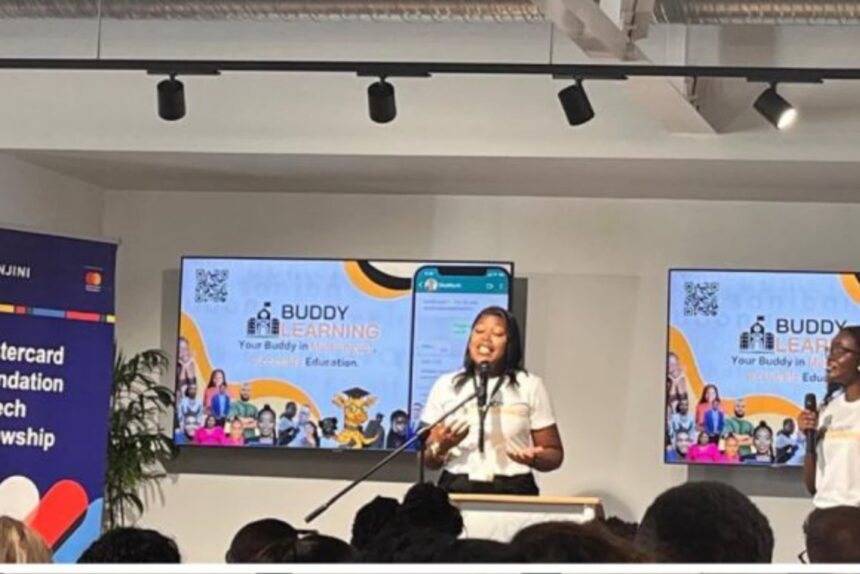
South African education technology startup Buddy Learning is positioning itself as a transformative solution to the students’ struggle of high cost for tutoring, limited access to quality teachers, and language barriers in formal learning systems.
Founded in 2022, the company is using artificial intelligence and one of Africa’s most widely used communication platforms, WhatsApp, to make personalised academic support more affordable and accessible.
Through its flagship product, BuddyAI, students can ask academic questions, receive explanations, and practise through quizzes in their preferred language, all while learning content aligned with the South African curriculum.
Beyond the AI product, the company also operates a network of vetted tutors across South Africa and Botswana, blending technology with human support. With thousands of families already served, hundreds of thousands of questions answered, and strong learner retention rates.
Buddy Learning is emerging as one of Africa’s notable ed-tech ventures tackling structural inequalities in education.
What is Buddy Learning?
Buddy Learning is a South African ed-tech startup founded in 2022 with a mission centered on expanding opportunity through education. The company was established by Tshaamano Mubaba, whose personal upbringing shaped the business vision.
Mabuba grew up in Madombhidza township in Limpopo Province, where she witnessed first-hand how poverty, language limitations, and unequal access to learning resources often determine academic outcomes.
“That lived experience drove me to build a solution that could scale,” she said.
Her statement reflects a reality across many African communities, where talented students often fall behind not because of lack of ability, but because of the environments they are born into. Buddy Learning seeks to close that gap by providing educational support that is practical, localised, and affordable.
How Exactly It Works: AI and Human Tutors
At the center of the startup’s model is BuddyAI, a multilingual AI tutor built directly into WhatsApp. Instead of requiring students to download heavy applications or use laptops, learners can simply use a familiar messaging platform already common across Africa.
According to the company, BuddyAI allows students to ask school-related questions, receive explanations, and practise through quizzes in their home language. Importantly, the lessons are designed to align with the South African curriculum, ensuring relevance for learners preparing for examinations and school assessments.
“At the core of the solution is BuddyAI, a WhatsApp-based AI tutor that allows students to ask questions, receive explanations, and practise through quizzes in their home language, aligned to the South African curriculum,” Mabuba explained.
However, Buddy Learning does not rely on artificial intelligence alone. The company also operates a marketplace of more than 70 vetted tutors across South Africa and Botswana who provide one-on-one academic support.
“Alongside this, we operate a marketplace of over 70 vetted tutors across South Africa and Botswana, providing personalised, one-on-one academic support,” Mabuba said.
This hybrid model means students can benefit from instant AI support for everyday questions while also accessing human tutors for deeper learning needs, exam preparation, and personalised coaching.
Why is This Important?
Buddy Learning’s model addresses three persistent barriers that continue to undermine education access across many African countries: cost, language, and accessibility.
Traditional private tutoring is often expensive, placing it beyond the reach of lower-income families. At the same time, many digital education products are imported solutions built for foreign markets, often failing to reflect local curricula or indigenous languages.
“There were three major barriers in education, cost, language, and access,” the founder said.
“Traditional tutoring is expensive and often inaccessible to the majority of students, while most digital solutions are not localised for African contexts, particularly in terms of language and curriculum alignment,” she added.
Buddy Learning says it responds to these gaps through affordability, accessibility via WhatsApp, and multilingual support across all 11 official South African languages.
This matters because language remains one of the least discussed barriers in education. Students often understand concepts better in their mother tongue, yet many learning platforms provide support only in English. By teaching in local languages, Buddy Learning improves both comprehension and confidence among learners.
Traction and Milestones So Far
The startup says demand has been strong, with growing usage driven largely by word-of-mouth referrals and partnerships with schools.
According to the company:
- Over 4,000 families have been supported through its tutoring platform
- BuddyAI has reached more than 1,700 active users
- The AI system has answered over 245,000 academic questions
- User retention rates are around 90 per cent
- Approximately 90 per cent of learners improved their academic performance
“We have supported over 4,000 families through our tutoring platform, while BuddyAI has reached over 1,700 active users. To date, the AI has answered over 245,000 questions, with user retention rates around 90 per cent,” Mabuba said.
“Importantly, we’ve seen measurable academic improvement, with approximately 90 per cent of learners improving their performance. The combination of affordability and accessibility has driven organic growth, particularly through word-of-mouth and school partnerships.”
These figures suggest that the startup is not only attracting users but also delivering measurable educational outcomes, an important benchmark in the ed-tech industry.
Buddy Learning Revenue Model
Unlike many startups that rely entirely on investor capital in their early stages, Buddy Learning says it has largely been revenue-supported.
The company currently earns income through its tutoring marketplace, where students pay per lesson or purchase lesson packages. It is also preparing to introduce a subscription model for BuddyAI, which could provide recurring revenue as the platform scales.
“While we are still in a growth phase and reinvesting heavily into product development, the business has demonstrated strong unit economics and a clear path to profitability as we scale,” Mabuba said.
This indicates a business model focused not only on social impact but also on long-term sustainability.
Funding Support and Expansion Plans
Although revenue has supported much of its growth, Buddy Learning recently secured external backing after being selected for the third edition of the Injini Mastercard Foundation EdTech Fellowship.
Through the programme, the startup received ZAR1.2 million (about US$73,000) in equity-free funding, meaning it did not have to surrender ownership shares to access the capital.
Currently operating in South Africa and Botswana, the company says its immediate priority is deepening market penetration in those countries while continuing to refine BuddyAI.
“Our immediate focus is deepening penetration in these markets while refining BuddyAI. However, the long term vision is pan-African expansion, particularly into regions with similar challenges around language diversity and access to education,” Mabuba said.
“Because our core product is built on WhatsApp, scaling into new markets is operationally efficient and highly feasible,” she added.
Talking Points
Buddy Learning is solving a real African problem with a smart distribution strategy, meeting learners where they already are on WhatsApp rather than forcing adoption of expensive new platforms. Its focus on language inclusion and curriculum alignment is stronger than many foreign ed-tech products that often misunderstand local realities.
However, the model also faces serious questions beneath the hype. WhatsApp is convenient but limited for deeper learning experiences such as structured coursework, analytics, long-form assessments, and rich visual teaching tools.
Claims that 90% of learners improved performance sound impressive, but without independent data, sample sizes, or controlled measurement standards, such figures should be treated cautiously.
The hybrid AI-plus-human tutor marketplace is promising, yet scaling tutor quality control across countries can become operationally difficult and expensive. Revenue sustainability may also be tested if low-income families, the target market, cannot maintain subscriptions consistently.
In essence, Buddy Learning has identified a powerful entry point and deserves credit for practical innovation, but long-term success will depend on proving measurable outcomes, retaining affordability, managing tutor quality, and evolving beyond a chatbot into a fuller education ecosystem.
______________________
Bookmark Techparley.com for the most insightful technology news from the African continent.
Follow us on X/Twitter @Techparleynews, on Facebook at Techparley Africa, on LinkedIn at Techparley Africa, or on Instagram at Techparleynews