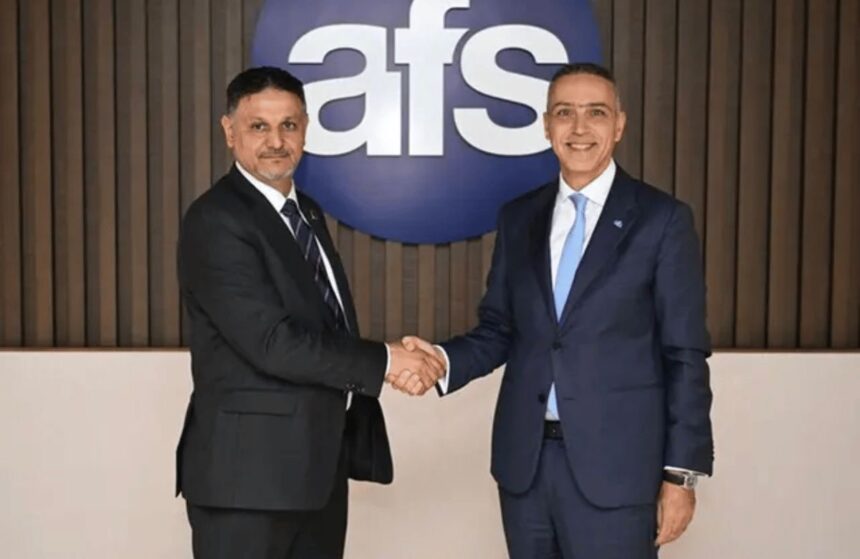
Middle East and Africa payments provider Arab Financial Services (AFS) has entered a partnership with Libyan Islamic Bank to modernise Libya’s payment infrastructure, signalling a broader push towards digital banking and financial inclusion in the country.
The collaboration will see Libyan Islamic Bank adopt AFS’s card issuance and processing technologies, alongside enhanced security systems and scalable digital infrastructure, in a move designed to improve customer experience and expand access to modern financial services.
The partnership aims to introduce internationally aligned card services, enabling faster onboarding, smoother transactions and broader access to digital banking tools.
Through AFS’s platform, Libyan Islamic Bank will deploy Visa-enabled card solutions, allowing customers to conduct secure transactions across both local and international networks.
This shift is expected to play a role in reducing reliance on cash while improving efficiency across retail payments, merchant services and consumer banking.
Building secure and scalable financial infrastructure
A central component of the partnership is the integration of advanced security technologies, including tokenisation and encryption frameworks designed to protect customer data and minimise fraud risks.
As digital payment adoption increases, security concerns remain a key barrier to trust in emerging markets. By embedding these safeguards into its infrastructure, the partnership aims to strengthen confidence in Libya’s evolving digital financial ecosystem.
In parallel, AFS will support the development of a scalable technology backbone for Libyan Islamic Bank, enabling it to introduce new payment products and services more rapidly.
“Seeing this strategy move from a blueprint into reality is a proud moment for our partnership. By leveraging AFS’s digital framework, Libyan Islamic Bank is optimizing its operations to deliver the fast, intuitive experiences its customers expect. This is a milestone for the future of Libyan finance, and AFS is honored to support it,” Dr. Samer Soliman, CEO, AFS Group.
Enhancing customer experience through technology
For Libyan Islamic Bank, the collaboration is positioned as part of a broader effort to align its services with global banking standards while responding to evolving customer expectations.
“As Libya advances toward a more connected and cashless economy, our partnership with AFS enables us to deliver secure, efficient, and innovative card services that meet international standards,” said Adel Kshad, General Manager, Libyan Islamic Bank.
The agreement also reflects Arab Financial Services’s broader expansion strategy across North Africa, where demand for digital payment infrastructure is increasing amid rising mobile penetration and fintech adoption.
By strengthening its presence in Libya, AFS is positioning itself to play a central role in shaping the region’s evolving financial services landscape.
The partnership aligns with the company’s wider objective of promoting financial inclusion by equipping banks and financial institutions with modern payment capabilities.
Positioning Libya for digital financial growth
As Libya continues to rebuild and modernise its economy, the development of digital financial infrastructure is expected to play a critical role in supporting growth, improving transparency and enhancing access to financial services.
The introduction of advanced payment systems can help integrate more individuals and businesses into the formal financial sector, reducing dependency on cash and informal channels.
For Libyan Islamic Bank, the partnership provides a pathway to scale its digital offerings while improving operational efficiency and customer engagement.
By combining technological expertise with local market presence, such collaborations are increasingly seen as essential to overcoming infrastructure gaps and unlocking new opportunities in financial services.
Talking Points
It is particularly important that the collaboration goes beyond card issuance to include end-to-end payment processing, security infrastructure, and scalable digital systems, which are critical foundations for long-term financial modernisation.
The integration of technologies such as tokenisation and encryption reflects a growing emphasis on trust and security, which remains one of the most important barriers to digital payment adoption in emerging markets.
At Techparley, we see this as part of a wider regional shift where banks are no longer just digitising services, but rebuilding core infrastructure to support real-time, secure, and interoperable financial transactions.
The focus on building scalable infrastructure also signals a forward-looking approach, ensuring that Libyan financial institutions are positioned not just for current demand but for future innovation in payments and digital banking services.
With the right execution, this collaboration has the potential to lay the groundwork for broader financial inclusion and a more connected digital economy across Libya.
——————-
Bookmark Techparley.com for the most insightful technology news from the African continent.
Follow us on Twitter @Techparleynews, on Facebook at Techparley Africa, on LinkedIn at Techparley Africa, or on Instagram at Techparleynews.