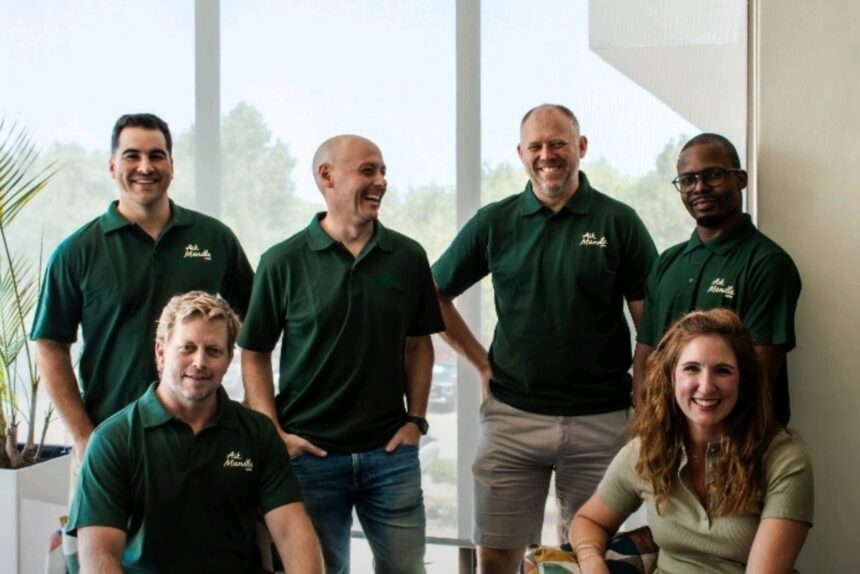
South African startup, AskMandla, is leveraging WhatsApp and artificial intelligence to formalise domestic employment relationships, simplify labour compliance for household employers, and connect domestic workers to the formal financial system.
Launched in May last year, the WhatsApp-native platform was designed to place South Africa’s estimated 1.6 million domestic workers and the households that employ them on the same digital infrastructure used across the formal economy.
Through its WhatsApp-based platform powered by an AI assistant named Mandla, the startup enables employers to manage contracts, payroll administration, payslips, and government registration requirements through simple conversations on an app they already use daily.
For AskMandla, the mission extends beyond payroll management. The company is positioning itself as a gateway to financial inclusion for a workforce that has historically remained invisible to banks, lenders, insurers, and other financial service providers.
By creating verified employment records and documented income histories, the startup believes it can unlock new opportunities for domestic workers while reducing compliance burdens for employers.
The Problem AskMandla is Solving
South Africa’s domestic employment sector represents one of the country’s largest labour markets, yet the overwhelming majority of employment relationships remain informal.
According to AskMandla, roughly 80 per cent of domestic workers operate without written contracts, payslips, unemployment insurance registration, or documented records of employment. The result is a labour ecosystem where billions of rand flow through informal channels each year, leaving both employers and employees exposed to risks.
“The gap is the absence of infrastructure that’s actually shaped for the household,” said Ean Barnard, Head of Growth at AskMandla.
The lack of formal employment structures creates challenges on multiple fronts. Domestic workers often struggle to prove their income when applying for loans or other financial products, while employers may unknowingly fail to comply with labour regulations.
Existing payroll and compliance tools are frequently designed for businesses rather than households, making them expensive, complex, or impractical for domestic employment arrangements.
Barnard noted that doing nothing leaves employers and workers vulnerable to labour inspections and legal complications, while attempting to manage compliance independently often requires legal or administrative expertise that many household employers simply do not possess.
How AskMandla Works
At the centre of AskMandla’s solution is WhatsApp, which serves as the platform’s primary interface. Instead of downloading specialised software or navigating complicated payroll systems, employers can simply engage with Mandla, the startup’s AI-powered assistant, through WhatsApp conversations.
Through this process, employers can generate employment contracts, register workers for unemployment insurance, produce monthly payslips, and manage ongoing administrative requirements.
“For the household employer, it turns the whole compliance burden, employment contract, UIF registration, monthly payslips, and ongoing admin, into a two-minute WhatsApp chat with our AI assistant, Mandla,” Barnard explained.
The approach reflects a deliberate effort to simplify labour compliance and make formalisation accessible to ordinary households. By reducing administrative complexity, AskMandla hopes to encourage greater adoption among employers who might otherwise avoid formalising employment relationships due to perceived costs or bureaucratic challenges.
The startup itself evolved from Shesha-LawZA, a domestic labour platform founded by AskMandla’s Chief Legal Officer, Janine Kane-Berman. While the earlier platform successfully provided legal contracts and compliance guidance through a mobile application, the team eventually realised that its delivery method was limiting adoption.
“The legal substance worked; the delivery layer didn’t,” Barnard said. “Domestic workers don’t sit at desks. They live on WhatsApp.”
This insight ultimately led to the creation of AskMandla as a WhatsApp-first platform.
What is in It for Domestic Workers?
For domestic workers, the benefits extend far beyond receiving wages. AskMandla provides workers with official payslips, documented employment histories, and verified records of income.
These documents can serve as critical proof of employment when interacting with banks, financial institutions, landlords, and other organisations that require evidence of stable earnings.
“For the domestic worker, we deliver something they’ve often never had, a real payslip, a documented employment record, and Earned Wage Access,” Barnard said.
The company argues that something as simple as a monthly payslip can have transformative implications for workers who have spent years operating in informal employment arrangements.
“A monthly payslip isn’t just paper. For someone who has worked informally for years, that payslip is the first document a bank will accept as proof of income. That’s how someone becomes visible to the formal financial system,” Barnard added.
By creating these formal employment records, AskMandla believes it can help domestic workers establish financial identities and access services that have historically been out of reach.
Earned Wage Access: What It Means
One of the platform’s most notable financial offerings is Earned Wage Access (EWA), which launched in April this year.
Unlike traditional loans, Earned Wage Access allows workers to access a portion of wages they have already earned before their official payday. If a worker faces an emergency or unexpected expense during the month, they can draw from wages accrued through completed work rather than borrowing money at potentially high interest rates.
According to AskMandla, approved requests can result in funds reaching a worker’s bank account within 24 hours. Barnard stressed, in addition, that transparency has been central to the company’s approach.
“The fees are set upfront before each transaction, are matched to the customer’s income level, and have no hidden charges,” he said.
The company is particularly cautious about distinguishing its offering from predatory lending practices that often target financially vulnerable individuals.
“We’ve been deliberate about this, there is a long history of predatory lending products dressed up as access to wages, and we don’t want to be any part of that pattern,” Barnard explained.
Looking ahead, AskMandla plans to expand its financial-services portfolio to include savings products, insurance solutions, and healthcare coverage.
WhatsApp in AskMandla’s Operations
WhatsApp is not merely a communication channel for AskMandla; it is the foundation of the company’s operating model.
The startup’s leadership recognised that domestic workers and household employers were already active on WhatsApp, making it a more natural platform than dedicated applications or web-based systems.
By embedding employment management directly into a familiar messaging environment, AskMandla reduces barriers to adoption and minimises the learning curve for users.
The decision appears to be resonating with customers. During its first year of operations, the company processed more than ZAR5 million in domestic-worker salaries and generated nearly 1,000 payslips.
Barnard said the startup’s monthly churn rate remains below two per cent, an indicator that users continue to find value in the service.
“In a market where most household services have churn rates in the double digits, this tells us people stay because the product works for them,” he said. “They choose to renew, every month, on WhatsApp.”
Currently, AskMandla operates exclusively within South Africa, with subscriber concentrations in Johannesburg, Cape Town, and Durban, where domestic employment density is highest.
Why This Matters, Especially to Investors
Beyond solving a labour-compliance challenge, AskMandla is building what investors increasingly view as a valuable financial infrastructure play.
The company generates revenue through two primary channels. Household employers pay monthly subscription fees for payroll and compliance services, while financial products such as Earned Wage Access create additional revenue opportunities.
However, the startup’s long-term value proposition lies in the employment data it generates.
Every contract, payslip, and employment record created through the platform contributes to a verified financial identity for workers who previously existed outside formal systems. This data creates opportunities to deliver a growing range of financial services at scale.
“The strategic shape is subscription as the acquisition mechanic, and financial services are where the business compounds,” Barnard said.
“Every employer relationship generates an employment record. Every employment record makes the worker visible to the financial system. That visibility is what unlocks the financial-services revenue at scale,” he added.
For investors, this represents more than a payroll solution. It is an attempt to build the foundational infrastructure that connects millions of underserved workers to formal financial services.
If successful, AskMandla could demonstrate how messaging platforms, artificial intelligence, and fintech can work together to formalise informal labour markets while creating sustainable business opportunities in the process.
______________________________
Bookmark Techparley.com for the most insightful technology news from the African continent.
Follow us on X/Twitter @Techparleynews, on Facebook at Techparley Africa, on LinkedIn at Techparley Africa, or on Instagram at Techparleynews