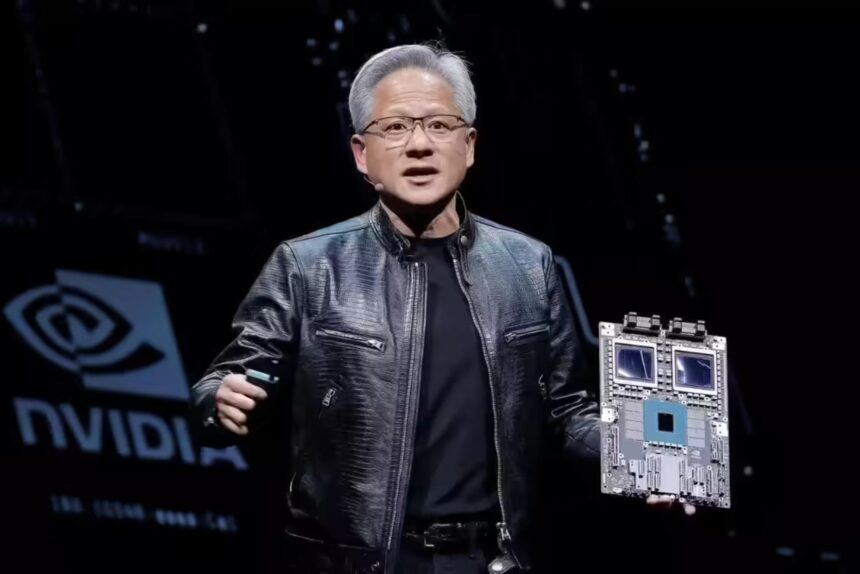
NVIDIA has announced that its next-generation Vera Rubin platform has entered full-scale production, marking a milestone in the global race to build the infrastructure powering the emerging era of agentic artificial intelligence.
The platform, which NVIDIA describes as its most advanced AI factory architecture to date, is designed to support large-scale AI systems capable of reasoning, planning, retrieving information and executing complex tasks autonomously.
The company says Vera Rubin delivers up to ten times the agent-processing performance of its previous-generation Grace Blackwell platform, positioning it as a key building block for future AI factories.
“Agentic AI is a new kind of workload. One prompt can launch a thousand-step journey of reasoning, retrieval, tool use and response generation. Vera Rubin was built for this moment — an AI factory engine that delivers intelligence at scale, with the performance, efficiency and security needed to power the next industrial revolution,” said Jensen Huang, founder and CEO, NVIDIA.
AI Moves Beyond Chatbots
The announcement underscores the growing competition among technology companies, cloud providers and AI laboratories seeking to deploy increasingly powerful computing infrastructure to support next-generation artificial intelligence workloads.
The launch comes as the AI industry shifts beyond traditional generative AI applications towards what many technology leaders describe as “agentic AI”, systems capable of carrying out multi-step tasks with minimal human intervention.
Unlike conventional AI chatbots that respond to individual prompts, agentic AI systems can perform complex workflows involving reasoning, tool usage, information retrieval and autonomous decision-making.
Global Manufacturing Ecosystem Mobilises
The production ramp-up reflects the scale of demand anticipated for AI infrastructure over the coming years.
Vera Rubin represents the third generation of NVIDIA’s MGX rack-scale architecture, which has evolved into one of the company’s most widely adopted infrastructure platforms.
NVIDIA said hundreds of manufacturing and supply chain partners across more than 350 factories in 30 countries are participating in production, including approximately 150 partners in Taiwan alone.
Major technology manufacturers such as Dell Technologies, Hewlett Packard Enterprise (HPE), Lenovo and Supermicro are already producing Vera Rubin systems, alongside a broader ecosystem that includes ASUS, Foxconn, IBM, NetApp, Nutanix, Quanta Cloud Technology, Wistron and Wiwynn.
The scale of the manufacturing effort highlights how AI infrastructure has become a strategic industry in its own right, extending far beyond semiconductor design into global supply chains, data centre construction and cloud computing services.
Building Infrastructure for Million-GPU AI Factories
At the centre of NVIDIA’s vision is the concept of AI factories, highly specialised computing environments designed to generate, train and deploy AI models at unprecedented scale.
To support this ambition, Vera Rubin introduces NVIDIA Spectrum-X Ethernet Photonics, which the company describes as the world’s first co-packaged optics switching platform built around 200Gb/s SerDes technology.
Traditional networking infrastructure has increasingly become a bottleneck in large-scale AI deployments, particularly as organisations connect thousands or even millions of graphics processing units (GPUs).
NVIDIA claims the new networking technology delivers five times greater power efficiency, five times higher AI uptime and faster deployment compared with conventional networking systems.
The technology is expected to provide the foundation for future million-GPU AI clusters, with cloud infrastructure providers including CoreWeave, Lambda and Oracle Cloud Infrastructure among the first adopters.
Security Becomes a Core Priority
As AI systems increasingly process proprietary corporate information, regulated data and sensitive intellectual property, infrastructure security is becoming a major concern for enterprises deploying advanced AI workloads.
NVIDIA has integrated full-stack confidential computing capabilities into the Vera Rubin platform, enabling data protection across processors, networking systems and storage environments.
The platform combines Vera CPUs, Rubin GPUs and NVIDIA’s NVLink networking architecture within a secure execution environment designed to protect workloads from unauthorised access and tampering.
Cloud providers including Microsoft Azure, IBM Cloud, CoreWeave, Lambda and Nebius are among the companies adopting NVIDIA’s confidential computing technologies.
The company has also integrated its BlueField-4 data processing units and DOCA software platform to support zero-trust security architectures, network isolation and runtime threat detection across large-scale AI environments.
As organisations increasingly deploy AI agents capable of handling sensitive business operations, security and governance are expected to become as important as raw computing performance.
Accelerating the Global AI Infrastructure Buildout
Beyond hardware, NVIDIA is also introducing its DSX platform, a software and operational framework designed to simplify the deployment and management of large-scale AI factories.
The platform provides infrastructure designs, simulation tools, lifecycle management software and operational frameworks intended to reduce deployment complexity and improve reliability.
Several of NVIDIA’s major manufacturing partners, including Dell, HPE, Lenovo and Supermicro, have already committed to adopting DSX alongside Vera Rubin deployments.
Industry observers note that simplifying infrastructure deployment could become increasingly important as businesses, governments and research institutions race to build AI capacity without the engineering resources typically available to hyperscale technology companies.
Talking Points
It is significant that NVIDIA is positioning Vera Rubin not merely as another AI chip platform, but as the infrastructure backbone for the next generation of agentic AI systems capable of reasoning, planning, and executing complex tasks autonomously.
The platform’s promise of delivering ten times the agent throughput of the previous Grace Blackwell generation highlights how quickly AI infrastructure is evolving to meet growing computational demands from enterprises, cloud providers, and AI laboratories.
At Techparley, we see this as evidence that the AI race is increasingly shifting beyond model development to the infrastructure layer. The companies that control the computing power, networking systems, and deployment frameworks behind AI may ultimately shape the future of the industry.
NVIDIA’s focus on networking, security, and operational software is particularly noteworthy. As AI workloads become more complex and sensitive, raw processing power alone will no longer be enough. Reliability, scalability, and trust will become equally important competitive differentiators.
However, the scale of investment required to build AI factories raises questions about accessibility and concentration of power. Smaller organisations and emerging markets may find it difficult to participate meaningfully in the next wave of AI innovation without access to affordable computing infrastructure.
As Vera Rubin enters production, there is an opportunity for NVIDIA and its ecosystem partners to influence how AI infrastructure is distributed globally. If access can be broadened beyond hyperscalers and large technology firms, platforms like Vera Rubin could help accelerate AI adoption across industries, research institutions, and developing economies.
——————-
Bookmark Techparley.com for the most insightful technology news from the African continent.
Follow us on Twitter @Techparleynews, on Facebook at Techparley Africa, on LinkedIn at Techparley Africa, or on Instagram at Techparleynews.