



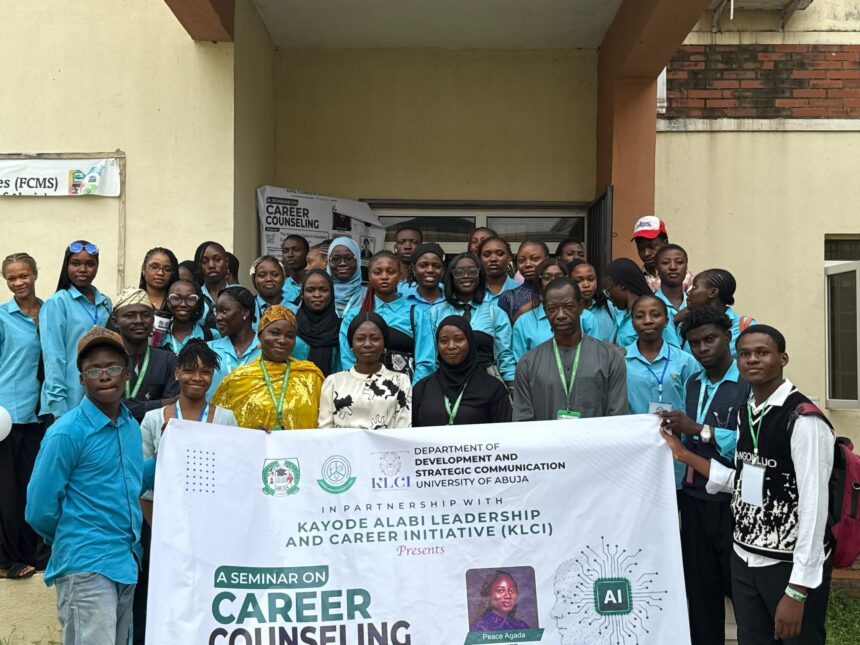
Students of the Faculty of Communication and Media Studies at the University of Abuja, in a significant step toward understanding the growing role of artificial intelligence in career development, participated in a practical workshop designed to expose them to emerging digital tools shaping the future of work.
According to statement made available to Techparley Africa on Tuesday, June 16, the workshop, titled “The Role of AI Tools in Students’ Career Awareness in Communication and Media Studies” brought together 200-Level students enrolled in the ICT for Development Communication course to explore how AI can be leveraged to provide career guidance, improve decision-making, and prepare young people for increasingly technology-driven professional environments.
Facilitated by Mr. Abdullahi Ahmed Aminullahi and Dr. Lateef Odegbenle, the session introduced participants to Rafiki, an AI-powered career guidance platform developed to help African youths gain career clarity, discover relevant opportunities, and make informed professional choices.
Beyond understanding the technology itself, students were encouraged to critically evaluate its relevance, strengths, and limitations from the perspective of emerging communication professionals.
The workshop reflects a growing recognition within higher education that practical exposure to digital technologies is becoming as important as theoretical knowledge, particularly in fields such as communication and media studies where technological innovation continues to redefine professional practice.
How Rafiki Uses AI to Support Development
A major highlight of the workshop was the introduction of Rafiki, an AI-driven platform designed to address one of the most pressing challenges facing many young Africans, access to reliable career guidance and informed decision-making.
Through the platform, students were exposed to how artificial intelligence can be applied to support personal and professional development by helping users identify career pathways, access opportunities, and better understand their strengths and interests.
The workshop demonstrated how AI technologies are increasingly being deployed beyond commercial applications to address developmental challenges, particularly in education, employment, and youth empowerment.
By introducing students to a practical solution already being applied within the African context, the organisers sought to encourage critical thinking around the potential of technology to create meaningful social impact.
Participants were challenged to view the platform not merely as users but as future communication professionals capable of evaluating how digital tools can be designed, communicated, and deployed to solve real societal problems.
Bridging Theory and Practice in Communication Studies
University officials used the occasion to reaffirm the institution’s commitment to experiential learning and practical education.
Speaking on the significance of the initiative, the Head of the Department of Development and Strategic Communication, Dr. Aishat AbdulRauf-Salau, emphasized the need for communication education to evolve alongside technological advancement.
“Communication education must evolve alongside technological advancements. Our goal is to ensure that students do not merely learn about communication technologies but gain practical experience in applying them to solve real societal challenges. We are committed to preparing graduates who can thrive in an increasingly digital world,” she said.
Her remarks underscored a broader shift occurring within communication education globally, where institutions are increasingly integrating hands-on learning experiences into academic programmes to ensure graduates are equipped with both theoretical understanding and practical competence.
Also speaking at the event, Dr. Barnabas Gbam, who represented the Dean of the Faculty, described the workshop as an example of the kind of innovative educational approach required to prepare students for contemporary realities.
“The Faculty remains committed to promoting innovative teaching approaches that foster critical thinking, problem-solving, and technological literacy. Initiatives such as this expose students to practical solutions and reinforce the University’s vision of producing graduates who can effectively contribute to national development and the global knowledge economy,” he stated.
The workshop therefore served as more than a classroom exercise; it became a practical demonstration of how communication education can be applied to address real-world challenges through technology-driven solutions.
KLCI’s Role in Supporting Career Awareness
The organisers also acknowledged the contribution of the Kayode Alabi Leadership and Career Initiative (KLCI), which partnered with the department to support the workshop and enrich students’ learning experience.
Special recognition was given to Peace Agada, who represented the organisation and engaged participants on issues relating to career development, leadership, and the transformative opportunities presented by AI-powered solutions.
The partnership highlighted the growing importance of collaboration between academic institutions and career-focused organisations in helping students navigate an increasingly competitive and rapidly changing labour market.
Such collaborations provide students with access to industry insights, mentorship opportunities, and practical knowledge that may not always be available within traditional classroom settings.
By bringing together educators, development practitioners, and technology-focused stakeholders, the initiative demonstrated how collective efforts can contribute to building a more informed, digitally literate, and career-ready generation of graduates.
Why AI Literacy Matters for Future Communication Professionals
As artificial intelligence continues to reshape industries worldwide, experts at the workshop stressed that communication professionals can no longer afford to ignore its growing influence.
Professor Nevelyn Batta, Professor of Strategic Communication, noted that AI is already transforming how information is gathered, analysed, and communicated across sectors.
“Artificial Intelligence is no longer a future concept; it is already shaping how communication professionals gather information, make decisions, and engage audiences. Students who understand its opportunities and limitations today will be better prepared for tomorrow’s workplace,” she said.
Her remarks reflected a growing consensus among industry leaders that AI literacy will become a fundamental competency for future professionals. From audience analysis and content development to strategic planning and decision-making, AI tools are increasingly becoming embedded within communication practice.
For students preparing to enter the profession, understanding both the capabilities and limitations of these technologies will be essential not only for career success but also for ensuring responsible and ethical communication in a digital age.
Speaking after the workshop, facilitator Abdullahi Ahmed Aminullahi said the exercise represented the core principles of Development Communication by demonstrating how communication and technology can work together to address human challenges.
“The true value of communication education lies not only in understanding theories but in applying them to solve real-world problems. As educators, we must prepare students to navigate and shape an increasingly digital future through innovation, critical thinking, and practical engagement,” he said.
The workshop forms part of the Department of Development and Strategic Communication’s broader efforts to promote experiential learning and prepare future communication professionals to harness emerging technologies for social impact, development, and career advancement.
Talking Points
The workshop is a commendable step in the right direction and reflects the growing recognition that universities can no longer rely solely on theoretical instruction to prepare students for a rapidly evolving job market.
Exposing communication students to AI-powered career guidance tools such as Rafiki is particularly relevant at a time when artificial intelligence is reshaping how professionals work, learn, and make decisions.
However, the true measure of success will not be the workshop itself but its long-term impact. Many academic institutions organize technology-focused events that generate excitement for a day but fail to translate into sustained digital competence, innovation, or employability outcomes.
To avoid becoming another symbolic exercise, the initiative should be integrated into broader curricula, supported by continuous training, practical projects, and measurable student outcomes. There is also a need for critical conversations about AI’s limitations, ethical concerns, bias, and overreliance on automated systems.
Nonetheless, the collaboration between academia and career-development stakeholders demonstrates a forward-looking approach that other Nigerian universities should emulate if they are serious about producing graduates equipped for the realities of the digital economy.
_____________________________
Bookmark Techparley.com for the most insightful technology news from the African continent.
Follow us on X/Twitter @Techparleynews, on Facebook at Techparley Africa, on LinkedIn at Techparley Africa, or on Instagram at Techparleynews