TechAble, a Nigeria-based digital skills and youth empowerment initiative, is seeking to bridge the digital divide confronting young people with disabilities by expanding access to technology, STEM education and future-ready skills.
Established in 2024 as an initiative of the Deafzion Foundation, the programme responds to what its organisers describe as a significant gap in disability-inclusive technology education.
Through bootcamps, workshops and community programmes, TechAble provides training in digital literacy, data, artificial intelligence, problem-solving, leadership and employability.
The initiative has already trained more than 40 young people with disabilities across Nigeria and established partnerships with organisations including LEAP Africa, Dow, Windows on America and state disability agencies.
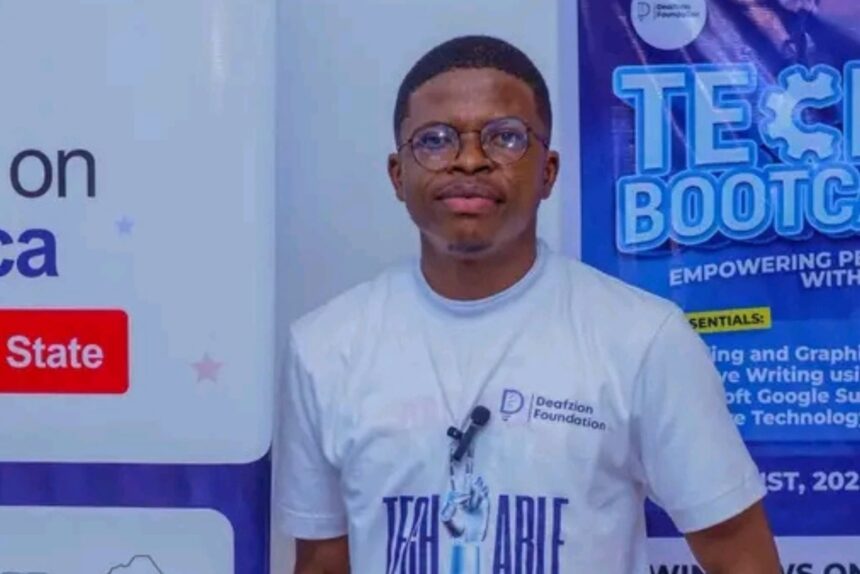
Its executive director, Emmanuel Izuchukwu Osita, said TechAble was created because “very few” digital skills programmes are intentionally designed to accommodate learners with disabilities or provide genuinely inclusive learning environments.
What to Know About TechAble
TechAble is an inclusive digital skills and youth empowerment initiative created to ensure that young Africans, particularly people with disabilities and those from underserved communities, can participate meaningfully in the technology-driven economy.
The initiative was established in 2024 under the Deafzion Foundation, a Nigerian social impact organisation focused on disability rights, inclusive education and youth empowerment.
Rather than treating disability inclusion as an additional component of conventional technology education, TechAble places accessibility at the centre of its training model.
Its programmes include bootcamps, workshops and community-based learning activities designed to develop practical digital literacy, data and AI fundamentals, problem-solving abilities, leadership capacity and employability skills.
According to Osita, the initiative was born from “a major gap in disability-inclusive tech education,” as many existing digital-skills programmes do not adequately consider the needs of learners with disabilities.
The Pain Points in TechAble’s Focus
At the heart of TechAble’s work is the problem of digital exclusion, particularly the difficulties faced by young people with disabilities who want to acquire technology-related skills but encounter barriers that other learners may not face.
The existence of digital-skills programmes does not necessarily mean that such programmes are accessible to everyone.
A deaf learner, visually impaired participant or young person requiring assistive technology may find conventional training environments difficult to navigate without appropriate accommodations.
TechAble therefore focuses on accessibility, inclusive teaching methods, assistive technologies and psychosocial support.
Osita explained that the initiative “differentiates itself by embedding accessibility, inclusive pedagogy, assistive technologies, and psychosocial support into digital skills training.”
The approach addresses not merely access to training, but the ability of participants to actively learn, participate and translate their knowledge into economic opportunities.
More Than 40 Youths Already Trained
Although still at an early stage, TechAble has recorded measurable progress since its establishment.
The initiative has trained more than 40 youths with disabilities across Nigeria in digital and AI skills, while building partnerships with organisations including LEAP Africa, Dow, Windows on America and state disability agencies.
The programme also appears to be attracting interest beyond the immediate beneficiaries.
“Uptake has been strong and organic,” Osita said.
He noted further that the initiative has received significant interest from students, parents, schools and partner organisations.
Participation and retention have reportedly been strong, with particularly notable engagement among girls with disabilities.
This is important because sustained participation is often as significant as initial enrolment in skills-development programmes.
By combining technical training with an inclusive environment, TechAble is attempting to create a pathway through which young people with disabilities can develop skills that potentially improve their educational, professional and entrepreneurial prospects.
TeachAble’s Partnerships and Expansion Plans
TechAble currently operates in Nasarawa State, Abuja and Plateau State, but its ambitions extend beyond these locations.
The initiative plans to expand into additional Nigerian states and selected African countries by working with schools, NGOs and development agencies.
Such partnerships could be particularly important because scaling disability-inclusive technology education requires more than trainers and classrooms.
It requires access to equipment, assistive technologies, funding, suitable infrastructure and institutions capable of reaching underserved populations.
TechAble’s existing relationships with organisations such as LEAP Africa, Dow, Windows on America and state disability agencies provide an early foundation for that expansion.
The initiative’s strategy also reflects an understanding that disability inclusion cannot be achieved by one organisation working alone.
Building a wider ecosystem of schools, civil-society organisations, government agencies and private-sector partners could enable the programme to reach significantly more young people while adapting its model to different communities.
Funding and Infrastructure Remain Major Challenges
Despite its early progress, TechAble faces challenges that could determine how quickly and sustainably it expands.
The initiative is currently funded through grants, partnerships, donations and in-kind support, leaving it dependent on external resources to sustain and scale its activities.
Osita identified “limited funding, accessibility costs, infrastructure constraints in underserved areas, and low awareness around disability-inclusive tech education” as key challenges.
These obstacles are significant because inclusive education can require additional investment in assistive technologies, accessible learning materials, specialised support and appropriate infrastructure.
Meanwhile, underserved communities may already struggle with basic digital infrastructure such as reliable electricity, internet connectivity and access to devices.
Nevertheless, TechAble says strong community support, partnerships and demand have helped it overcome some of its early difficulties.
Its long-term success will ultimately depend on whether it can convert this initial demand into sustainable funding, stronger institutional partnerships and a scalable model for disability-inclusive digital education across Nigeria and Africa.
_________________________
Bookmark Techparley.com for the most insightful technology news from the African continent.
Follow us on X/Twitter @Techparleynews, on Facebook at Techparley Africa, on LinkedIn at Techparley Africa, or on Instagram at Techparleynews