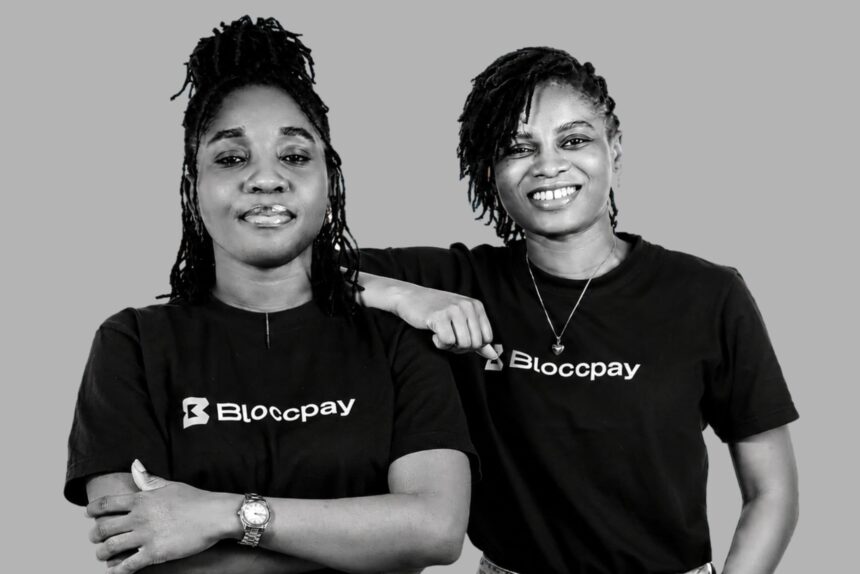
Nigerian fintech startup Bloccpay is building a stablecoin-powered payroll and invoicing platform designed to simplify how businesses pay distributed teams while helping freelancers and contractors in emerging markets manage and document their income.
Founded by Ajoke Asunmonu and Jennifer Enchenim in 2022, the startup allows businesses to automate payroll while enabling independent professionals to receive international payments through bank accounts, crypto wallets and mobile money.
Beyond facilitating payments, Bloccpay is attempting to address a less visible challenge facing freelancers, the absence of a consolidated financial history that can demonstrate their earnings.
“Beyond the payment itself, transactions generate a history of work done and income received,” Echenim said.
She further argued that such documentation can become valuable when workers apply for loans, open accounts abroad or support visa applications.
What is Bloccpay and what it does
Bloccpay is a Nigerian financial technology startup focused on cross-border payroll, invoicing and income management for businesses and independent professionals.
Its central proposition is to make it easier for companies in developed markets to pay workers in emerging markets without forcing either side to navigate multiple payment platforms, currencies and intermediaries.
The startup serves businesses that employ distributed teams as well as freelancers and contractors who work with international clients.
For businesses, Bloccpay provides a payroll system through which employers can add workers, establish payment frequencies and review payroll before approving payments.
Once approved, the platform handles the payment process by debiting the business and crediting the relevant workers.
For freelancers, the company provides an invoicing mechanism that allows them to send payment links to clients, meaning clients do not necessarily need to create Bloccpay accounts before settling invoices.
The company also views transaction records as an important part of its offering. Instead of treating payments as isolated transactions, Bloccpay wants to create a documented history of income and work that can potentially help independent workers demonstrate their financial standing.
How does Bloccpay work?
Bloccpay operates on both sides of the international payment transaction. On the business side, an employer can create an account, add its contractors or employees and establish how frequently they should be paid.
At each payroll cycle, the company reviews and approves the payments, after which Bloccpay generates the payroll, debits the business and credits the workers.
On the freelancer side, a professional can invoice an international client through Bloccpay. The client receives a payment link and can settle the invoice without necessarily becoming a Bloccpay user.
Once the payment is processed, the freelancer can receive funds through available channels, including a bank account, cryptocurrency wallet or mobile-money service, depending on the market.
Stablecoins form part of the infrastructure underpinning the platform. Rather than requiring every cross-border transaction to move through conventional banking rails, stablecoin-based infrastructure can facilitate the movement of digital, dollar-linked value across borders before funds are converted or paid out through local channels.
The model is designed to remove some of the friction that the founders themselves encountered while receiving international earnings.
The problem Bloccpay is trying to solve
Bloccpay’s origins are closely linked to Echenim’s experience as a remote worker receiving international income.
She described a process in which she had to send her dollar earnings to a friend’s dollar account, convert the funds into stablecoins through a peer-to-peer transaction and subsequently convert those stablecoins into naira.
“I then had to use another peer-to-peer transaction to convert the stablecoins into naira because the platform I was paid through offered an exchange rate that was about 40 per cent worse,” Echenim said.
According to her, the process involved three separate steps, two intermediaries and delays at different stages before she could access money she had already earned.
The founders subsequently researched whether the problem extended beyond their own experience and found similar challenges among cross-border workers in Africa and other emerging markets.
They identified not only payment friction but also what they described as a documentation gap.
Traditional employees usually generate payslips, employment letters and regular salary credits that can demonstrate their income.
Independent workers, however, may have earnings spread across different clients, currencies and payment platforms. Bloccpay therefore sees an opportunity to combine payment infrastructure with financial documentation.
From payroll to a broader financial platform
Although payroll and invoicing are Bloccpay’s current focus, the founders envision the company eventually becoming a broader financial platform for freelancers and contractors.
The roadmap includes products such as health insurance, yield products, cards and other benefits that are commonly associated with traditional employment.
“We want Bloccpay to be a one-stop platform for managing income and everyday life,” Echenim said. “Payroll and invoicing are where we’ve started, but the roadmap includes health insurance, yield products, and other benefits traditionally reserved for full-time employees.”
The strategy reflects a broader attempt to address the financial disadvantages often associated with independent work. A freelancer may earn consistently but still lack access to products that depend on formal employment records.
By combining payment activity with income documentation, Bloccpay hopes to build a foundation upon which additional financial services can be offered.
However, expanding from payments into insurance, yield products and other financial services would also introduce additional regulatory, compliance and operational requirements across the different markets where the company operates.
Bloccpay’s traction, funding and business model
Despite remaining in private beta, Bloccpay says it has processed more than $400,000 in gross transaction volume and serves close to 300 users. The company also reported substantial recent growth, with gross transaction volume in the second quarter of 2026 increasing sevenfold compared with the previous quarter.
“By the end of the first half of 2026, we had already matched our total transaction volume for all of 2025,” Echenim said.
She added that user feedback had influenced product decisions, including backdated payroll, mid-cycle contractor additions and mobile-money integration.
Bloccpay has largely been bootstrapped but has received a $100,000 grant from the Stellar Community Fund Build Award.
It has also participated in the Techstars Founder Catalyst Programme and joined the Circle Alliance Program, which the company says has provided access to capital, structure and the stablecoin ecosystem.
Its current customers and users are concentrated in Nigeria, Kenya, Ghana and South Africa, while payouts are also available in Uganda and Tanzania. Its business customers are primarily located in the United States and United Kingdom.
The startup charges businesses $15 per contractor per month, while invoicing and withdrawals each attract a one per cent fee. Deposits are free.
The founders, however, say the current fee structure represents only the beginning of the company’s potential revenue model as it considers additional financial products.
Bloccpay’s expansion plans
Bloccpay’s next major challenge is moving from a controlled private-beta environment into broader market adoption.
The company says its priorities will include strengthening its presence in existing markets, expanding payment and payout corridors and introducing additional local payment options.
“Once we open it up to the public, distribution becomes the priority,” Asunmonu said.
The company also intends to grow its team and accelerate its product development and geographical expansion if it secures the investment required to support those ambitions.
The opportunity is significant because remote work has made it increasingly possible for businesses in countries such as the US and UK to hire professionals in African markets.
Yet the infrastructure for paying those workers and providing them with a coherent financial history remains fragmented.
Bloccpay is therefore positioning itself beyond a conventional remittance or payment service.
Its longer-term ambition is to become infrastructure through which global workers can receive income, document their earnings and potentially access financial products that have historically been easier for formally employed workers to obtain.
The startup’s success will ultimately depend not only on transaction growth but also on whether it can scale its payment infrastructure, maintain competitive pricing, navigate regulations across multiple jurisdictions and convert its growing transaction activity into sustainable revenue.
For now, however, Bloccpay is attempting to turn a common problem among Africa’s increasingly global freelance workforce into a broader financial technology opportunity.
____________________________
Bookmark Techparley.com for the most insightful technology news from the African continent.
Follow us on X/Twitter @Techparleynews, on Facebook at Techparley Africa, on LinkedIn at Techparley Africa, or on Instagram at Techparleynews