

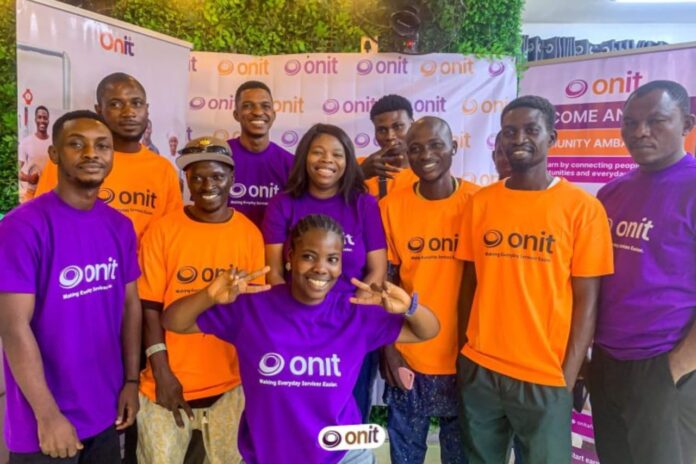
Nigerian technology-enabled services startup, Onit Innovations, has generated more than ₦100 million in cumulative revenue while completing over 7,000 service orders, as it seeks to transform the country’s informal household and business services industry through technology, workforce development and structured service delivery.
Launched in Lagos in May 2024, the startup connects households and businesses with verified professionals providing services such as laundry, home cleaning, technical repairs, procurement, grocery shopping and errands.
Beyond connecting customers with service providers, Onit is building an organised workforce infrastructure that involves recruiting, training, assessing and verifying professionals before deploying them to customers.
The company has also developed a pool of more than 500 verified service associates, who have collectively earned over ₦40 million through its platform.
Its founder and Chief Executive Officer, Dorcas Obeahon, said the business was established to address persistent challenges surrounding trust, service quality, accountability and consistency in Nigeria’s largely informal service economy.
What is Onit Innovations and What Does It Do?
Onit Innovations is a Nigerian startup focused on organising everyday household and business services by connecting customers with trained and verified professionals through a technology-enabled platform.
Its services cover several areas, including laundry, home cleaning, technical and repair services, procurement, grocery shopping and errands, providing individuals and organisations with access to different service professionals through a single platform.
Unlike conventional online directories that primarily allow customers to search for and contact available workers, Onit takes a more hands-on approach by managing the workforce and service delivery process.
The company recruits, trains, assesses and verifies its service associates before assigning them to customers. It also establishes operating standards, provides customer support and monitors workers’ performance to ensure service quality and accountability.
According to Obeahon, the idea emerged from her personal experience managing professional responsibilities alongside family obligations in Lagos. She explained that finding dependable household assistance was not simply about locating someone capable of performing a task but also ensuring trust, consistency and accountability.
“I began to see that the problem was much bigger than simply finding someone who could perform a task. The real challenge was trust, quality, accountability and consistency,” she said.
The startup therefore aims to bridge the gap between customers seeking reliable services and skilled informal workers who need better access to training, professional opportunities and consistent demand.
Tackling Trust Deficit and Structural Challenges in the Informal Service Economy
Onit’s business model addresses some of the longstanding challenges affecting Nigeria’s informal service industry, particularly the difficulty of finding reliable professionals and the absence of standardised service delivery procedures.
Many households and businesses depend on personal recommendations, social media advertisements and informal referrals when searching for cleaners, technicians, laundry workers and other service providers. However, these arrangements do not always guarantee workers’ competence, reliability or accountability.
At the same time, many capable informal service professionals operate without formal training, verifiable employment records or predictable access to customers. This limits their ability to build professional reputations, secure regular jobs and improve their earning capacity.
Onit seeks to address both sides of the problem by establishing a structured system where customers can access verified professionals while workers benefit from training, performance assessment and more organised employment opportunities.
Obeahon noted that several businesses already operate in individual segments of the service industry, but explained that Onit’s approach goes beyond connecting customers with available workers.
“Our approach is broader because we are building the underlying service and workforce infrastructure rather than simply providing a directory where customers find workers,” she said.
This distinction positions the startup as a managed services platform seeking to improve the overall reliability and organisation of an industry that largely operates through informal arrangements.
BlueVarsity, Workforce Development and Opportunities for Service Professionals
A major component of Onit’s strategy is workforce development through its training arm, BlueVarsity, which focuses on equipping service professionals with the skills and knowledge required to deliver services more effectively. The initiative has trained more than 3,000 people, reflecting the startup’s effort to address the skills and professionalism gaps within Nigeria’s informal service economy.
Through its workforce development model, Onit seeks to ensure that service associates possess more than the basic technical ability to perform assigned tasks. Professional conduct, customer relations, service standards, accountability and consistent performance are also important aspects of the company’s operating structure.
The startup currently has a pool of more than 500 verified service associates who have collectively earned over ₦40 million through the platform. This demonstrates how the business is attempting to create economic opportunities for workers while providing customers with more dependable services.
The approach is particularly relevant in Nigeria, where a significant number of people earn their livelihoods through informal occupations but often lack access to structured training, professional networks and predictable customer demand.
By combining training with access to service requests, Onit is seeking to create a system in which workers can improve their professional capabilities, establish more credible work records and earn income through a more organised service delivery network.
Revenue Growth, Business Model and Strategic Partnerships
Onit has reported more than 7,000 completed service orders for over 500 customers and cumulative revenue exceeding ₦100 million, generated primarily through margins and commissions on services delivered through its platform.
Beyond individual service requests, the company has diversified its commercial offerings through recurring household service plans, business-to-business (B2B) contracts and workforce training.
Its recurring service plans allow customers to access household services regularly, while B2B arrangements create opportunities to provide services to organisations that require structured support for their operations. The company is also developing employee-benefit products that would enable organisations to provide household service access as part of their employee welfare packages.
Obeahon explained that customer retention and cross-service adoption are important aspects of the company’s growth strategy, noting that customers who initially engage the platform for one service often return for other needs.
“A customer may initially come to us for laundry, and later use Onit for cleaning, repairs, procurement or errands,” she said.
The startup has largely financed its operations through founder capital, internally generated revenue and grants. It has also received support through entrepreneurship programmes, including the Women in Tech accelerator by Standard Chartered Bank and Village Capital, as well as Orange Corners Nigeria.
These programmes have provided opportunities for business development, institutional support and exposure to the broader entrepreneurship ecosystem.
Expansion Plans, Operational Challenges and the Road Ahead
Following its initial growth in Lagos, Onit plans to strengthen its operations in the city before expanding into other major Nigerian urban markets and eventually selected African cities. The expansion strategy reflects the company’s ambition to establish a scalable service infrastructure that can serve households and businesses across different markets.
However, maintaining consistent service quality as its workforce and customer base expand remains a major operational challenge. The company has recognised that verifying workers’ identities and backgrounds is not sufficient to guarantee satisfactory service delivery. It must also ensure that professionals consistently meet established standards after deployment.
Obeahon explained that the company identified this challenge early in its operations, prompting it to strengthen its workforce management and quality assurance systems.
“We learned quite early that verification alone was not enough. We needed training, operating procedures, quality assurance, performance tracking and accountability after deployment,” she said.
This challenge highlights a broader issue facing technology-enabled service marketplaces, where rapid expansion must be balanced with customer satisfaction, workforce reliability and operational efficiency.
For Onit, its long-term prospects will depend on its ability to maintain service standards, attract repeat customers, retain competent professionals and build sustainable revenue streams as it expands beyond Lagos.
Nevertheless, its approach highlights the growing role of technology in addressing everyday economic challenges beyond conventional fintech and digital commerce, while demonstrating how the organisation of informal services can create business opportunities, improve productivity and expand income opportunities for workers.
___________________________________
Bookmark Techparley.com for the most insightful technology news from the African continent.
Follow us on X/Twitter @Techparleynews, on Facebook at Techparley Africa, on LinkedIn at Techparley Africa, or on Instagram at Techparleynews

