



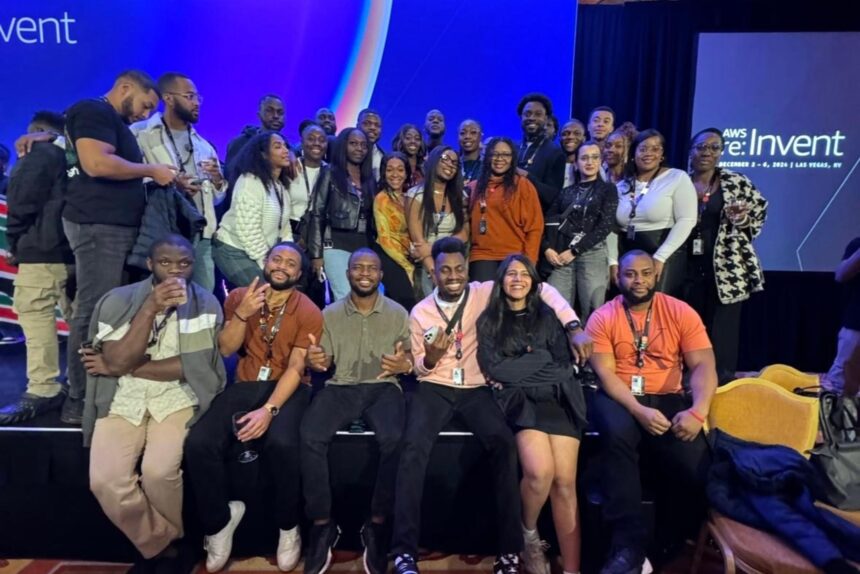
A Nigerian software engineer and senior backend engineer at Ampersand, Jemil Oyebisi, has said that artificial intelligence (AI) agents remain imperfect, despite significant technological progress showcased at the AWS re:Invent 2025 conference in Las Vegas.
Oyebisi made the remarks in a recent LinkedIn post following his return from the annual cloud computing event, one of the world’s largest gatherings of developers, engineers and technology leaders organised by Amazon Web Services (AWS).
In his post, Oyebisi noted that the limitations of AI agents were openly acknowledged at this year’s re:Invent, marking a shift from earlier narratives that often overstated the readiness of autonomous systems.
“Agents aren’t perfect yet, they still hallucinate and lose context, but that’s part of the process. What’s exciting is seeing the progress: continuous evaluation, agentCore, #MCP agent-to-agent protocol, and tools like Kastra pushing things forward,” he wrote.
What You Need to Know
According to him, while AI agents continue to suffer from issues such as hallucinations and loss of context, the industry is now demonstrating clearer, more practical pathways towards solving these problems.
Oyebisi said hallucinations, where AI systems generate false or misleading outputs have been one of the most persistent concerns surrounding large language models and agent-based systems.
He added that context loss, which affects an agent’s ability to maintain continuity across complex tasks, also remains a barrier to large-scale deployment, particularly in enterprise environments.
Despite these shortcomings, Oyebisi said AWS re:Invent 2025 offered “much more clarity around the AI journey” than previous editions of the conference.
One of the most notable developments, he said, was agentCore, an AWS framework designed to support the building, monitoring and continuous evaluation of AI agents.
The framework places emphasis on systematic testing and real-time assessment, allowing developers to identify errors early and reduce the frequency of hallucinations over time.
Continuous evaluation, according to Oyebisi, represents a critical shift away from one-off model testing towards ongoing performance measurement, especially as agents become more autonomous and embedded in production systems.
Agent-to-Agent Communication Gains Momentum
Another key highlight from the event was the growing focus on the Model Context Protocol (MCP), an emerging agent-to-agent communication standard aimed at enabling collaboration between AI agents.
Oyebisi explained that such protocols are essential if the industry is to realise AWS’s broader ambition of scaling to “a billion agents”.
By allowing agents to exchange structured context, validate outputs and coordinate tasks, MCP could help prevent cascading errors that arise when agents operate in isolation.
He also pointed to tools such as Kastra, which are designed to support orchestration and evaluation across multiple agents, as evidence that the ecosystem around agent reliability is beginning to mature.
A Shift From Hype to Infrastructure
Oyebisi’s reflections suggest that AWS re:Invent 2025 marked a turning point in how AI agents are discussed within the developer community. Rather than focusing solely on future potential, the conversation has moved towards the practical infrastructure required to make agents dependable at scale.
“So many advancements since last year, and much more clarity around the AI journey. One big highlight for me was the agentCore and the road to a billion agents,” he wrote.
Beyond the technical announcements, Oyebisi also highlighted the international nature of the conference, noting interactions with developers from Nigeria, Kenya, the United Kingdom, Germany, Canada, Argentina, South Africa and several other countries.
He described the experience as a reminder that the future of AI agents will be shaped not only by platforms and protocols, but by a global community of engineers learning, iterating and improving year after year.
As enterprises increasingly adopt agent-based AI systems, experts say Oyebisi’s assessment underscores a growing consensus within the industry that perfection remains elusive, but structured progress is now guiding the next phase of AI development.
Talking Points
It is notable that Jemil Oyebisi’s reflections from AWS re:Invent 2025 strike a measured tone, acknowledging that AI agents are still imperfect, particularly in areas such as hallucinations and loss of context, even as adoption accelerates across industries.
Rather than overselling the technology, his emphasis on progress over perfection aligns with the reality many engineers and enterprises face when deploying agent-based systems in production environments.
Equally important is the growing attention on agent-to-agent communication through the Model Context Protocol (MCP), which could play a critical role in reducing isolated failures and enabling coordinated, scalable AI systems.
At Techparley, we see this evolution as a necessary step towards responsible AI adoption, where transparency, evaluation, and interoperability are treated as core requirements rather than afterthoughts.
As platforms like AWS continue to refine agentCore and related tooling, there is a clear opportunity for the global developer community to shape how these systems are deployed, governed, and trusted at scale over the coming years.
——————-
Bookmark Techparley.com for the most insightful technology news from the African continent.
Follow us on Twitter @Techparleynews, on Facebook at Techparley Africa, on LinkedIn at Techparley Africa, or on Instagram at Techparleynews.