



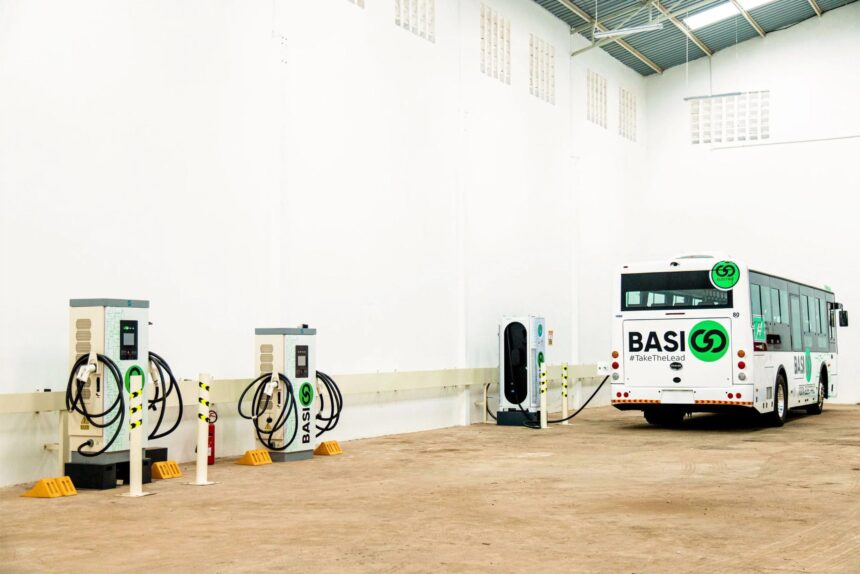
BasiGo, Kenya’s leading provider of electric bus solutions, has officially opened a new electric vehicle (EV) fast-charging site at the Shell Athi River Service Station, marking a significant expansion of its dedicated charging network.
The startup says the launch deepens its “E-Mobility Backbone”, a nationwide charging strategy designed to support the shift to green public transport.
It is BasiGo’s third charging location hosted by Vivo Energy Kenya under the Shell banner, following earlier deployments at Shell Waiyaki Way in Nairobi and Shell New Gatitu in Thika.
Positioned along the Nairobi–Kitengela–Machakos corridor, the new station can charge up to four vehicles simultaneously. It is equipped with one CCS2 fast charger (two guns) and one GBT charger (two guns), ensuring compatibility across a broad range of electric bus models.
Decentralising EV Infrastructure Beyond Nairobi
Speaking at the launch, Moses Nderitu, Managing Director of BasiGo Kenya, described the Athi River site as a critical step in decentralising the country’s EV infrastructure.
“Every new charging site is a critical step toward a cleaner, more sustainable transport system for Kenya. Access to reliable charging remains the biggest barrier to the adoption of e-mobility, and partnerships like these are helping us overcome it,” said Nderitu.
He added that the location underscores the scalability of BasiGo’s model.
“This is our third site with Shell, and it demonstrates that the model works and can scale. What’s especially important is that this station is expanding electric mobility beyond Nairobi’s city limits.”
He added that the location of the Athi River site was especially important in building confidence among operators considering the switch to electric buses. The visibility of charging infrastructure directly along existing routes, combined with rapid charging and reliable access, reduces operational uncertainty for public transport providers.
When operators are assured they can recharge efficiently without disrupting schedules, the transition to electric buses becomes a straightforward commercial decision.
Leveraging Retail Networks for Green Mobility
The partnership taps into Vivo Energy Kenya’s extensive retail footprint, integrating EV charging into existing transport hubs rather than building standalone facilities.
Peter Murungi, Managing Director of Vivo Energy Kenya, said the collaboration reflects a broader strategy to embed clean energy solutions within the company’s service stations.
“Every day, we serve millions of Kenyans across our retail network, and today we are expanding that service to support electric mobility. Through partnerships like this, we are optimising our existing sites while supporting the growth of Kenya’s electric mobility ecosystem and creating new business opportunities.”
Murungi noted that the collaboration drives innovation in Kenya’s transport sector. He explained that Vivo Energy Kenya’s extensive station network aligns with the daily routes of operators, making the partnership with BasiGo a natural fit.
With Athi River as their third joint site, he highlighted the significant potential to scale the charging infrastructure across the network as electric fleets continue to expand in the country.
Momentum Builds Behind BasiGo’s ‘Road to 1000’
The Athi River launch comes amid rapid growth for BasiGo. The company recently surpassed 100 electric buses in operation on Kenyan roads and secured fresh funding from Proparco to accelerate its “Road to 1000” initiative.
By establishing high-speed charging hubs in strategic locations, including Athi River, Buruburu and Kikuyu, BasiGo is assembling what it says is Kenya’s most extensive DC fast-charging network.
The infrastructure now supports a fleet that has collectively driven more than 1.5 million clean kilometres, reducing both fuel costs for operators and emissions in urban centres.
As Kenya positions public transport at the heart of its climate and urban mobility goals, experts say the expansion of reliable, route-aligned charging infrastructure may prove decisive.
With Athi River now live, BasiGo is signalling that electric buses are no longer confined to pilot projects but are steadily becoming an option for mass transit across the country.
Talking Points
It is impressive that BasiGo has expanded its EV charging network with the Athi River site, addressing one of the biggest barriers to electric bus adoption in Kenya: access to reliable, route-aligned charging infrastructure.
This single site alone strengthens the confidence of public service vehicle operators to transition to electric, particularly along high-traffic corridors such as Nairobi–Kitengela–Machakos.
At Techparley, we see how developments like this can accelerate the shift to green mobility beyond central Nairobi, supporting the broader goal of sustainable urban transport and decarbonisation.
The station’s ability to charge multiple buses simultaneously, with CCS2 and GBT compatibility, means operators can maintain schedules efficiently, making electric fleets a practical business choice rather than a logistical challenge.
However, there is still room to expand the network to cover more strategic corridors and rural links. Adoption will depend on how effectively additional stations reduce downtime, ensure reliability, and integrate with operators’ daily routes.
As BasiGo scales, partnerships with retail networks like Shell provide an opportunity to accelerate deployment, increase visibility, and embed electric mobility into Kenya’s transport ecosystem. With the right support, BasiGo could become a key catalyst for the widespread adoption of sustainable public transport in Kenya and the wider region.
——————-
Bookmark Techparley.com for the most insightful technology news from the African continent.
Follow us on Twitter @Techparleynews, on Facebook at Techparley Africa, on LinkedIn at Techparley Africa, or on Instagram at Techparleynews.