



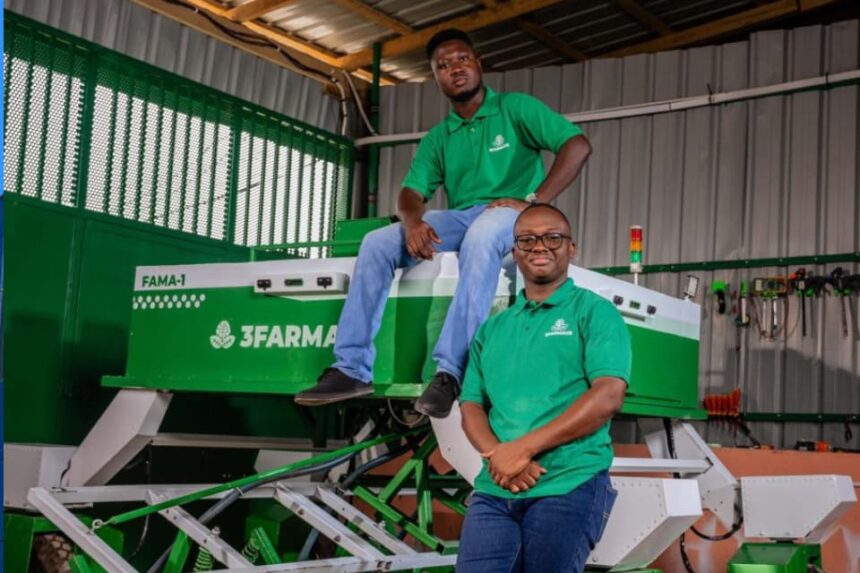
A Ghanaian agritech startup, 3Farmate, is drawing attention across the continent with the launch of its autonomous farming robot, FAMA, a machine designed to transform how crops are planted and managed in Africa’s challenging agricultural environments.
Built to operate without human intervention, FAMA can plant seeds, apply fertiliser, weed, and spray crops while navigating farmland using a vision-based artificial intelligence system instead of GPS.
The innovation, which emerged from a university dorm room, directly addresses long-standing structural gaps in African agriculture, where unreliable infrastructure and difficult terrain often limit the effectiveness of imported technologies.
As co-founder and CEO Clinton Anani explained, “The system is built for real farm conditions, uneven ground, loose and muddy soils, unpredictable weather,” adding that “one operator can oversee multiple robots, each covering 27 to 35 acres per day with sub-85mm planting precision.”
This is a value proposition that is already attracting widespread interest from farmers and agribusinesses.
What to Know About 3Farmate
Founded in 2021, 3Farmate’s origin story is as unconventional as it is inspiring. The company was born in a university dorm room, where its founders began experimenting with rudimentary materials to test their ideas.
“And I mean that literally. My co-founder and I were cutting metal pipes in the room, assembling prototypes out of wood and plastic, and testing them on whatever open ground we could find,” Anani said.
Those early prototypes, though crude, validated the concept and laid the groundwork for what has become a fully functional autonomous system. Today, the startup remains lean, powered by a three-person engineering team responsible for robotics, embedded systems, software, and mechanical design.
Notably, every stage of development, from the first prototype to the current full-scale robot, has been executed locally in Ghana. This in-house approach underscores both the technical capacity and resource efficiency that define the company’s growth trajectory.
How the Startup Solves Farming Problems
At the heart of 3Farmate’s innovation is its deliberate focus on African farming realities. Unlike conventional agricultural robots that depend heavily on GPS, FAMA uses a vision-based AI system to navigate fields. This distinction is critical in regions where GPS signals are unreliable or entirely unavailable.
“That is the reality on most large-scale farms across Africa,” Anani noted, highlighting a fundamental gap the company set out to address.
Beyond navigation, FAMA is engineered to handle the physical complexities of African farmland, including uneven terrain and variable soil conditions. By automating multiple farming processes, planting, fertilising, weeding, and spraying, the robot reduces reliance on manual labour while improving efficiency and accuracy.
Farmers can access the technology through a pay-per-acre model, eliminating the need for heavy upfront investment.
As Anani put it, “Farmers pay us per acre, so they get access to this level of automation without buying any equipment upfront.”
Bridging a Critical Gap in Global Agri-Robotics
While the global agri-robotics industry continues to expand, much of its innovation remains concentrated in regions with advanced infrastructure. Companies such as John Deere, Naio Technologies, and FarmWise have developed sophisticated systems tailored to North American and European farms.
However, these solutions often assume flat landscapes, consistent connectivity, and reliable GPS coverage. 3Farmate positions itself as a corrective to this imbalance.
“Nobody was building autonomous farming robots for African conditions. So we did,” Anani said.
By eliminating dependence on GPS and designing for rugged environments, the company is effectively localising a global technology trend, making it relevant and accessible to African farmers.
Field Testing, Market Traction, and Early Adoption
Following more than 60 test runs and coverage of over 100 acres across different soil types, 3Farmate officially launched FAMA to the market. The response has been immediate and encouraging.
According to Anani, the startup is already in discussions with more than 70 farmers and several large-scale crop production companies.
Initial deployments are focused on staple crops such as corn and soybeans, aligned with the planting season that begins in late March and runs into April. Importantly, the company has not had to aggressively market its solution.
“We have not had to chase interest. Farmers are coming to us,” Anani revealed.
The appeal lies in both cost savings and operational efficiency, with FAMA capable of reducing planting costs by up to 60 percent per acre while mitigating labour shortages during critical planting windows.
Lean Funding, High Efficiency, and Expansion Plans
Despite operating in a capital-intensive sector, 3Farmate has demonstrated remarkable financial discipline. The startup has raised approximately $200,000 over four years, a figure significantly lower than typical funding levels for robotics ventures at a similar stage.
This funding has supported the entire research and development cycle, from prototype to deployment-ready system.
“To put that in perspective, we went from a dorm room prototype to a fully autonomous, field-tested robot on a fraction of what most robotics companies spend before they even have a working demo,” Anani said, emphasizing the company’s capital efficiency as a key point of pride.
While Ghana remains its primary market, 3Farmate is already looking beyond national borders. The company’s technology has been intentionally designed for adaptability, enabling it to scale across regions with similar agricultural conditions without requiring extensive re-engineering.
“We designed the system to be adaptable from the start, so expanding into new geographies is more of a go-to-market question than a re-engineering one,” Anani explained. “If it works in Ghanaian farm conditions, it can work across the region.”
As Africa continues to grapple with the dual challenges of food security and agricultural productivity, 3Farmate’s innovation shows a broader shift toward locally developed, context-aware technologies.
By combining affordability, efficiency, and adaptability, the startup is not only redefining mechanised farming on the continent but also positioning itself at the forefront of Africa’s emerging agri-tech revolution.
Talking Points
The emergence of 3Farmate and its autonomous robot FAMA represents a compelling case of context-driven innovation, particularly in a sector where imported solutions have historically failed to align with African realities.
By prioritising vision-based AI over GPS dependency and adopting a pay-per-acre model, the startup demonstrates a sharp understanding of both infrastructural gaps and farmers’ financial constraints, which significantly strengthens its value proposition.
However, while its early traction and cost-reduction claims are promising, questions remain around scalability, durability across diverse ecological zones, and the operational complexity of maintaining such robots in rural settings with limited technical support infrastructure.
Additionally, competing against well-established global players like John Deere will require not just technological differentiation but sustained capital, distribution networks, and after-sales service reliability.
Analytically, 3Farmate’s success will hinge on its ability to transition from an innovative prototype-driven venture into a robust, service-oriented agritech company capable of delivering consistent performance at scale across Africa’s fragmented agricultural landscape.
________________________
Bookmark Techparley.com for the most insightful technology news from the African continent.
Follow us on X/Twitter @Techparleynews, on Facebook at Techparley Africa, on LinkedIn at Techparley Africa, or on Instagram at Techparleynews