



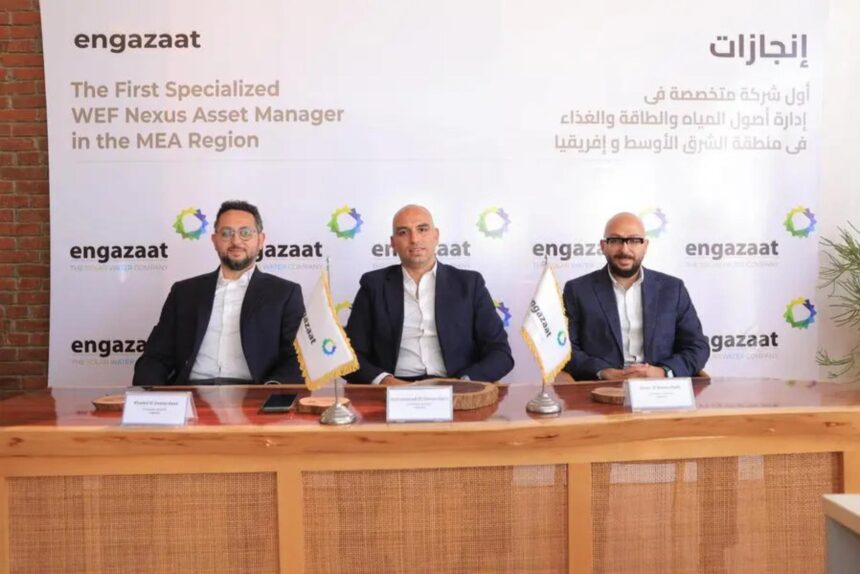
Engazaat, the Middle East and Africa’s specialised asset manager focused exclusively on the water, energy and food (WEF) nexus, is planning to invest more than $100 million in regional expansion as part of a wider $250 million project portfolio.
The Egyptian startup is scaling operations across Egypt, Lebanon and the United Arab Emirates, as governments, agribusinesses and industrial players across the region seek more cost-efficient infrastructure to address pressures from climate change, water scarcity and food security.
Its founding partner and chief executive, Muhammad El Demerdash, said the company’s core strategy is built on treating these systems as a single investment case rather than as separate infrastructure silos.
“We approach water, energy, and food infrastructure as one connected investment case,” El Demerdash said. “When these systems are designed and financed together, they perform better and cost less to run. That is the model we have been building and operating for over 14 years, delivering stable returns and measurable impact in remote areas while supporting sustainable development goals.”
What You Need to Know
Founded in 2011, Engazaat operates across water, renewable energy and food production, designing, financing and operating sustainable infrastructure projects that serve farms, businesses and communities.
Engazaat’s regional growth is being driven by long-term service and utility offtake agreements with commercial, agricultural and industrial clients. Projects are typically structured under a Build–Own–Operate (BOO) model, allowing the company to retain ownership and operational control of assets over extended concession periods.
Under its utilities-as-a-service model, clients pay for delivered services, such as irrigation, water treatment, and renewable power generation, transmission and distribution rather than financing or constructing infrastructure themselves.
Engazaat develops, owns and operates the assets, reducing upfront capital requirements for clients while generating stable, performance-based revenues.
Understanding the Startup’s Fund
To support its expansion strategy, Engazaat has launched the SAVE (Sustainable Agro-Village and Entrepreneurship) Sustainable Infratech Fund, a $200 million investment platform developed in partnership with CI Capital.
The fund is designed to serve as a direct financing mechanism for clean infrastructure projects across Engazaat’s target markets.
It is expected to be regulated by financial authorities in Egypt and Abu Dhabi, with further details on its structure and deployment strategy to be announced.
The launch comes amid rising investor interest in climate-aligned infrastructure assets that combine long-term revenue visibility with measurable environmental and social impact.
Flagship Projects and Climate Impact
One of Engazaat’s flagship developments is the SAVE-1 project in Egypt’s Dakhla Oasis, a remote agricultural region where access to water and power has historically constrained productivity. The project integrates renewable energy and water systems to support sustainable agricultural activity.
According to the company, SAVE-1 is expected to generate 126.5 gigawatt-hours of green energy over its operating life and eliminate more than 460,000 tonnes of carbon dioxide emissions, while also creating local employment opportunities.
El Demerdash said Engazaat’s projects typically operate under 25-year concession periods, with power and water purchase agreements denominated in both US dollars and Egyptian pounds. These contracts are commonly structured on take-or-pay models, providing revenue certainty and reducing demand risk.
The company is also evaluating public-private partnership (PPP) opportunities with the Egyptian government across solar energy, water management and agricultural infrastructure.
Track Record and Regional Positioning
To date, Engazaat has invested around $33 million in active projects, developed more than 63 megawatts of solar capacity, enough to power approximately 40,000 homes and manages over 15 million cubic metres of water annually for agricultural use.
Engazaat is a signatory to the Abu Dhabi Global Sustainable Finance Declaration and has received multiple regional and international awards recognising its infrastructure execution and climate impact model.
As countries across the Middle East and Africa intensify efforts to secure food systems, decarbonise energy supply and manage water scarcity, Engazaat is positioning itself as a specialist platform capable of delivering integrated, long-term infrastructure solutions at scale.
Talking Points
It is notable that Engazaat is treating water, energy, and food infrastructure as a single, integrated investment case, rather than three separate problems, an approach that directly addresses the inefficiencies that have long plagued climate and agricultural infrastructure across the region.
This WEF-nexus model positions Engazaat as more than a traditional infrastructure developer, enabling it to deliver projects that are not only more cost-efficient to operate but also better aligned with long-term sustainability and food security goals.
At Techparley, we see Engazaat’s utilities-as-a-service model as a practical solution for farms and businesses that lack the capital or expertise to build and manage complex infrastructure on their own, particularly in remote and climate-vulnerable areas.
The planned $100 million expansion, backed by a broader $250 million project pipeline, signals growing investor confidence in climate-aligned infrastructure that delivers both stable returns and measurable environmental impact.
As Engazaat rolls out its SAVE Sustainable Infratech Fund and deepens partnerships with governments and private sector players, there is a clear opportunity to position the company as a foundational platform for climate-resilient water, energy, and food infrastructure across the Middle East and Africa.
——————-
Bookmark Techparley.com for the most insightful technology news from the African continent.
Follow us on Twitter @Techparleynews, on Facebook at Techparley Africa, on LinkedIn at Techparley Africa, or on Instagram at Techparleynews.