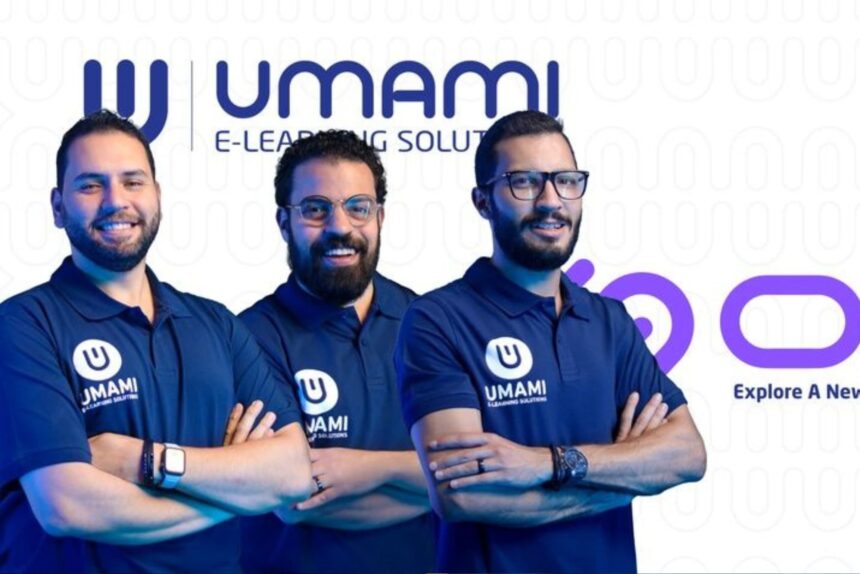
Egyptian EdTech company, UMAMI E-Learning Solutions has launched its Learning Operating System (LOS), an AI-powered digital infrastructure designed to help governments, educational institutions and enterprises connect learning, skills development, workforce readiness and organisational performance in one integrated system.
The launch is backed by a phased investment plan exceeding EGP50 million, equivalent to more than $1 million, as the company prepares to expand its learning infrastructure offering across Egypt and the wider Middle East and North Africa (MENA) region.
Founded in 2019 by Ahmed Seif El-Din, UMAMI has developed digital learning and workforce development solutions for institutions across more than 35 countries.
According to the company, LOS is designed to address a growing institutional challenge, organisations invest heavily in training but often lack the systems required to translate learning activities into measurable workforce and organisational outcomes.
What is UMAMI?
UMAMI E-Learning Solutions is an Egyptian education technology and workforce development company. The company develops digital solutions that enable governments, educational institutions and businesses to deliver learning and workforce development programmes at scale.
Instead of focusing exclusively on online course delivery, UMAMI positions itself around the broader challenge of developing human capability through technology.
The company says its experience supporting large-scale learning initiatives across more than 35 countries has exposed a recurring problem, institutions frequently invest significant resources in training without having a unified system capable of connecting learning with workforce outcomes.
This experience has informed the development of LOS, which represents the company’s move from delivering digital learning solutions toward providing the underlying infrastructure through which institutions can manage learning, skills and workforce development.
As CEO Ahmed Seif El-Din explained, “Launching LOS™ marks a defining milestone in our journey as we transition from delivering digital learning solutions to building intelligent learning infrastructure.”
The Services UMAMI Offers
UMAMI’s services centre on digital learning, workforce development and institutional capability building.
Its solutions are designed for a broad range of environments, including governments, ministries, formal education, healthcare, technical and vocational education and training (TVET), as well as corporate organisations.
Through its technology, the company seeks to help institutions move beyond simply making educational content available online toward understanding whether people are acquiring the capabilities required by their organisations and industries.
Its newly launched LOS expands this approach by bringing learning, skills, performance and decision-making into a connected ecosystem.
The platform is intended to integrate with different institutional frameworks, allowing organisations operating in different sectors to use a common infrastructure for managing learning and workforce development.
This makes UMAMI’s proposition broader than a conventional learning management system, as its objective is not only to administer courses but also to help institutions understand skill gaps, assess workforce readiness and make better-informed decisions about human-capital development.
Connecting Learning and Workforce Development
At the centre of UMAMI’s latest expansion is the Learning Operating System, or LOS, which the company describes as a “next-generation intelligent learning infrastructure” designed for governments, ministries and large-scale institutions across the MENA region.
The platform seeks to bring together several functions that are traditionally managed through separate systems. These include learning activities, skills development, performance measurement, workforce readiness and institutional decision-making.
In practical terms, LOS is designed to help an organisation understand not just whether employees or learners have completed training, but whether that training has translated into meaningful skills and improved capability.
The platform therefore seeks to create a continuous connection between learning and organisational outcomes. UMAMI compares the ambition of LOS to the role ERP systems play in business operations and CRM platforms play in customer management.
The company believes its system can similarly become an operating layer for human capability, connecting learning and skills data with workforce and institutional performance.
What the EGP50m+ Investment Will Fund
The launch of LOS is supported by a phased investment plan exceeding EGP50 million, or more than $1 million.
According to UMAMI, the funding will support the development and rollout of the new platform as the company expands its learning infrastructure operations across Egypt and the wider MENA region.
The investment comes at a time when organisations are increasingly looking for ways to measure the effectiveness of training and determine whether their workforce possesses the skills needed to respond to changing economic and technological demands.
For UMAMI, the funding represents an opportunity to develop LOS into a scalable infrastructure product capable of supporting institutions across multiple sectors and markets.
The company’s emphasis on national and regional scalability also suggests that the platform is being designed from the outset for large-scale institutional adoption rather than only individual learners.
By combining learning technologies with workforce and performance data, UMAMI aims to position LOS as a long-term infrastructure layer for organisations seeking to continuously develop their human capital.
UMAMI’s Recognition in African Ecosystem
The LOS launch follows two notable recognitions for UMAMI that could strengthen the company’s position as it enters its next phase of growth. The company recently became one of the first companies in Egypt to receive the official Startup Label Certificate under the country’s national Startup Charter.
The Charter is a state-recognised framework intended to strengthen Egypt’s technology and entrepreneurship ecosystem by identifying and supporting startups that meet national standards relating to innovation, technological reliance, scalability and investment readiness.
The initiative is aligned with Egypt’s Vision 2030 ambition of developing a knowledge-based and innovation-driven economy, with targets including supporting up to 5,000 startups, generating approximately 500,000 direct and indirect jobs, and increasing access to international markets.
Beyond Egypt, UMAMI was also named among the 2026 Top 100 Entrepreneurs in Africa by African Business Heroes, providing further recognition of its growing profile within Africa’s technology and entrepreneurship ecosystem.
Why UMAMI’s LOS Matters
The significance of LOS extends beyond the launch of another digital learning platform.
Across Africa and the wider MENA region, governments, educational institutions and businesses face a growing need to understand whether their investments in education and training are producing the skills required by changing economies.
Traditional learning management systems can show whether someone enrolled in or completed a course, but institutions increasingly need deeper answers about skills acquisition, workforce readiness and performance.
LOS seeks to address this gap by connecting these different dimensions within a single digital ecosystem. This could allow large organisations to identify skills shortages, better target training programmes and make decisions based on learning and workforce data.
For economies undergoing digital transformation, such infrastructure could also support more strategic approaches to human-capital development.
UMAMI says its broader objective is to help institutions respond to changing market demands while contributing to “digital transformation, educational excellence, and sustainable economic competitiveness.”
AI and the Future of Human Capability Development
UMAMI’s strategy reflects a wider shift in EdTech from simply digitising education toward using artificial intelligence and data to make learning more responsive to workforce needs.
By incorporating AI and intelligent architectures into LOS, the company wants institutions to move toward more data-driven approaches to developing human capability.
Not only treating training as an isolated activity, the system is designed to connect learning with skills, performance and organisational decision-making.
This approach could become increasingly important as employers and governments grapple with rapidly changing skill requirements driven by artificial intelligence, digitalisation and emerging technologies.
For UMAMI, the long-term ambition is to provide institutions with infrastructure capable of continuously identifying capability requirements and supporting targeted development.
“Our focus is on leveraging AI and intelligent architectures to fundamentally redefine how organizations and governments develop human capability across Egypt and the wider region,” Seif El-Din said.
This underscores the company’s ambition to position learning infrastructure as a strategic component of institutional and economic development.
_________________________
Bookmark Techparley.com for the most insightful technology news from the African continent.
Follow us on X/Twitter @Techparleynews, on Facebook at Techparley Africa, on LinkedIn at Techparley Africa, or on Instagram at Techparleynews