



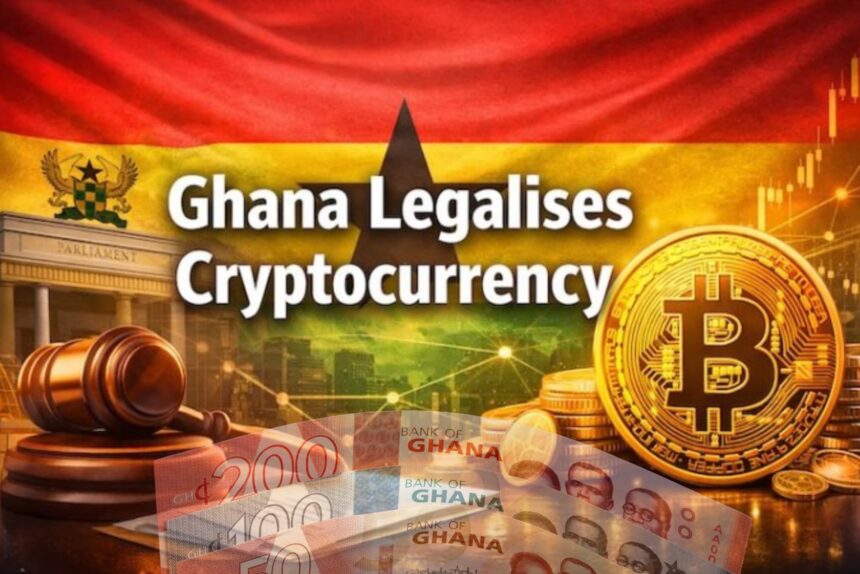
Ghana has taken a decisive step into the future of digital finance by formally legalising cryptocurrency through a newly enacted law, showing a major policy shift from caution to structured adoption.
The move places the country among a growing number of African states choosing regulation over restriction as digital assets continue to gain traction across the continent.
With this law, cryptocurrency activities in Ghana move from a legal grey area into a clearly defined regulatory environment, placing oversight under the Bank of Ghana while recognising the economic realities of widespread crypto usage.
Beyond legality, the policy reflects Ghana’s broader ambition to harness financial innovation, protect consumers, attract investment, and position itself as a regional leader in Africa’s evolving fintech ecosystem.
What You Should Know About Ghana’s Crypto Legal Action
At the heart of Ghana’s decision is a new legal framework that officially recognises cryptocurrencies and digital asset service providers as part of the country’s financial system.
Prior to this development, crypto usage was neither explicitly legal nor illegal, creating uncertainty for users, investors, and businesses.
While authorities had issued warnings about risks, millions of Ghanaians continued to trade and transact using digital assets for remittances, savings, and cross-border payments.
The new law changes this dynamic by assigning regulatory authority to the Bank of Ghana, which will now license, supervise, and monitor cryptocurrency exchanges, wallet providers, custodians, and other virtual asset service providers.
These entities will be required to comply with financial reporting standards, anti-money-laundering rules, and consumer protection measures.
In essence, Ghana is not merely allowing crypto, it is integrating it into its formal financial architecture with safeguards designed to balance innovation and stability.
Benefits for the Crypto Community and National Economic Growth
For Ghana’s crypto community, legalisation offers clarity, legitimacy, and protection. Individual users can now participate in digital asset markets without fear of regulatory backlash, while businesses gain the confidence to build crypto-related products and services within a recognised legal framework.
This clarity reduces the risks associated with scams, unregulated platforms, and opaque transactions that thrived under regulatory uncertainty.
From a national economic perspective, the law opens doors to new investment, job creation, and innovation. Regulated crypto platforms can attract both local and international capital, contributing to Ghana’s fintech growth and digital economy agenda.
The move also strengthens financial inclusion by supporting alternative payment systems and cross-border remittances, particularly for populations underserved by traditional banking.
By formalising crypto activity, the government can also improve oversight, data collection, and potential tax revenue from digital asset businesses operating within the law.
A Review of Crypto Adoption Across the African Continent
Ghana’s decision reflects a broader continental trend. Africa has emerged as one of the fastest-growing cryptocurrency markets globally, driven by currency volatility, high remittance costs, limited access to banking services, and a young, tech-savvy population.
Countries such as Nigeria, Kenya, South Africa, and Ghana have recorded significant peer-to-peer crypto activity despite regulatory hesitations.
However, African governments have adopted different approaches. Some have imposed strict restrictions or outright bans, while others have cautiously explored regulatory frameworks.
Ghana’s approach places it in the camp of countries recognising that crypto adoption is already a reality and that regulation, rather than prohibition, offers a more effective path to managing risks while unlocking benefits.
Why This Matters for Africa’s Digital and Economic Ecosystem
Ghana’s crypto legalisation carries implications far beyond its borders. It sends a strong signal to other African economies that structured regulation can coexist with innovation.
By choosing to regulate rather than suppress digital assets, Ghana positions itself as a potential hub for blockchain innovation, fintech startups, and digital finance research in West Africa.
For the broader African ecosystem, this move contributes to policy learning and regional momentum. It reinforces the idea that digital assets, when properly governed, can support economic resilience, financial inclusion, and cross-border trade.
As more African countries observe Ghana’s implementation, its success, or shortcomings, may shape future crypto regulations across the continent.
Talking Points
Ghana’s decision to legalise cryptocurrency is commendable and forward-looking, but its success will be measured less by legislative symbolism and more by regulatory execution.
In a region where policy announcements often outpace institutional capacity, the real test lies in how quickly and competently the Bank of Ghana can translate this law into clear, enforceable, and innovation-friendly rules.
Without transparent licensing processes, consistent supervision, and strong consumer protection mechanisms, the framework risks becoming either overly restrictive, stifling startups and discouraging investment, or too lax, exposing users to fraud and systemic risk.
Moreover, effective enforcement will require technical expertise, inter-agency coordination, and sustained political will, all of which are still developing across many African regulatory environments.
That said, Ghana’s choice to regulate rather than resist reflects a mature understanding of Africa’s digital realities and positions the country as a potential policy pacesetter on the continent.
If implementation is handled with balance and competence, this move could serve as a blueprint for responsible crypto governance in Africa; if not, it may reinforce skepticism about whether regulatory ambition can truly keep pace with technological change.
_____________________
Bookmark Techparley.com for the most insightful technology news from the African continent.
Follow us on X/Twitter @Techparleynews, on Facebook at Techparley Africa, on LinkedIn at Techparley Africa, or on Instagram at Techparleynews