



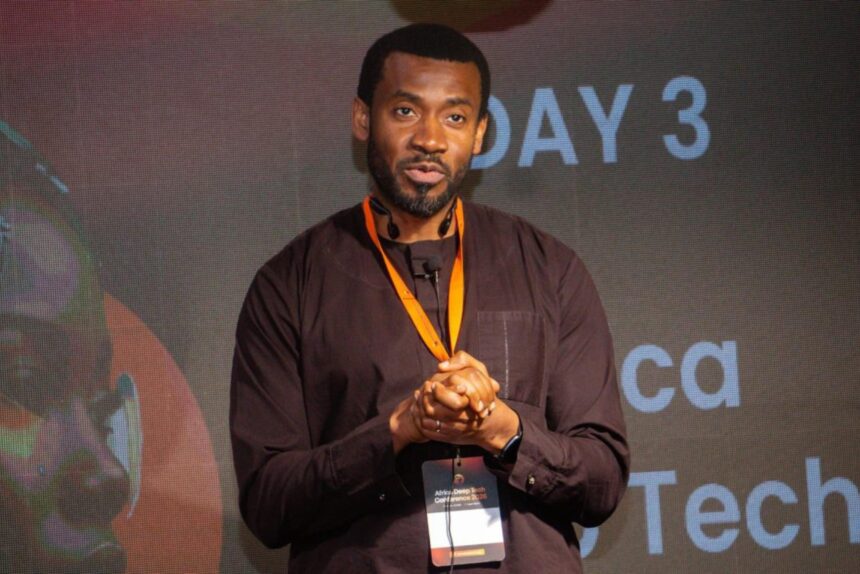
For Chukwuemeka Afigbo, the convener of the Africa Deep Tech Foundation (ADTF), the challenge facing Africa’s technologists is not a lack of ideas. It is the absence of structured pathways that allow those ideas to mature into world-class innovations.
Afigbo believes the continent’s deep tech future depends on building institutions capable of supporting long-horizon research and experimentation. His thesis is that if Africa builds even imperfect systems that connect talent, capital and infrastructure, deep tech innovation will follow.
Deep tech, in this context, refers to technologies rooted in fundamental scientific breakthroughs, complex engineering and original research, including artificial intelligence, advanced materials, robotics and biotechnology, rather than simply applying existing software tools.
That belief recently moved from theory to action when the foundation held its first in-person Africa Deep Tech Conference in Lagos on 25 February 2026, marking a public milestone for a network that had largely operated behind the scenes.
What you need to know
For nearly three years, the Africa Deep Tech Foundation functioned as a relatively discreet network of roughly 180 to 190 members spread across Africa and its global diaspora.
Members include engineers, investors, scientists, doctors, policymakers and entrepreneurs united by a single requirement: participants must be African and committed to advancing deep tech on the continent.
Until recently, most of the group’s engagement took place privately through discussions, mentorship sessions and collaborative exchanges.
“Even though the group is currently dominated by Nigerians, about 30–40% of our core members are non-Nigerian Africans in the diaspora. We hope to grow that share even further,” Afigbo told TechCabal.
The foundation began stepping into the public spotlight only in the past year, starting with an open webinar that offered outsiders a glimpse into its internal conversations.
Encouraged by strong interest, ADTF soon launched a continent-wide Innovation Challenge focused on solving structural barriers to deep tech development.
The infrastructure gap behind Africa’s AI ambitions
The foundation’s work addresses a broader structural problem confronting Africa’s technology ecosystem.
According to estimates from TechCabal Insights in 2025, artificial intelligence alone could contribute $1 trillion to Africa’s GDP by 2035. Yet only around 5% of African AI practitioners currently have access to high-performance computing infrastructure, such as GPUs and specialised hardware required for serious machine learning research.
In Nigeria, the challenge is particularly striking.
The country produces a large and youthful workforce, about 3.5 million young people enter the labour market annually, according to the World Economic Forum. Yet only about 11% of the workforce possesses advanced digital skills.
The result is a gap between technical talent and the systems required to transform that talent into globally competitive research-driven companies.
ADTF’s strategy is to close this gap by linking engineers with scientists, founders with regulators, and early-stage builders with mentors and peers capable of sustaining long-term innovation.
From idea to prototype
One of the foundation’s first public initiatives was its Innovation Challenge, which attracted over 2,000 registered participants from 14 African countries.
From that pool, organisers reviewed roughly 350 high-quality submissions, eventually narrowing them to 60 shortlisted entries.
After additional evaluation and mentorship, 16 semi-finalists advanced to a second stage before the field was reduced to eight finalists, who pitched their ideas live.
Four winners ultimately emerged.
The total prize pool amounted to $20,000, a modest figure compared with venture funding rounds.
But Afigbo insists the prize money was never the primary objective.
Africa’s deep tech bottleneck, he argues, often lies in what he calls “survival capital”, small amounts of funding that help innovators move from prototype to early validation.
In practical terms, that transition can be decisive. A concept may cost only a few dollars to sketch out, a prototype perhaps hundreds. But building a minimum viable product (MVP) may require tens of thousands of dollars.
Many innovators abandon their ideas during this stage when financial pressures push them toward stable employment.
Regulatory interest and ecosystem momentum
Government institutions are also beginning to show interest in the foundation’s work. Representatives from the Nigerian Communications Commission signalled openness to deeper collaboration, noting that discussions around emerging technologies remain fragmented.
The National Information Technology Development Agency has requested a formal proposal for review, while Galaxy Backbone has expressed interest in artificial intelligence partnerships.
For Afigbo, regulatory imperfection should not be viewed as an obstacle.
He points to the evolution of Africa’s fintech sector, which expanded rapidly despite initial regulatory uncertainty and operational risks.
A long-term vision
Afigbo currently continues to work in Silicon Valley as Senior Director of Developer Success at Okta, a role that helps him connect African innovators with global technology ecosystems.
The Africa Deep Tech Foundation itself operates as a fully registered non-profit supported by volunteers and collaborators across multiple countries.
Its focus remains on early-stage deep tech talent, particularly individuals working to transform prototypes into viable products.
Several companies have already benefited directly or indirectly from its programmes, including Terra Industries, Cure Bionics, StriveEV, FarmSpeak Technologies and Ascendance EV.
For Afigbo, the foundation’s immediate goal is to identify the continent’s most determined innovators and ensure they do not disappear into the margins of the technology workforce.
Talking Points
Chukwuemeka Afigbo and the Africa Deep Tech Foundation are addressing a key structural challenge in Africa’s technology ecosystem: while talent exists, pathways to transform ideas into globally competitive deep tech are scarce.
The Foundation’s approach is practical and systemic. By connecting engineers with scientists, founders with regulators, and early-stage builders with mentors and peer networks, ADTF is building infrastructure around innovation, rather than expecting talent to navigate the system alone.
At Techparley, we see this model as a blueprint for enabling early-stage deep tech ecosystems across the continent. Extending mentorship, small-scale funding, and peer accountability can carry innovators from prototype to minimal viable product (MVP), bridging the critical “survival capital” gap.
The Foundation also leverages Africa’s cost efficiency. A modest investment can support multiple high-quality researchers for the same amount that would fund a single researcher in Silicon Valley, making Africa uniquely positioned to scale deep tech talent if the right structures are in place.
With the right combination of guidance, community, and strategic support, the Foundation has the potential to transform how African innovators navigate the journey from idea to global impact.
——————-
Bookmark Techparley.com for the most insightful technology news from the African continent.
Follow us on Twitter @Techparleynews, on Facebook at Techparley Africa, on LinkedIn at Techparley Africa, or on Instagram at Techparleynews.