


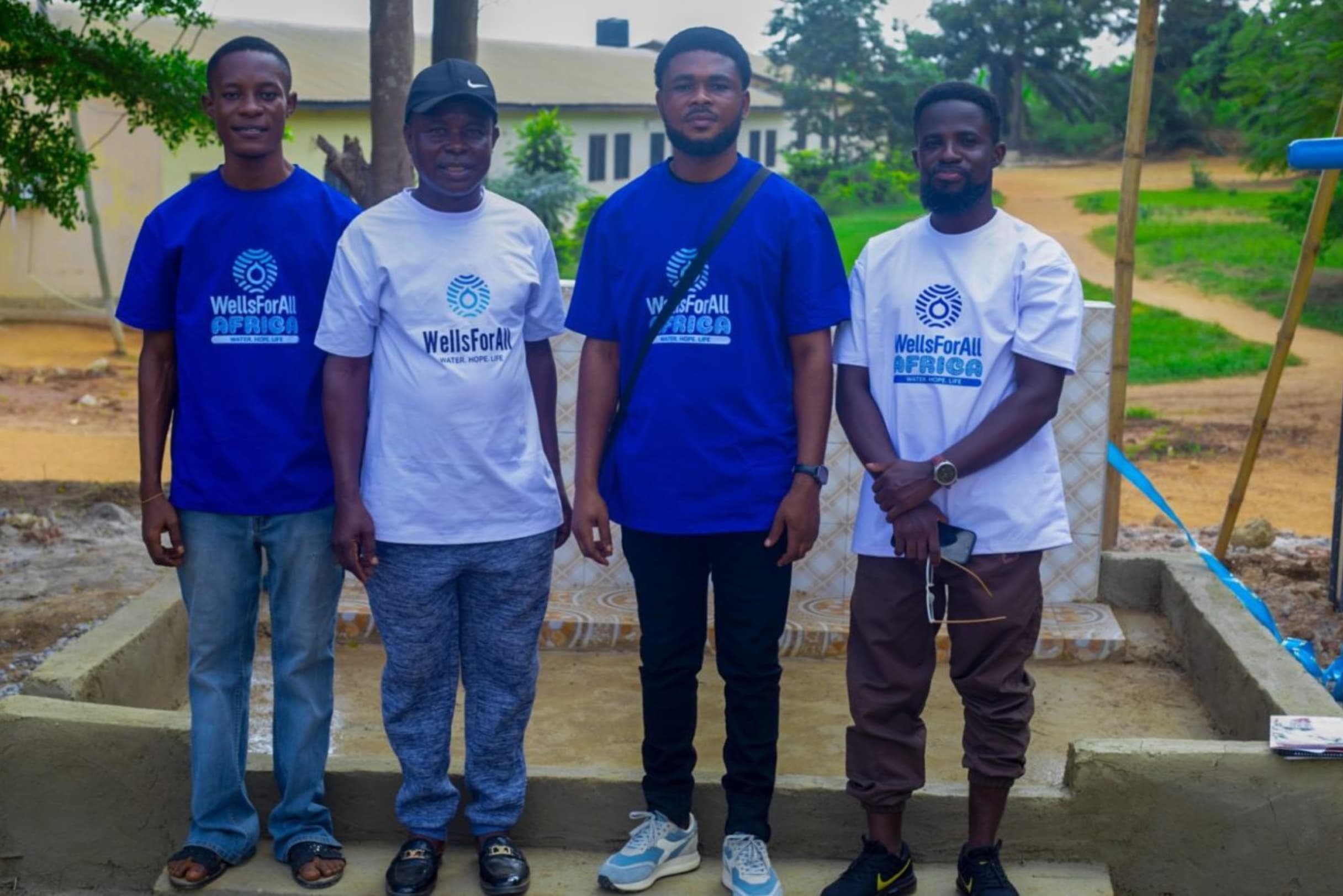
Access to clean and safe drinking water remains a pressing challenge for millions of people living in underserved rural communities across Africa. In 2025, Ghana-based social impact organisation WellsForAll took a decisive step toward addressing this crisis by completing 25 mechanised boreholes.
The organisation is delivering sustainable water access to thousands of people through an innovative, transparent funding model.
Backed by US$150,000 in community-governed financing enabled by blockchain technology, the initiative not only tackled immediate water shortages but also demonstrated how digital accountability tools can drive measurable social impact.
According to the organisation, the intervention led to a 40 per cent reduction in waterborne diseases and up to a 60 per cent increase in school attendance for girls, underscoring how access to clean water directly improves health outcomes, education, and quality of life.
As founder Samuel Owusu-Boadi noted, the milestone represents “more than numbers , they represent healthier families, children staying in school, and communities with dignity.”
Delivering Sustainable Water Infrastructure to Rural Communities
At the core of WellsForAll’s work is the delivery of mechanised boreholes designed to provide reliable, long-term access to clean drinking water.
Unlike temporary water interventions, these boreholes are built with sustainability in mind, covering not just construction but also commissioning and long-term operational support.
The organisation’s 2025 project focused on rural and underserved communities where access to potable water is either unreliable or completely absent.
By prioritising durability and maintenance, WellsForAll aims to ensure that communities do not return to unsafe water sources after short-term aid expires, addressing a long-standing weakness in many water access programmes across the continent.
Measurable Health and Education Impact
Beyond infrastructure, WellsForAll’s intervention has produced clear, measurable social outcomes.
Communities served by the newly completed boreholes recorded a 40 per cent reduction in waterborne diseases, highlighting the direct link between safe water access and improved public health.
Equally significant is the impact on education, particularly for girls. With clean water now available closer to home, school attendance for girls improved by up to 60 per cent, reflecting how reduced time spent fetching water translates into better educational participation.
These outcomes illustrate how water access acts as a foundation for broader social development, influencing health, gender equity, and long-term human capital.
Community-Governed Funding Through Blockchain Technology
A defining feature of the WellsForAll model is its use of blockchain-enabled, community-governed funding, specifically through the Hive blockchain’s Decentralized Hive Fund (DHF).
Rather than relying on a small group of donors or opaque funding structures, the DHF allows Hive stakeholders to collectively propose, vote on, and fund real-world projects.
This process creates what the organisation describes as “an auditable and transparent funding pipeline that ensures capital is aligned with measurable outcomes.”
By decentralising decision-making, the model gives a global community a direct role in supporting social impact initiatives while maintaining clear records of how funds are approved and deployed.
Blockchain as Accountability Infrastructure, Not a Buzzword
WellsForAll is careful to distinguish its approach from projects that adopt blockchain primarily as a fundraising novelty. Instead, the organisation positions blockchain as accountability infrastructure, designed to provide visibility into both fund allocation and on-the-ground impact.
Through the transparent nature of the blockchain ledger, stakeholders can trace how resources move from approval to implementation, reducing the risk of mismanagement and increasing trust.
This approach reframes blockchain from a speculative or abstract technology into a practical governance tool for development finance, particularly in sectors where transparency has historically been a challenge.
Prioritising Long-Term Sustainability Over Short-Term Charity
According to founder Samuel Owusu-Boadi, what sets the 2025 milestone apart is not just the number of boreholes delivered, but the values underpinning the project.
“What makes this milestone especially meaningful is that it was achieved through a transparent, community-driven funding model that prioritises long-term sustainability over short-term charity,” he said.
This philosophy reflects a growing shift in development practice, where success is measured not only by immediate outputs but by durability, community ownership, and lasting social change.
By combining sustainable infrastructure with transparent funding governance, WellsForAll is positioning itself as a model for how technology and community participation can reshape development outcomes across Africa.
A Scalable Model for Development Across Africa
As water insecurity continues to affect rural populations across the continent, WellsForAll’s approach offers a scalable blueprint for future interventions.
The combination of measurable impact, community governance, and transparent financing provides a compelling case for how social enterprises can leverage digital tools to solve entrenched development challenges.
With health improvements, increased school attendance, and restored dignity for communities at the centre of its mission, WellsForAll’s 2025 achievement signals a future where clean water delivery is not only effective but also accountable and community-led.
Talking Points
WellsForAll’s intervention stands out not just for delivering clean water infrastructure, but for how it challenges persistent weaknesses in traditional development funding, particularly opacity, donor dominance, and short-termism.
Using blockchain-enabled, community-governed financing, the organisation introduces a higher level of transparency and shared accountability, ensuring that funding decisions are tied to verifiable outcomes rather than goodwill alone.
The reported reductions in waterborne diseases and improved school attendance for girls suggest that the model is translating into real social value, not merely technological experimentation.
However, while the approach is promising, its long-term success depends on sustained community capacity to maintain the boreholes and on whether blockchain governance can remain accessible to local stakeholders who may not be digitally literate.
Without deliberate efforts to bridge this gap, there is a risk that decision-making remains effectively remote, despite its decentralised label.
Nonetheless, as an accountability tool rather than a fundraising gimmick, WellsForAll’s model offers a credible and potentially scalable framework for aligning development finance with transparency, impact measurement, and long-term sustainability.
________________________
Bookmark Techparley.com for the most insightful technology news from the African continent.
Follow us on X/Twitter @Techparleynews, on Facebook at Techparley Africa, on LinkedIn at Techparley Africa, or on Instagram at Techparleynews