Marriage has always lived between two loud extremes. For some, it is a romantic reward system, find love, perform commitment, and happiness will follow. For others, it is outdated, restrictive, or quietly oppressive, an institution to endure or escape.
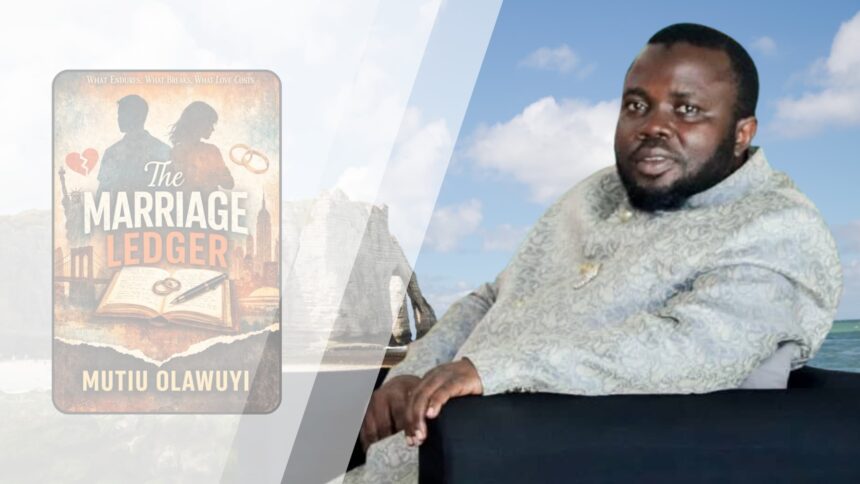
Between idealization and abandonment, endurance and abrupt exit, couples across cultures are left navigating intimacy without language, repair without training, and conflict without literacy. Into this global confusion steps Mutiu Olawuyi’s The Marriage Ledger. It is a documentary-fictional exploration of modern marriage that refuses both fantasy and cynicism.
What more? It instead offers what the author calls “restorative realism”, a bold intellectual and literary framework that insists on clarity over comfort and repair over moral posturing.
Describing himself as a “restorative realist,” Olawuyi explains that his work rejects both romantic illusion and corrosive despair.
“Restorative realism rejects romantic idealism that sanitizes marriage and also rejects cynical narratives that treat commitment as ‘naïveté’ or oppression,” he says. “It focuses on consequences, repair, and ethical responsibility.”
The result is not advice literature, nor propaganda, but a carefully constructed narrative ecosystem that interrogates power, silence, emotional debt, and structural pressure inside contemporary unions.
A Literary Intervention, Not Therapy
Unlike traditional relationship books, The Marriage Ledger does not ask readers to choose between staying or leaving. Instead, it slows the conversation down.
“I wrote this novel out of fatigue, moral fatigue,” Olawuyi admits. “Fatigue with how dishonestly we talk about marriage.”
In a world shaped by social media performance, cultural scripts, and ideological extremes, the author argues that real marriages collapse not because of hatred, but because of misunderstanding and emotional illiteracy.
“Love is not the problem in most marriages. The absence of emotional education is.”
This author’s authoritative stance elevates the book beyond fiction. It becomes a cultural intervention, one grounded in sociology, ethics, and institutional critique rather than sentimental narrative.
Accounting (Ledger) for What Couples Refuse to Name
The book’s title is neither decorative nor metaphorical in a shallow sense. It is diagnostic.
“The ledger represents what marriage always keeps, even when couples pretend it doesn’t,” Olawuyi explains. “Every marriage keeps accounts, of labor, sacrifice, silence, forgiveness, resentment, unmet needs, emotional debt.”
He offers one of the most striking lines in the book’s conceptual framing: “The ledger doesn’t punish; it records.”
What many couples describe as sudden collapse, he argues, is merely accumulated imbalance finally surfacing.
“What people often experience as ‘sudden collapse’ is usually delayed accounting.”
In this framing, marriage becomes less about dramatic betrayal and more about slow erosion, unspoken truths quietly adding up.
Love and Power: The Myth of Neutral Affection
Perhaps the book’s most provocative assertion is that love does not neutralize power. It often conceals it.
“Love is never power-free,” Olawuyi states. “Power enters marriage through money, language, religion, immigration status, gender expectations, emotional withdrawal, even silence.”
In The Marriage Ledger, the partner with endurance is often praised as virtuous, while the one who speaks is labeled difficult. Needs are prioritized unevenly. Exhaustion is normalized for some and acknowledged for others. Dissatisfaction is pathologized or spiritualized depending on who expresses it.
By interrogating these subtle hierarchies, Olawuyi reframes marriage as an institutional space shaped by economics, belief systems, and social conditioning, not merely romance.
New York as Social Laboratory
Set across New York City’s boroughs, the novel treats geography as structural force rather than background decoration. Each borough therefore becomes a symbolic ecosystem.
“The Bronx teaches survival. Manhattan rewards performance. Queens demands negotiation. Brooklyn elevates ideology. Staten Island hides endurance.”
Marriage, the author insists, does not happen in isolation. “It happens inside economies, migration systems, housing stress, professional cultures, and moral communities.”
In this way, New York becomes an amplified version of global urban life, making visible the pressures that shape private intimacy all across the world.
From Blame to Emotional Education
Rather than pointing fingers across actors in the private intimacy ventures, the author believes the innocent-like nature of partners in marriage, even to the detrimental level of the marriage they seem to hold dear .
Olawuyi resists villain narratives. “Moral judgment is cheap and often lazy,” he says. His characters are not monsters but “under-skilled people operating under intense structural and emotional pressure.”
The central question of the book is not “Who is bad?” but “What was never taught?” What surprised him most during the writing process was how rarely malice drives failure.
“Most marriages fail not from hatred, but from fear, fear of speaking, fear of needing, fear of destabilizing what little security exists.”
And perhaps most sobering, “How deeply children feel everything, even when adults insist they don’t.”
Meet Mutiu Olawuyi
Mutiu Olawuyi is a restorative realist, communication and PR strategist, media manager, social entrepreneur, creative writer, academic, and independent researcher. His works have consistently interrogate power, intimacy, belief, and social institutions.
Positioned at the intersection of narrative craft and critical theory, Olawuyi is not merely a novelist but a literary inventor whose ideas extend into frameworks such as Restorative Realism, DUP-Centric Curriculum theory, and ECOPEACE Learning Theory.
His previous works, including Veil of Rescue, A City on Trial, The Shadow of the Giant, and The Blotted Pawpaw, represent a bold experiment in form and silence. He reflects, professionally, a sustained commitment to examining how private relationships are shaped by public systems.
Drawing from his background in media, peace advocacy, education, and public discourse, Olawuyi approaches storytelling as both artistic expression and social inquiry, advancing a constructivist vision grounded in truth, human dignity, and emotional accountability.
Talking Points
The Marriage Ledger is a disciplined and intellectually ambitious work that resists the temptation to flatter its reader.
Rather than dramatizing marriage through scandal or sentimentality, Mutiu Olawuyi constructs a steady, almost forensic exploration of emotional debt, power imbalance, and inherited relational illiteracy.
What makes the book compelling is not plot theatrics, but its conceptual clarity, the idea that “the ledger doesn’t punish; it records” reframes marital breakdown as accumulated silence rather than sudden catastrophe.
At times, the philosophical density may demand patience from readers expecting lighter narrative pacing, but that density is also its strength; it treats marriage as an institution shaped by economics, belief systems, migration, and fear, not merely feeling.
Personally, I find the novel’s refusal to moralize refreshing. It neither condemns nor excuses its characters, instead asking the more unsettling question, what were they never taught?
In a literary climate saturated with either romantic fantasy or cynical dismissal, The Marriage Ledger stands out as a sober, necessary contribution, less a love story and more an ethical audit of intimacy in modern society.
_______________________
Bookmark Techparley.com for the most insightful technology news from the African continent.
Follow us on X/Twitter @Techparleynews, on Facebook at Techparley Africa, on LinkedIn at Techparley Africa, or on Instagram at Techparleynews