

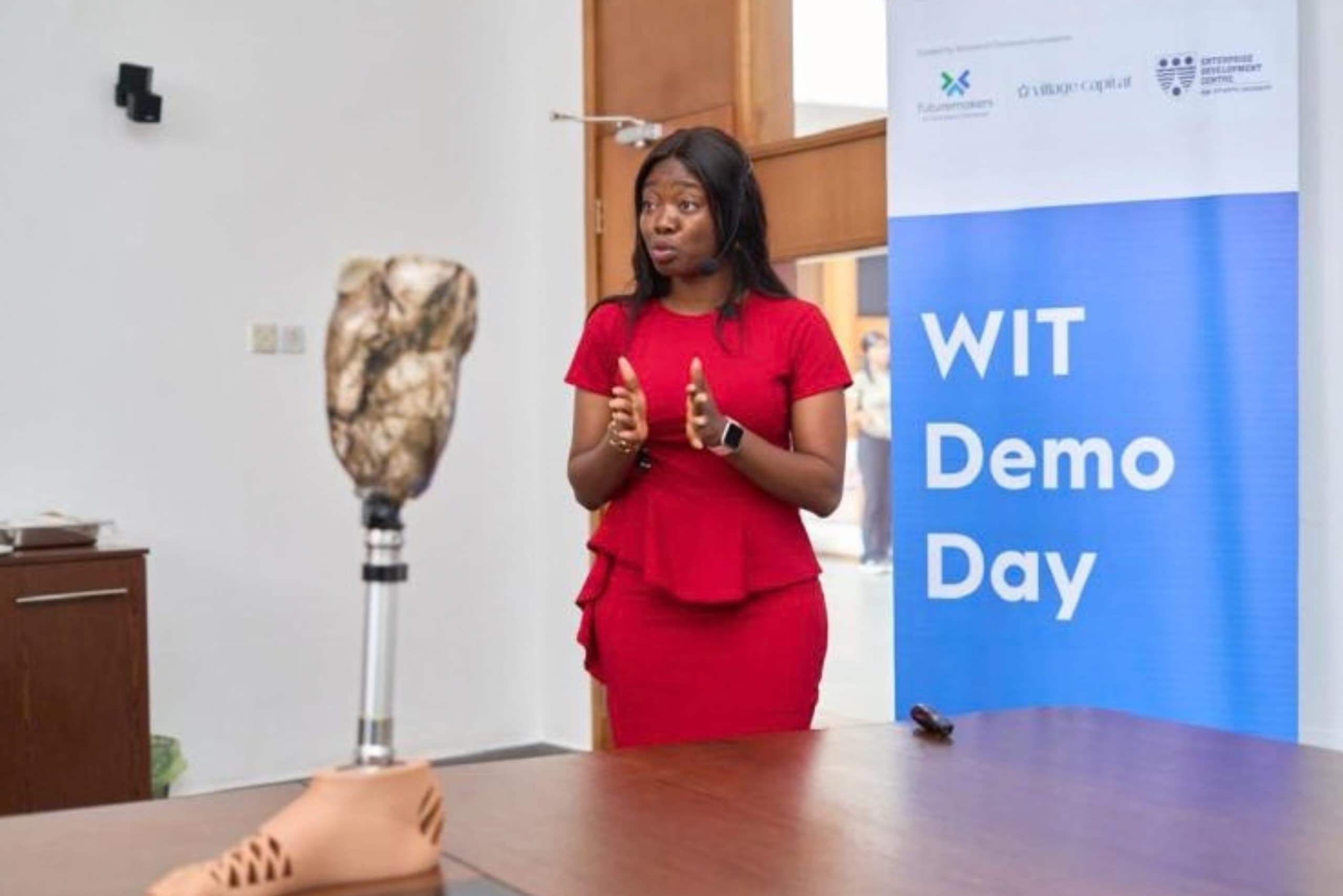
Nigerian health-tech startup Dynalimb Technologies is using 3D technology, digital healthcare tools and clinical expertise to tackle longstanding challenges surrounding access to prosthetic, orthotic and rehabilitation services across Africa.
The company was founded by professionals with more than 25 years of combined experience in prosthetics and orthotics. It seeks to reduce the cost and waiting time associated with mobility devices while improving the wider patient-care experience.
Its co-founder and COO, Blessing Akinsanya Aniefiok, said the company’s mission was shaped by both personal experience and challenges observed in clinical practice.
“Limb loss is not simply about losing a body part. It affects someone’s ability to work, care for their family, participate in society and live independently,” she said.
Dynalimb says it has now served more than 1,000 patients while developing a broader digital mobility-care infrastructure for Africa.
What is Dynalimb and What Does It Do?
Dynalimb Technologies is a Nigerian technology-enabled mobility company combining medical expertise with 3D manufacturing and digital healthcare infrastructure.
Its work focuses primarily on three connected areas, producing 3D-printed prosthetic and orthotic devices, developing its DynaX digital platform, and providing clinical services through trained prosthetists and orthotists.
The company says 3D manufacturing can reduce some of the time, cost and complexity associated with conventional production methods.
According to Aniefiok, a basic traditional prosthetic device in Nigeria can cost more than N1.6 million and take approximately four to six weeks to produce, while Dynalimb’s average device costs about N800,000 and can be delivered in around seven days, depending on the device and clinical requirements.
Beyond manufacturing, the startup is building technology to connect assessment, design, production, rehabilitation and follow-up care.
What Problem is Dynalimb Trying to Solve?
Dynalimb is responding to a major gap in access to prosthetic, orthotic and rehabilitation services across Africa.
The company estimates that more than 30 million people on the continent need such services, yet many struggle to obtain them because of high costs, long production periods, limited numbers of trained professionals and the concentration of specialist services in relatively few locations.
Patients can also encounter inefficient administrative and clinical processes, including manual measurements, plaster or POP casting, paper records and fragmented communication between healthcare professionals.
“Our team saw first-hand how difficult access to prosthetic and orthotic care could be,” Aniefiok said.
Further explained that some patients encountered during clinical practice had to wait weeks or months for devices.
Dynalimb is therefore attempting to address not only the price of mobility devices, but also the wider inefficiencies that can delay patients’ treatment and rehabilitation.
Changing Prosthetic Manufacturing with Technology
At the centre of Dynalimb’s approach is the use of 3D technology to rethink how prosthetic and orthotic devices are designed and manufactured.
When the founders began exploring the technology, they encountered a Nigerian market with limited local reference materials and little established infrastructure for applying 3D systems to prosthetics and orthotics.
Much of their early work consequently involved experimenting and developing their own processes. The result is a model that uses digital measurement, scanning and 3D manufacturing to reduce some of the traditional barriers associated with producing mobility devices.
The company says its average prosthetic device costs approximately N800,000 and can be delivered in about seven days, compared with more than N1.6 million and four to six weeks for a traditional basic device.
However, Dynalimb stresses that clinical requirements still determine the appropriate device and production process for each patient.
Building a Digital Infrastructure for Mobility Care
Beyond physical devices, Dynalimb is developing DynaX, a digital platform designed to connect different stages of prosthetic, orthotic and rehabilitation care.
The platform brings together tools for digital measurement and scanning, patient management, virtual clinical collaboration, therapy support and other parts of the patient journey.
Its purpose is to reduce dependence on fragmented systems that can make healthcare delivery slower and more difficult to coordinate.
Aniefiok identified manual processes such as plaster or POP casting, paper-based records and fragmented communication as some of the challenges the platform seeks to address.
“Our long-term vision is for DynaX to become infrastructure that connects the different stages of mobility care from assessment and measurement through device design, manufacturing, rehabilitation and follow-up,” she said.
This makes Dynalimb’s ambition broader than producing artificial limbs; it is seeking to create a connected digital ecosystem around mobility care.
The Journey From Personal Experience
Dynalimb’s development is closely linked to Aniefiok’s personal experience with limb loss and the founders’ professional exposure to patients requiring mobility support.
The COO, Aniefiok said seeing her aunt experience limb loss related to diabetes helped her understand the wider social and economic consequences of mobility challenges.
That experience reinforced what she and her colleagues were witnessing in clinical environments, where patients faced significant barriers to obtaining appropriate devices and rehabilitation services.
The company says that its response has now reached more than 1,000 patients, including individuals and healthcare institutions. It has also attracted growing interest from hospitals seeking to improve the way they provide prosthetic, orthotic and rehabilitation services.
“Ultimately, we are not simply trying to manufacture cheaper prosthetic devices,” Aniefiok said. “We want to make the entire mobility-care journey more accessible, efficient and dignified.”
Funding, Partnerships and the African Expansion Plans
Like many early-stage healthcare hardware companies, Dynalimb faces the challenge of raising enough capital to invest in equipment, technology, people and product development while keeping its services affordable.
The company has therefore relied primarily on founder-led growth, grants and startup programmes during its early stages.
Its participation in the Standard Chartered Foundation’s Women in Tech Accelerator, implemented locally by the Enterprise Development Centre with support from Village Capital, provided funding as well as mentorship, networks, visibility and business support.
Dynalimb currently regards Nigeria as its primary market and plans to strengthen partnerships with healthcare institutions while expanding its operational capacity in Lagos, Abuja, Port Harcourt and Kano.
Beyond Nigeria, the company is exploring markets including Ghana, Kenya and Rwanda.
Aniefiok said Dynalimb does not intend to simply export products, but wants to “build local partnerships and adapt our technology and service model to each market,” with the long-term goal of developing scalable African mobility-care infrastructure.
________________________
Bookmark Techparley.com for the most insightful technology news from the African continent.
Follow us on X/Twitter @Techparleynews, on Facebook at Techparley Africa, on LinkedIn at Techparley Africa, or on Instagram at Techparleynews

