



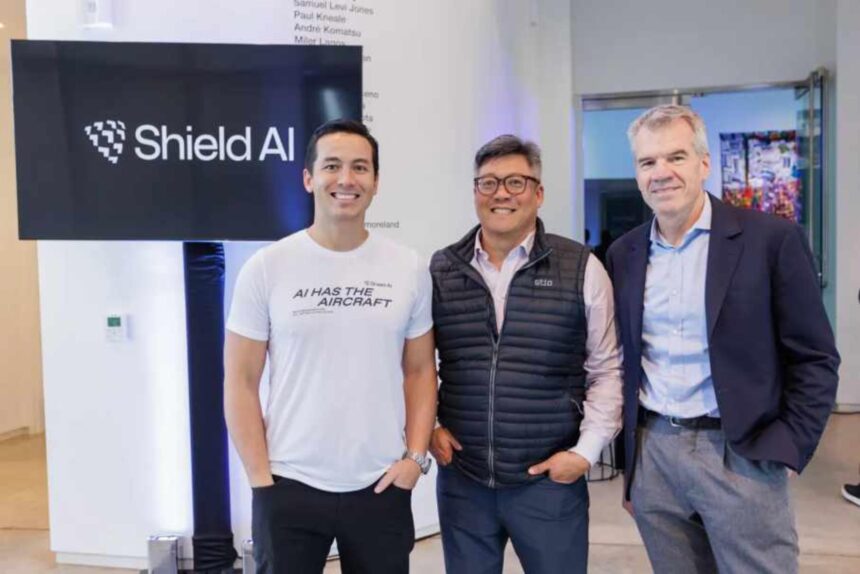
Shield AI is raising fresh capital at a pivotal moment for global defence, as software increasingly defines how military power is built, deployed, and sustained.
Founded by former US Navy SEAL Brandon Tseng, alongside Ryan Tseng and Andrew Reiter, the San Diego-based defence technology company has announced plans to raise $1.5 billion in Series G funding at a $12.7 billion post-money valuation.
The round is accompanied by an additional $500 million in fixed-return preferred equity financing, marking one of the largest capital raises in the autonomy-driven defence sector.
The investment is led by Advent International and co-led by JPMorganChase’s Strategic Investment Group under its Security and Resiliency Initiative. Existing investors, including Snowpoint Ventures, InnovationX, Riot Ventures, Disruptive, and Apandion are also participating.
“The acquisition of Aechelon will accelerate the work we are doing with Hivemind, particularly in simulation like the Department of War’s JSE (Joint Simulation Environment),” Shield AI CEO Gary Steele said in a statement.
What You Need to Know
Meanwhile, funds managed by Blackstone are committing $500 million in preferred equity, alongside a $250 million delayed draw facility, bringing the total potential backing to $750 million.
As part of the deal, Advent Chairman David Mussafer will join Shield AI’s board, with Todd Combs appointed as a board observer, moves that reinforce institutional confidence in the company’s trajectory.
Shield AI has built its business around precisely this challenge.
Its flagship software, Hivemind, enables drones and aircraft to execute missions in contested environments where traditional systems often fail.
The platform has already been tested on F-16 fighter jets and integrated into the US Air Force’s Collaborative Combat Aircraft programme, placing the company at the heart of some of the Pentagon’s most closely watched initiatives.
Bridging Autonomy and Simulation
A significant portion of the new capital will be used to acquire Aechelon Technology, a portfolio company of Sagewind Capital known for its advanced simulation tools.
Aechelon specialises in high-fidelity simulation, physics-based sensors, and synthetic environments used by the US military and allied forces. The acquisition is expected to strengthen Shield AI’s ability to test and refine autonomous systems in realistic digital scenarios.
The Joint Simulation Environment plays a critical role in modern defence development, enabling military teams to test aircraft, autonomous platforms, and tactics in highly realistic virtual conditions before real-world deployment.
By integrating simulation more tightly with autonomy, Shield AI aims to shorten the feedback loop between training, testing, and operational execution.
Conflict Driving Demand for Intelligent Systems
Recent conflicts in Ukraine and the Middle East have accelerated demand for autonomous systems capable of operating in unpredictable and high-pressure environments.
In such conditions, where infrastructure is often degraded or non-existent, software becomes the decisive layer, determining how systems adapt, respond, and survive.
Defence contractors and government agencies are increasingly prioritising this software layer, shifting focus from purely hardware-led capabilities to integrated, intelligent systems.
Shield AI’s rapid rise reflects this trend. As recently as January 2025, the company was reportedly exploring a $200 million funding round at a $5 billion valuation. Its latest raise more than doubles that figure in just over a year.
From Special Operations Roots to Global Defence Player
Shield’s technologies are already deployed by both the United States and Ukrainian governments, placing the company in live operational environments rather than controlled test settings.
This real-world exposure has helped position Shield AI as a key player in the next phase of defence innovation.
Experts say what is unfolding around Shield AI reflects a broader shift across the defence landscape. While hardware remains essential, it is increasingly software that determines effectiveness on the battlefield.
With fresh capital and a strategic push into high-fidelity simulation, Shield AI is positioning itself at the centre of this transformation, where autonomy, software, and modern warfare converge.
Talking Points
It is significant that Shield AI is raising capital at a time when software is becoming the defining layer of modern military power, shifting the focus from traditional hardware to intelligent, autonomous systems.
This funding round not only reflects investor confidence but also highlights a broader transformation in defence, where the ability to operate in contested environments without GPS or constant communication is becoming critical.
At Techparley, we see this as a clear signal that autonomy is no longer theoretical, it is actively shaping how wars are fought and how defence systems are designed and deployed.
Shield AI’s Hivemind platform stands out for its ability to enable drones and aircraft to execute missions independently, addressing one of the most pressing challenges in modern warfare: resilience in disrupted and high-risk environments.
The planned acquisition of Aechelon Technology also strengthens the company’s position, particularly in combining high-fidelity simulation with autonomy. This integration is crucial, as it allows for faster testing, iteration, and deployment of systems in realistic scenarios.
As Shield AI scales, strategic partnerships with governments and defence institutions will be key to sustaining momentum and expanding its influence. With the right execution, the company is well-positioned to play a central role in defining the future of autonomous defence systems.
——————-
Bookmark Techparley.com for the most insightful technology news from the African continent.
Follow us on Twitter @Techparleynews, on Facebook at Techparley Africa, on LinkedIn at Techparley Africa, or on Instagram at Techparleynews.