



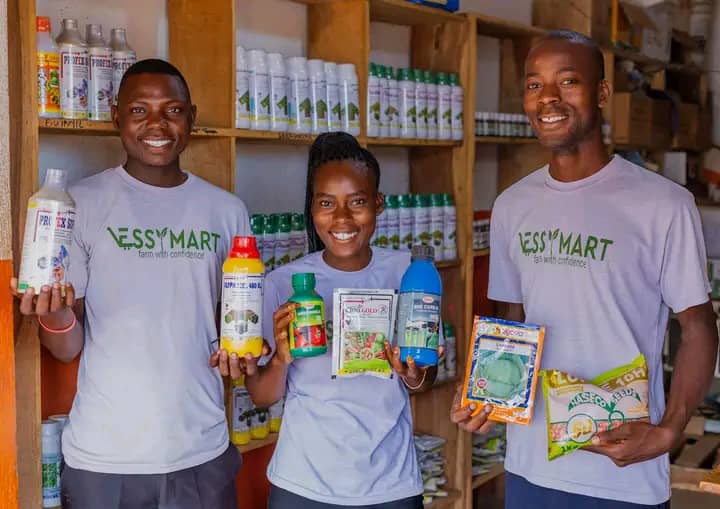
Small-scale farmers in Uganda form the backbone of food production yet remain among the most economically vulnerable, this Ugandan agri-tech startup Essymart is emerging as a transformative force to solve this problem.
Founded in 2022, the startup is tackling hunger and extreme poverty among farming families by delivering an all-in-one support system that combines financing, quality farm inputs, agricultural training, technology, and post-harvest market access.
By working directly with farmers, many of them in remote rural areas, Essymart says it is helping households significantly boost productivity and income, with farmers who join its programme recording income increases of between 40 and 45 per cent.
“Farmers who join our programme typically see a 40–45 per cent increase in their incomes on the crops, fruit trees, vegetables and other products we support by the use of WebApp, SMS and voice calls,” founder Elvis Kadhama told Disrupt Africa.
From serving just a few dozen farmers at launch, Essymart has rapidly expanded to reach thousands across Eastern Uganda, positioning itself not merely as a supplier of farm products but as a farmer-centred ecosystem designed to move families onto a sustainable path out of poverty.
What You Should Know About Essymart
Essymart was founded in 2022 by Elvis Kadhama, Viola Nakadama, and Stella Doreen Namulondo with a clear mission, to improve food security and incomes for smallholder farmers by addressing the full range of challenges they face.
Rather than offering complicated solutions, the startup delivers a bundled package of services that target every stage of the farming cycle.
These services include access to high-quality seeds, fertilisers, and pesticides; training in modern and efficient farming practices; financing to help farmers afford inputs at the right time; and post-harvest support that connects farmers to markets.
According to the company, it is this integrated approach that enables farmers to increase yields and generate more reliable income from their land, allowing families to begin “paths to prosperity.”
Essymart currently serves over 5,000 farmers across districts such as Mayuge, Iganga, Bugiri, Namayingo, Kaliro, and Bugweri, focusing on regions where access to agricultural support services is often limited.
How Essymart Operates
At the heart of Essymart’s model is direct engagement with farmers, supported by simple but effective technology.
The startup uses a combination of web applications, SMS, and voice calls to communicate with farmers, provide guidance, and monitor progress, ensuring that even those without smartphones or constant internet access can benefit.
Beyond technology, Essymart maintains an on-the-ground presence, working closely with farming communities to understand their needs and tailor support accordingly.
This hybrid approach, blending digital tools with physical engagement, allows the startup to build trust and deliver services effectively, even in hard-to-reach rural areas.
Crucially, Essymart does not position itself as just another agricultural input vendor.
Instead, it focuses on building what it describes as a farmer-centred ecosystem, supporting farmers before planting, during cultivation, and after harvest to ensure improved outcomes across the entire value chain.
Measurable Impact on Farmer Incomes and Productivity
The results, according to Essymart, have been significant. Farmers enrolled in its programme typically experience a 40–45 per cent increase in income from supported crops, fruits, vegetables, and other agricultural products.
This increase is driven by better yields, improved farming practices, and stronger access to markets.
“Farmers who join our programme typically see a 40–45 per cent increase in their incomes,” Kadhama said, highlighting the role of training, financing, and digital communication in achieving these gains.
By helping farmers grow more food and sell it more profitably, Essymart contributes not only to household income stability but also to broader goals of food security and rural economic resilience.
Funding, Partnerships, and Rapid Growth
While Essymart is primarily self-funded, it has also attracted external support in the form of grants from organisations including the Sahara Impact Fund, the Tony Elumelu Foundation (TEF), and the Alliance for Green Revolution in Africa (AGRA).
These grants have played a key role in accelerating adoption among smallholder farmers.
Since launching in 2022 with just a few dozen farmers, Essymart’s reach has grown rapidly. By 2024, the startup had served about 4,000 farmers, representing a 20 per cent increase over the previous year.
“By 2024 we had served about 4,000 farmers, a roughly 20 per cent increase over the prior year, and were nearing our 2030 goal of supporting 20,000 families,” Kadhama said.
Growth has been driven by a mix of direct, full-service clients and farmers reached through partnerships with public and private sector actors, reflecting strong demand for Essymart’s integrated model and an expanding delivery network.
Expansion Plans and Long-Term Vision
With adoption described as strong and demand continuing to rise, Essymart is now looking beyond Uganda.
The startup plans to expand its operations to Rwanda and Nigeria in the coming years, extending its mission to improve productivity, resilience, and income for smallholder farmers across the region.
Overall, Essymart’s story highlights how combining technology, finance, training, and market access into a single, farmer-focused solution can deliver tangible results.
As millions of smallholders seek more sustainable ways to earn a living from agriculture, Essymart’s integrated approach positions it as a notable player in Africa’s growing agri-tech ecosystem, and a promising model for tackling rural poverty at scale.
Talking Points
Essymart’s model stands out as a pragmatic and thoughtfully designed intervention in a sector where many agri-tech solutions fail by addressing only one piece of the farmer’s problem.
By bundling inputs, financing, training, technology, and market access, the startup demonstrates a strong understanding of the structural barriers that keep smallholder farmers trapped in low productivity and poverty.
However, while the reported 40–45 per cent income increase is compelling, long-term sustainability will depend on how well Essymart manages scale without diluting on-the-ground support, especially as it expands beyond Uganda into more complex markets like Nigeria.
The reliance on grant funding, although common at early stages, also raises questions about financial resilience and the path to a fully self-sustaining model.
Nonetheless, Essymart’s farmer-centred approach, emphasis on measurable impact, and willingness to work in remote areas suggest a maturity that many early-stage startups lack, positioning it as a credible blueprint for inclusive agricultural transformation if it can balance growth, impact, and commercial viability.
______________________
Bookmark Techparley.com for the most insightful technology news from the African continent.
Follow us on X/Twitter @Techparleynews, on Facebook at Techparley Africa, on LinkedIn at Techparley Africa, or on Instagram at Techparleynews