


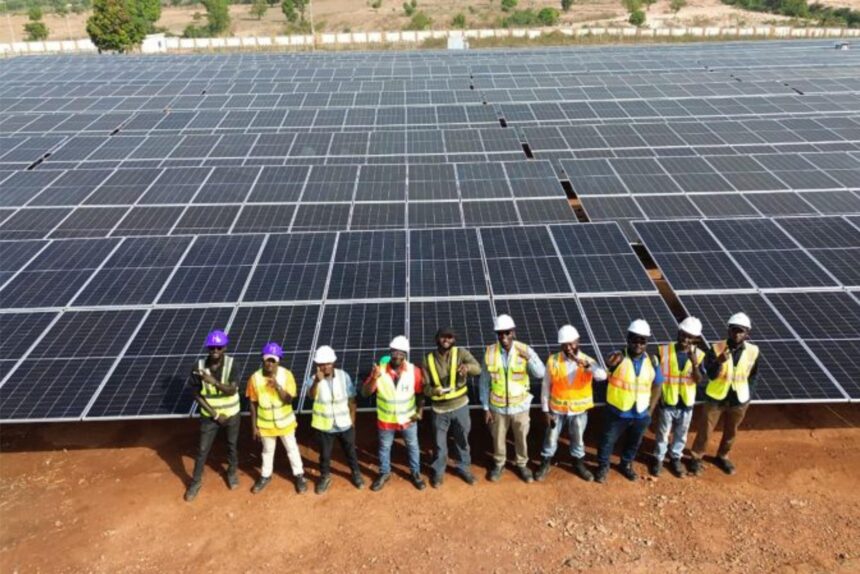
Husk, a leading distributed energy resources (DER) company, has announced the commissioning of a 1MWp solar hybrid facility at the Nasarawa State Secretariat in Nigeria, the administrative hub for key state government institutions.
The project was delivered in partnership with Step Engineering, with Husk managing the engineering, procurement, and construction (EPC) for the commercial and industrial (C&I) scale installation.
According to Husk, the new initiative is part of a broader effort by the Nasarawa state government to transition its operations to cleaner, more cost-efficient energy sources while reducing reliance on diesel generators.
“This project further deepens the strong relationship with the state, and demonstrates the huge untapped potential for C&I solar in Nasarawa and across government agencies and businesses in Nigeria,” Olu Aruike, Vice President of Business Development for West Africa and Nigeria Country Director at Husk, said in a press release.
What You Need to Know
The new solar hybrid plant is expected to provide reliable, sustainable power for all major state government offices, including administrative, public service, and support facilities.
From the outset, the system is designed to operate with low to zero diesel consumption, improving energy efficiency and significantly lowering operating costs.
Husk’s innovative delivery model also includes a knowledge transfer component, with the company providing operational support and training for state personnel over an initial 24-month period, ensuring that the Secretariat can maintain and operate the facility effectively.
Husk’s approach differs from conventional C&I solar projects. By sourcing components from globally recognised OEMs and applying a market-beating cost structure, the company was able to deliver the project below standard market benchmarks while retaining the warranties and quality assurance expected for high-value infrastructure.
The ‘Cloud Lab’ Approach to Solar Delivery
Experts say this approach reflects Husk’s broader mission of making renewable energy accessible and economically viable for businesses, governments, and communities, particularly in markets where diesel remains the dominant energy source.
Husk has maintained a strong presence in Nasarawa State since 2021. The company has deployed over 40 isolated mini-grids across nine Local Government Areas (LGAs) and several other large C&I projects.
Notably, in April 2025, Husk completed a 1.3MWp solar system for Olam Agri, one of the world’s largest agrifood conglomerates, marking another significant milestone in commercial solar adoption in the region.
The Nasarawa State Secretariat project adds to this portfolio, ensuring stable voltage, reliable power, fuel savings, and reduced carbon emissions, a template for future government and private sector projects in Nigeria.
Nigeria’s Commercial Solar Market
Nigeria’s commercial and industrial (C&I) solar market is experiencing rapid growth, with industry analysts projecting over 550MW of new capacity by 2029. The expansion is being driven by several factors, including high diesel costs, unreliable grid power, increasing regulatory support for renewable energy, and a rising corporate demand for sustainable energy solutions.
Husk’s presence in Nasarawa demonstrates the viability of commercial solar projects beyond Lagos and Abuja, highlighting opportunities for state governments, industrial clusters, and large-scale businesses to transition to clean energy.
According to industry leaders, the 1MWp solar hybrid facility will provide a significant reduction in diesel consumption, lowering fuel costs for the state, while also enhancing voltage stability to ensure a reliable and uninterrupted electricity supply, and reducing carbon emissions, supporting Nigeria’s broader climate and sustainability commitments.
The project exemplifies how distributed energy resources (DERs) can deliver tangible social, economic, and environmental benefits, while also creating local technical jobs through operations and maintenance programmes.
About Husk
Husk is a DER company delivering electricity to unserved and underserved communities in the Global South. Its AI-powered platform provides 24/7 renewable power to community, commercial, and residential customers.
Beyond energy provision, Husk offers e-commerce, credit-financing for branded appliances, and community solutions for e-mobility and the agricultural value chain.
In 2024, Husk was recognised as one of Fast Company’s 50 Most Innovative Companies in the World, ranking #24 overall and #1 in energy, and named the World’s Best Challenger Brand in the energy industry. CEO Manoj Sinhawas also listed among TIME 100 Most Influential Climate Leaders in Business.
Husk’s mission is to supercharge economic growth and social well-being across Asia and Sub-Saharan Africa, using renewable energy to drive prosperity and sustainability.
Talking Points
It is impressive that Husk has delivered a 1MWp solar hybrid facility for the Nasarawa State Secretariat, addressing a major challenge for government institutions in Nigeria.
This single project alone demonstrates how commercial and industrial solar solutions can reduce fuel costs, enhance voltage stability, and lower carbon emissions, making it a practical solution for real energy challenges facing public sector operations.
At Techparley, we see how projects like this can accelerate Nigeria’s clean energy transition beyond major cities, bringing tangible benefits to state governments, industrial clusters, and large-scale businesses.
The integration of solar generation, hybrid storage, and AI-powered monitoring means institutions can now operate with more reliable and cost-efficient energy, similar to the standards expected by large private enterprises.
As Husk scales across Nigeria and the wider region, exploring partnerships with other state governments and large commercial entities could accelerate adoption and deepen the footprint of renewable energy.
With the right strategic support, Husk has the potential to become a catalyst for Nigeria’s transition from diesel to solar power, driving economic growth and sustainability.
——————-
Bookmark Techparley.com for the most insightful technology news from the African continent.
Follow us on Twitter @Techparleynews, on Facebook at Techparley Africa, on LinkedIn at Techparley Africa, or on Instagram at Techparleynews.