



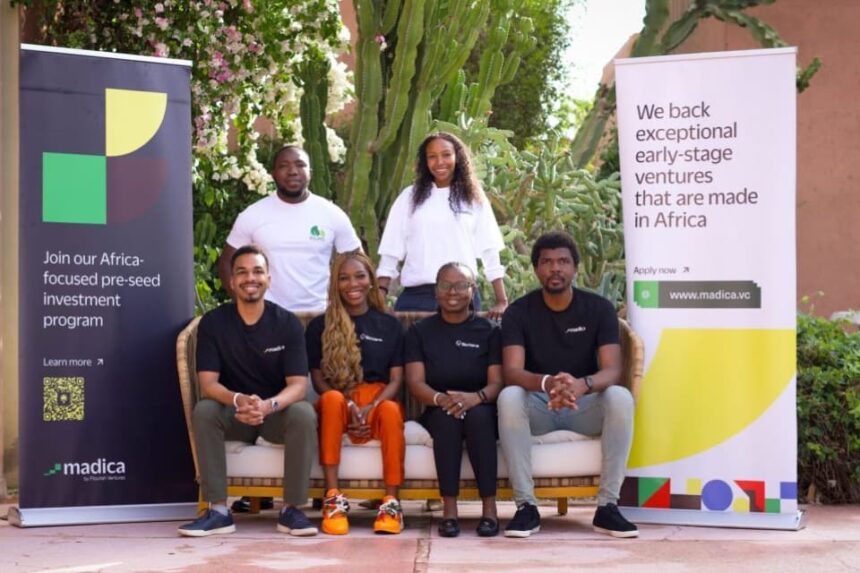
A strategic move that underscores growing confidence in Africa’s early-stage innovation ecosystem has led Madica to expand its startup portfolio with new investments in three tech-enabled ventures, Kilimo Fresh, Hakimu, and Biovana.
The announcement not only increases Madica’s portfolio to 13 startups but also reinforces its mission to back underrepresented founders solving critical challenges across agriculture, legal systems, and healthcare data infrastructure.
Each of the selected startups will receive up to $200,000 in funding alongside structured support over an 18-month period.
As Emmanuel Adegboye, head of Madica, noted, “Each new investment brings us closer to the portfolio we set out to build, one that reflects the full breadth and diversity of African entrepreneurship.”
The expansion speaks of a deliberate effort to deepen impact at the pre-seed stage, where access to capital and institutional support remains limited for many African founders.
What is Madica and What It Does
Launched in 2022, Madica is a sector-agnostic investment programme designed to support early-stage African startups, particularly those led by founders who are often overlooked by traditional funding systems.
Affiliated with Flourish Ventures, the platform goes beyond capital injection by offering a structured company-building approach that combines funding with operational guidance.
Madica’s model is rooted in democratizing access to high-quality entrepreneurial resources. This includes mentorship, executive coaching, and curated exposure to global technology ecosystems.
The programme specifically targets mission-driven founders, reflecting a broader shift in venture capital toward impact-oriented innovation. By focusing on the pre-seed stage, Madica is positioning itself as a foundational player in Africa’s startup pipeline, helping ideas transition into scalable ventures.
Who Are the Three Beneficiaries and What They Do
The latest cohort reflects both geographic and sectoral diversity, spanning East and West Africa while addressing core economic and social challenges.
Kilimo Fresh, based in Tanzania and co-founded by Baraka Chijenga and Justice Mangu, is tackling inefficiencies in agricultural supply chains.
The startup connects smallholder farmers to urban markets by aggregating, processing, and distributing fresh produce through a technology-enabled system.
Its goal is to reduce post-harvest losses while improving farmers’ incomes, an intervention that directly addresses one of Africa’s most persistent agricultural challenges.
From Kenya, Hakimu, co-founded by Rawan Dareer, Ahmed Ahmed, and Ahmed Elbashir, is building a pan-African legal infrastructure powered by artificial intelligence.
By leveraging AI, the startup aims to simplify and scale access to legal services across the continent, potentially lowering costs and bridging gaps in legal accessibility for individuals and businesses alike.
In Nigeria, Biovana, co-founded by Estelle Dogbo and Dr. Jumi Popoola, operates at the intersection of health data and global research.
The platform focuses on data harmonisation and certification, enabling African health datasets to be structured and validated for use in pharmaceutical development, AI models, and clinical research. This positions Biovana as a key enabler in integrating African data into global scientific ecosystems.
What Kilimo Fresh, Hakimu, and Biovana Get
Each of the three startups will receive up to $200,000 in funding, but the value of Madica’s support extends far beyond capital. The companies will participate in an 18-month programme designed to accelerate their growth and operational maturity.
This includes a tailored curriculum that addresses the specific needs of each startup, hands-on mentorship from industry experts, and executive coaching aimed at strengthening leadership capacity.
Additionally, the founders will benefit from two fully funded immersion trips to key technology ecosystems, both within Africa and internationally, providing exposure to best practices and potential partnerships.
Crucially, the startups will gain access to Madica’s global investor network, positioning them for future fundraising opportunities.
This combination of financial support, knowledge transfer, and network access is designed to provide what Adegboye described as “the resources, relationships, and runway they need to succeed at this early stage.”
Why This Matters for Africa’s Startup Ecosystem
Madica’s latest investments highlight a critical evolution in Africa’s venture landscape, one that increasingly recognizes the importance of early-stage funding as a catalyst for long-term ecosystem growth. By focusing on pre-seed startups, Madica is addressing a funding gap that often prevents promising ideas from reaching viability.
The selected startups also reflect a broader trend toward solving foundational challenges within African economies. From improving agricultural supply chains to digitizing legal infrastructure and unlocking the value of health data, these ventures are building the underlying systems that can drive inclusive growth.
Moreover, the programme’s emphasis on underrepresented founders signals a shift toward more equitable capital distribution.
As Adegboye emphasized, “The opportunity across the continent is enormous, and we’re committed to being a crucial and consistent partner in realising it.”
This commitment not only strengthens individual startups but also contributes to a more diverse and resilient innovation ecosystem. In the long term, initiatives like Madica could play a pivotal role in shaping Africa’s position in the global tech economy.
By nurturing startups at their earliest stages and equipping them with the tools to scale, the programme is helping to build a pipeline of ventures capable of attracting larger investments, creating jobs, and driving technological advancement across the continent.
Talking Points
Madica’s expanding footprint signals a welcome intervention in Africa’s chronically underfunded pre-seed stage, but it also exposes the limitations of impact-driven venture models that risk overpromising systemic change.
Madica is clearly positioning itself as a pipeline builder for underrepresented founders. Still, the relatively modest cheque size, capped at $200,000, raises questions about how far such capital can realistically take infrastructure-heavy startups like health data platforms or AI-driven legal systems, which typically require deeper, sustained funding to scale.
The selection of Kilimo Fresh, Hakimu, and Biovana reflects strong thematic alignment with Africa’s structural gaps. Yet, execution risk remains high, particularly in fragmented markets where regulatory bottlenecks, weak data systems, and limited purchasing power can stall even the most well-intentioned innovations.
Moreover, while the programme’s mentorship, immersion trips, and investor access are valuable, they echo a familiar playbook that often benefits already well-positioned founders more than truly marginalized ones.
That said, Madica’s emphasis on early-stage support and ecosystem diversity is directionally correct and arguably necessary.
The real test, however, will be whether these startups can graduate beyond grant-like dependence into commercially viable, scalable businesses that attract follow-on capital and deliver measurable impact in notoriously difficult operating environments.
________________________
Bookmark Techparley.com for the most insightful technology news from the African continent.
Follow us on X/Twitter @Techparleynews, on Facebook at Techparley Africa, on LinkedIn at Techparley Africa, or on Instagram at Techparleynews