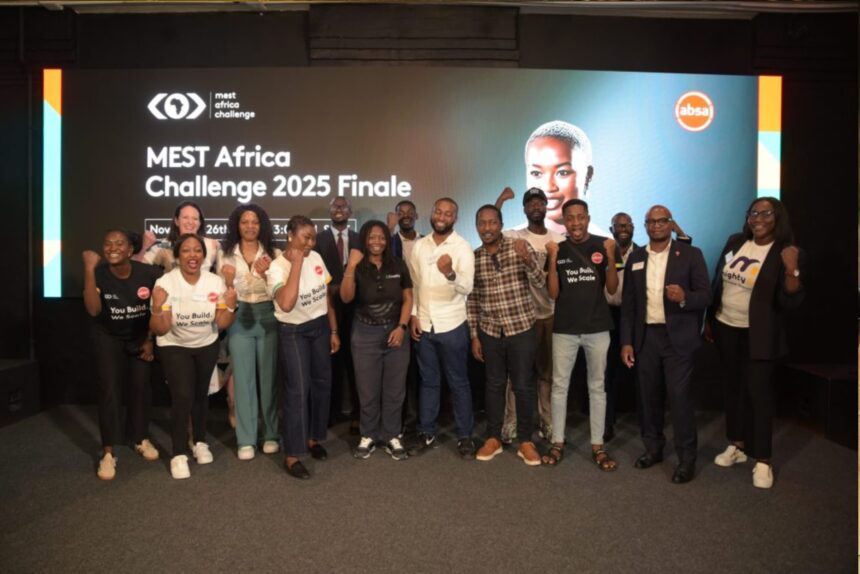
Black Swan, a Mauritius-based fintech startup, has clinched the top prize at the MEST Africa Challenge 2025, edging out hundreds of competitors from across eight African markets to secure the US$50,000 equity investment and regional exposure that comes with the prestigious award.
The startup was crowned during a high-energy grand finale held at Innovation City in Cape Town, where its co-founder, Derick Kazimoto, reiterated the company’s mission to “make Africa bankable.”
“Africa’s financial system cannot see the true creditworthiness of millions of consumers and micro, small, and medium-sized enterprises (MSMEs) because their data is fragmented, informal, and invisible to traditional lenders.m,” he emphasized.
What You Should Know
The 2025 edition of the MEST Africa Challenge, run in partnership with Absa, focused specifically on fintechs building solutions in digital payments, financial inclusion, insurtech, and value chain financing.
Hundreds of applications were submitted from Ghana, Kenya, Uganda, Zambia, Botswana, Mozambique, Seychelles, and Mauritius, with only 10 startups making it to the final pitch event in Cape Town.
The competition is recognised as one of Africa’s most influential platforms for early-stage startups, with past winners often going on to secure global partnerships, scale into multiple markets, and raise millions in follow-on funding.
What Is Black Swan, and What It Does
Black Swan is a data-driven fintech startup dedicated to improving Africa’s credit infrastructure.
Co-founded by Derick Kazimoto, the company identifies a deep-rooted problem, that’s tens of millions of individuals and MSMEs across Africa remain “invisible” to formal lenders because their financial data is unstructured, informal, or nonexistent in traditional systems.
Black Swan builds tools that help banks, MFIs, and digital lenders access previously hidden or fragmented financial behaviour, enabling them to make more accurate lending decisions.
Kazimoto explained that this shift from collateral-based lending to “data-driven credit” is “changing how banks and fintechs trust, lend, and grow.”
More About MEST Challenge 2025
The MEST Africa Challenge, established by MEST, an entrepreneurial training programme and seed investor founded in 2008 by Norwegian-Ghanaian entrepreneur Jorn Lyseggen, has become a continental proving ground for innovative startups.
With Absa as a strategic partner, the 2025 competition spotlighted fintech solutions capable of scaling across borders and solving some of Africa’s most persistent financial inclusion challenges.
According to MEST portfolio advisor Ashwin Ravichandran, this year’s event demonstrated a shift in founder priorities, with startups “building for scale” and emphasising compliance, interoperability, and continental readiness from day one.
How Black Swan Emerged Winner and the Benefits
Black Swan stood out for its ability to address one of the continent’s most stubborn barriers to financial inclusion, the lack of credible, structured, and accessible credit data.
Its solution offers lenders a way to evaluate borrowers previously locked out of formal credit systems, enabling more responsible lending while accelerating economic participation.
The US$50,000 equity prize not only injects fresh capital into the company but also gives access to the MEST founder network, Absa’s ecosystem, investor guidance, and opportunities for regional expansion.
Judges highlighted the company’s strong problem-definition, scalable business model, and alignment with Africa’s ongoing fintech evolution.
MEST Challenge 2025 Judgement Measures
Judges from Absa, the investment community, and the broader fintech industry evaluated startups based on:
- Problem clarity & market relevance
- Scalability across multiple African markets
- Compliance readiness and regulatory alignment
- Interoperability with banks and formal financial systems
- Business sustainability and revenue potential
- Impact on real-world sectors such as agriculture, trade, and energy
In line with these criteria, Ravichandran noted that “Fintech is now powering real sectors like agriculture, energy, and trade, and that’s where lasting impact will come from.”
Black Swan’s focus on enabling credit access across these sectors positioned it strongly against competitors.
Why This Matters
Africa remains home to more than 350 million unbanked adults, while over 65% of MSMEs struggle to access formal credit, according to global financial inclusion studies.
With the continent’s digital economy projected to reach US$180 billion by 2025, fintech innovation, especially on credit infrastructure, has become central to driving inclusive growth.
Black Swan’s win reflects a broader industry recognition that Africa’s next wave of fintech disruption will come from data intelligence, not just digital payments.
By enabling lenders to better understand borrower behaviour, Black Swan could unlock billions in previously inaccessible credit.
This has implications for job creation, SME survival rates, and cross-border trade, showcasing a new maturity in African innovation, one rooted in solving deeply local problems but adaptable for global expansion.
Talking Points
While Black Swan’s victory at the MEST Africa Challenge 2025 highlights a promising shift toward data-driven credit infrastructure, it also underscores the structural gaps that continue to define Africa’s financial ecosystem.
The startup’s mission to “make Africa bankable” is bold and necessary, but its impact will hinge on whether lenders, regulators, and fragmented data systems across the continent are willing, and able, to modernize quickly enough to support such innovation.
Africa’s credit invisibility problem is not merely a technological issue; it is tied to decades of informal financial habits, weak documentation culture, regulatory inconsistencies, and limited incentives for banks to lend to high-risk segments.
Black Swan’s approach offers a sophisticated solution, but its success will require deep collaboration with institutions historically slow to evolve.
Still, the startup’s win is a positive signal as it shows that African innovation is maturing beyond flashy financial apps toward infrastructure solutions that could unlock real economic mobility, if the continent is ready to embrace them.
_____________________
Bookmark Techparley.com for the most insightful technology news from the African continent.
Follow us on X/Twitter @Techparleynews, on Facebook at Techparley Africa, on LinkedIn at Techparley Africa, or on Instagram at Techparleynews