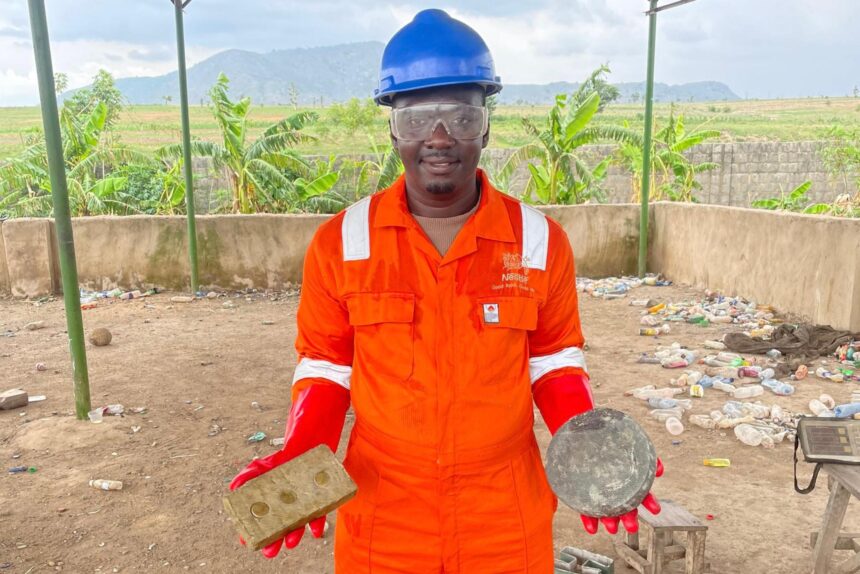
In Nigeria, where plastic waste continues to pose an environmental threat, a recycling startup is reimagining what waste can become. Abdullahi Suleiman, Founder and Chief Executive Officer of Triple R Recycling Limited, is building a business around converting discarded plastics into usable construction materials.
His journey began with a simple observation that communities across Nigeria lacked structured recycling systems, leaving plastic waste to accumulate in drainages, streets, and landfills. In response, Triple R Recycling Limited was established.
“I started by collecting plastic waste directly from households and communities in Abuja, rewarding people for turning in waste instead of dumping or burning it. Over time, we built a plastic waste recovery facility, where we sort and bale plastics for recycling,” Suleiman told Techparley Africa.
That grassroots model has since evolved into a more structured operation. Today, Triple R Recycling operates a plastic recovery facility in Kuje, Abuja, where waste is sorted and baled.
The company has also created employment opportunities for women and young people, positioning itself within Nigeria’s growing circular economy landscape.
How the Startup Turns Plastic Waste to Interlocking Bricks
The company’s latest innovation is a move into manufacturing, specifically, producing interlocking paving blocks using plastic waste and sand.
According to Suleiman, the idea was driven by two pressing issues, which are the scale of plastic pollution and the rising cost of construction materials in Nigeria.
“I started asking myself how waste plastic could become a useful construction product instead of ending up in drainage systems and landfills,” he said. “Producing interlocks using the caps from PET bottles and sand gave us an opportunity to tackle environmental pollution while also creating durable and affordable building materials.”
The process involves collecting and sorting plastic bottle caps, cleaning them, and heating the material until it melts. The molten plastic is then mixed with sand at controlled temperatures before being compressed into moulds to form interlocks.
Unlike traditional cement-based interlocks, these plastic alternatives are lighter, more water-resistant, and less prone to cracking under certain conditions.
They also reduce reliance on cement, offering a potential cost advantage in a market where building materials have become increasingly expensive.
What You Need to Know
Although still at the sample stage, the product has already generated interest among builders and community stakeholders.
Suleiman said many observers were initially surprised by the strength and finish of the interlocks. Feedback has largely been positive, with growing curiosity around how the product performs over time and whether it can scale for broader construction use.
“Many people were surprised that waste plastic could produce something strong and attractive. Builders and community members who saw the samples were impressed by the finishing and weight. Some stakeholders also showed interest because the product addresses both environmental sustainability and affordable housing concerns,” he said.
This early interest highlights a key advantage of the innovation. It addresses two challenges simultaneously, including environmental sustainability and affordable construction.
Nigeria’s construction sector remains cautious about new materials, particularly where safety and durability are concerned. Suleiman acknowledged that trust will need to be earned through consistent performance.
The company plans to conduct further laboratory and field testing, alongside pilot projects that will demonstrate real-world application. It is also working towards securing certifications and approvals from relevant regulatory bodies.
How the Grant Is Being Deployed
A recent grant from the Global Recycling Foundation, an international organisation, is helping accelerate Triple R Recycling’s transition from prototype development to early-stage production.
Estimated at around $500, the funding is being channelled into improving equipment capacity, refining product prototypes, and conducting more rigorous material testing on the company’s plastic-sand interlocks.
It is also supporting the expansion of its production capabilities and strengthening plastic waste collection systems across Abuja communities.
For an early-stage recycling and circular economy venture operating in a capital-intensive sector, even modest funding has proven catalytic, unlocking progress in areas that would otherwise remain constrained at the experimental stage.
What This Means
Beyond its commercial potential, the innovation reflects a broader shift in how waste is perceived.
Nigeria generates millions of tonnes of plastic waste annually, much of which is poorly managed.
By converting plastic into construction materials, Triple R Recycling is effectively transforming waste into a valuable economic resource.
This shift could drive environmental benefits, create jobs, and reduce costs across the construction value chain.
“I believe this innovation has strong potential,” Suleiman said. “This creates environmental, economic, and social benefits at the same time. Products like this encourage circular economy practices where waste becomes a resource instead of a problem.”
According to Suleiman, the company’s goal is to prove the product locally through roads, walkways, schools, and community projects, as sustainable construction materials are becoming more important globally.
Partnerships and the Road to Scale
To accelerate adoption, the company is engaging with environmental organisations, recycling networks, and stakeholders in the construction sector.
Suleiman emphasised that partnerships with government agencies, private developers, and sustainability-focused organisations will be critical to scaling the solution.
In the near term, Triple R Recycling plans to deploy its interlocks in local projects across Abuja and neighbouring states, including roads, walkways, and community infrastructure.
These pilot deployments are expected to serve as proof points, helping to build confidence and unlock broader commercial opportunities.
Over the next two to three years, Suleiman’s ambition is to scale both production and impact. The company aims to expand job creation, increase the volume of plastic waste it processes, and move from small-scale samples to large commercial projects.
Talking Points
It is notable that Triple R Recycling Limited is tackling two structural problems at once, including plastic waste pollution and the rising cost of construction materials in Nigeria. Few early-stage ventures successfully bridge environmental sustainability and practical infrastructure needs this directly.
The innovation of producing interlocks from PET bottle caps and sand, without cement, stands out as a potentially disruptive approach. By reducing reliance on cement, the product directly addresses cost pressures in the construction sector while offering a more environmentally friendly alternative.
At Techparley, we see this as a strong example of circular economy thinking in action. Turning waste into a usable construction input shifts plastic from being an environmental liability into an economic resource, which could reshape how communities perceive waste collection and recycling.
The early feedback from builders and stakeholders suggests there is real market curiosity and demand. If the durability and performance claims hold under extended testing, this could open up new pathways for affordable housing and community infrastructure projects.
As Triple R Recycling grows, there is a clear opportunity to integrate its waste collection network with its manufacturing ambitions. Doing so could strengthen supply chains, create more jobs for women and youths, and deepen its impact across communities.
In the long term, this model has the potential to extend beyond Nigeria. With plastic waste a global challenge, solutions that convert it into durable construction materials could find relevance across multiple emerging markets if properly scaled and standardised.
——————-
Bookmark Techparley.com for the most insightful technology news from the African continent.
Follow us on Twitter @Techparleynews, on Facebook at Techparley Africa, on LinkedIn at Techparley Africa, or on Instagram at Techparleynews.