



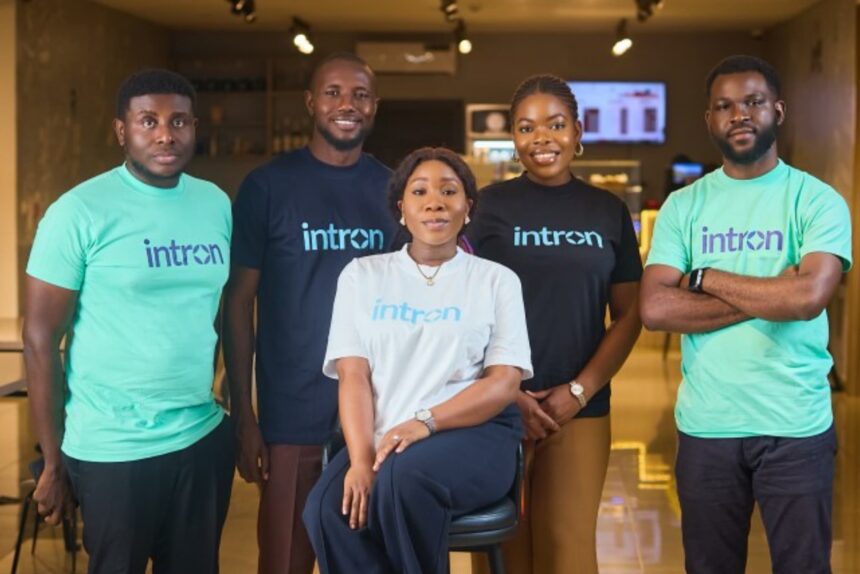
Nigerian voice technology startup, Intron, has unveiled Sahara v2.5, a major upgrade designed to make artificial intelligence better understand how Africans naturally communicate, particularly when speakers switch between languages during the same conversation.
The new platform introduces bilingual language-mixing speech recognition across 12 African languages and adds trilingual speech recognition for Kinyarwanda, English and French.
Founded in 2020 by Tobi Olatunji and Olakunle Asekun, Intron has positioned itself as an Africa-focused voice AI company serving sectors including healthcare, financial services, telecommunications, legal services and government.
The company says its latest technology addresses a major weakness in conventional AI systems, which can lose important information when speakers mix languages.
“Africa needs AI built for how Africans really speak,” Intron CEO Tobi Olatunji said.
What is Intron?
Intron is a Nigerian technology company focused on developing voice artificial intelligence specifically for the African market.
Founded in 2020 by Tobi Olatunji and Olakunle Asekun, the startup initially developed what it describes as Africa’s first clinical speech-recognition platform, helping healthcare professionals convert spoken information into useful digital documentation.
Its broader technology now provides speech recognition, text-to-speech and voice-agent capabilities for modern businesses operating in multilingual environments.
In practical terms, Intron wants computers to understand African users when they speak naturally, rather than forcing them to communicate in a particular language or accent.
The company’s technology is being applied across healthcare, call centres, financial services, telecommunications, legal services and government agencies.
In July 2024, Intron raised US$1.6 million in pre-seed funding to strengthen research and expand distribution.
What is Sahara?
Sahara is Intron’s voice AI platform, and Sahara v2.5 represents the company’s latest major upgrade. The platform enables computers to recognise human speech, convert it into text and generate natural-sounding spoken responses.
Its significance lies in its ability to handle multilingual conversations in which speakers switch between languages, a practice commonly known as code-switching.
For example, a Nigerian customer could begin a conversation in English, introduce Yoruba or Hausa expressions and continue in Nigerian Pidgin without having to change how they naturally speak.
Sahara v2.5 introduces bilingual language-mixing speech recognition for 12 African languages, including Hausa, Swahili, Zulu and Luganda.
Intron says it has also developed the world’s first African trilingual speech-recognition model supporting Kinyarwanda, English and French, using proprietary technology for which it has filed US patents.
Why Language Mixing Matters for African Voice AI
Language mixing is a normal part of everyday communication across Africa, but it has historically created difficulties for artificial intelligence systems designed around single-language interactions.
A doctor, for instance, may explain a medical condition in English before switching to Swahili to reassure a patient, while a Nigerian bank customer may discuss a financial product in Yoruba before completing the conversation in English or Nigerian Pidgin.
When conventional AI systems fail to recognise those switches, important sections of conversations can be lost, potentially affecting clinical notes, customer records, call logs, court documents and other forms of digital documentation.
Intron CEO Tobi Olatunji said code-switching was “one of the biggest problems” repeatedly identified by clients using voice AI. He added that “people should not have to translate themselves for a machine” or repeat only the English portions of what they say.
Sahara Expands African Language Coverage
Beyond its new language-mixing capabilities, Sahara v2.5 significantly expands the number of African languages supported by the platform.
Intron says new speech-recognition support for Nupe, Kanuri, Nigerian Fulfulde, Tigrinya, Kikuyu, Dholuo and Somali brings Sahara’s total African-language coverage to 31 languages.
This expansion is important because many voice technologies have traditionally prioritised globally dominant languages while providing limited support for Africa’s diverse linguistic landscape.
Intron is attempting to address that gap by developing technology that can be used across different linguistic communities and industries. The company also says Sahara’s text-to-speech and voice-agent capabilities now support language mixing across 13 languages.
According to Intron’s published benchmarks, Sahara outperformed ElevenLabs and Gemini in 11 of the 13 languages tested, while its speech-recognition system reportedly outperformed Gemini, ElevenLabs and Meta across all 12 bilingual languages evaluated.
What Sahara v2.5 Could Mean for Businesses
The latest Sahara release could allow African businesses to build voice-based services that communicate with customers in a more natural and inclusive way.
Banks could deploy voice agents capable of handling multilingual customer enquiries, telecommunications companies could use them for customer support, while hospitals could employ speech recognition to simplify clinical documentation.
Legal and government institutions could similarly benefit from systems capable of accurately capturing conversations involving multiple African languages. The technology could also reduce the amount of manual editing required after speech has been converted into text.
According to Olatunji, errors in existing systems can increase “post-editing time” and carry omissions into “downstream summaries, call logs, court records, and clinical notes.”
Ultimately, Intron’s vision is to make voice AI work with African communication patterns rather than requiring Africans to adapt their speech to the limitations of technology.
As Olatunji put it, “Voice AI should work with the way people already speak.”
Talking Points
Intron’s objectives are ambitious and strategically important, but they should be assessed with both optimism and scepticism.
Its central goal, to build voice AI around how Africans actually communicate, is a legitimate response to a major weakness in global AI development, where African languages and linguistic diversity have often received inadequate attention.
Expanding support to 31 African languages and handling code-switching could create significant value in healthcare, banking, government and customer service.
However, language coverage alone does not guarantee reliable commercial impact. Intron must demonstrate that its models remain accurate across accents, dialects, noisy environments and specialised terminology, while protecting sensitive voice data.
Its claims of outperforming major AI companies also require independent verification.
Ultimately, Intron’s ambition is commendable, but sustained trust, accuracy, affordability, scalability and measurable real-world adoption, not impressive benchmarks alone, will determine its success.
_________________________
Bookmark Techparley.com for the most insightful technology news from the African continent.
Follow us on X/Twitter @Techparleynews, on Facebook at Techparley Africa, on LinkedIn at Techparley Africa, or on Instagram at Techparleynews