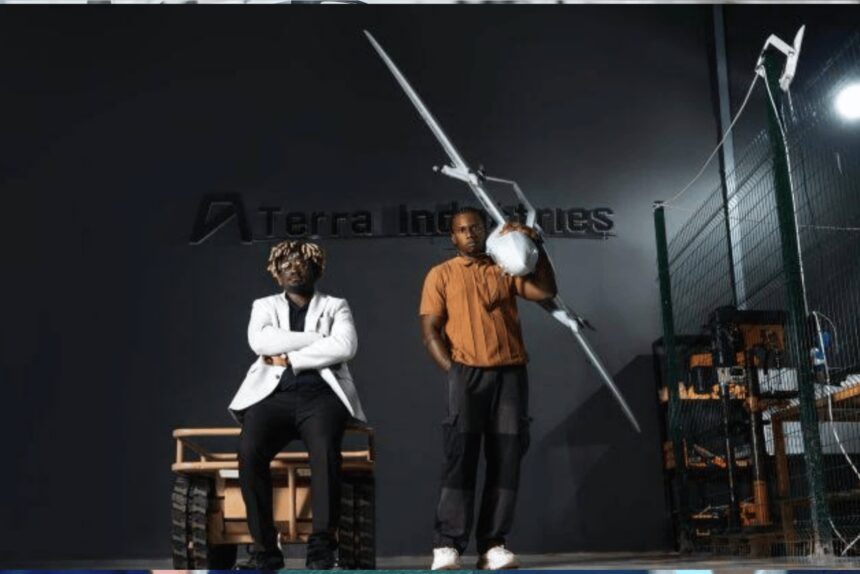
Barely a month after closing what was described as the largest funding round in Africa’s defence-technology sector, Nigerian startup Terra Industries has secured an additional $22 million in fresh capital.
The new round, completed in under two weeks, was led by repeat backer Lux Capital, with follow-on participation from 8VC, Nova Global and Silent Ventures. New investors include Belief Capital, Tofino Capital and Resilience17 Capital, founded by Olugbenga Agboola, alongside angel investors such as Jordan Nel and Hollywood actor Jared Leto.
The raise comes on the heels of a prior $11.8 million round, bringing Terra’s total recent funding to more than $33 million, a rare pace of capital accumulation within Africa’s still-nascent defence-tech ecosystem.
“Africa is industrialising faster than any other region,” said Nathan Nwachuku, Terra’s co-founder and chief executive officer. “But none of that progress will matter if we don’t solve the continent’s greatest Achilles’ heel, which is insecurity and terrorism.”
What You Need to Know
Founded in 2024 by Nwachuku and Maxwell Maduka, Terra integrates hardware and software by designing and manufacturing long- and mid-range autonomous drones, sentry towers and unmanned ground vehicles. These systems are connected through its proprietary operating platform, ArtemisOS.
The company’s pitch is to become Africa’s first vertically integrated “defence prime”, a role akin to that played in the United States by companies such as Anduril Industries and Palantir Technologies.
Unlike fragmented procurement models that rely on imported drones, foreign surveillance systems and outsourced analytics, Terra argues that security for African infrastructure must be tightly integrated, hardware built locally, software optimised for terrain, and systems capable of autonomous threat detection and response.
ArtemisOS, the firm’s central platform, is designed to enable real-time monitoring and coordinated response across land, air and maritime environments.
Infrastructure Security as Strategic Imperative
Africa holds roughly 30 per cent of the world’s critical mineral reserves and spends an estimated $100 billion annually on infrastructure development. Yet many of these projects, including mines, energy plants and transport corridors are located in remote or volatile regions prone to sabotage, illegal mining and militant attacks.
Governments and operators frequently depend on imported security systems that can be costly to maintain and vulnerable to geopolitical and supply-chain disruptions.
Terra is positioning itself as a domestic alternative, arguing that locally manufactured and managed systems reduce exposure to external dependencies while improving operational responsiveness.
The company says it currently secures infrastructure assets valued at approximately $11 billion and has signed contracts worth tens of millions of dollars across multiple African countries.
Capital Deployment and Global Footprint
Follow-on rounds of this size and speed are unusual in Africa, particularly in hardware-intensive sectors. Most startups on the continent take months and sometimes years between raises, and many struggle to secure repeat backing.
Terra’s rapid capital injection signals confidence not only in its product strategy but also in the broader thesis that Africa’s infrastructure security requires locally engineered solutions.
According to the company, the newly raised $22 million will be channelled towards expanding manufacturing capacity, accelerating deployments across Nigeria and allied African markets, and hiring senior engineering and business leaders across Africa, London and San Francisco.
That geographic hiring strategy suggests Terra intends to combine African field deployment with global technical expertise and capital networks.
A New Chapter for African Hard-Tech
The funding also reflects a broader shift in investor interest. While African venture capital has historically favoured asset-light fintech and software platforms, defence-tech, particularly where tied to infrastructure protection is emerging as a strategic sector amid global supply-chain recalibration and heightened security concerns.
Terra’s ascent represents a notable development in Africa’s technology narrative. Rather than building purely digital platforms, the startup is betting on capital-intensive, vertically integrated manufacturing, combining drones, ground systems and AI software under one operational umbrella.
If successful, technology experts say the model could redefine how security technology is built and deployed across the continent.
For Terra Industries, the wager is that Africa’s industrial expansion will require not only roads, mines and power plants, but also a domestically built security architecture capable of protecting them.
Talking Points
It is remarkable that Terra Industries has been able to close a $22 million follow-on round barely a month after raising $11.8 million, especially in a sector as capital-intensive and sensitive as defence technology. In Africa’s cautious funding climate, that speed signals strong investor conviction.
The company’s vertically integrated model stands out. By combining locally manufactured drones, ground systems and proprietary software under one platform, Terra is not merely selling hardware, it is building an ecosystem designed for African terrain and infrastructure realities.
At Techparley, we see this as a significant shift in narrative. For years, Africa’s startup ecosystem has leaned heavily towards asset-light fintech and consumer software. Terra’s rise suggests that hard-tech, particularly infrastructure security may be entering a new era of strategic relevance.
However, scaling defence technology across multiple jurisdictions will require regulatory precision, manufacturing discipline, and sustained capital. Execution risk remains high in hardware-driven ventures.
If Terra delivers on its ambition to become Africa’s first vertically integrated defence prime, it could redefine how critical infrastructure is protected across the continent and potentially catalyse a broader wave of locally engineered industrial innovation.
——————-
Bookmark Techparley.com for the most insightful technology news from the African continent.
Follow us on Twitter @Techparleynews, on Facebook at Techparley Africa, on LinkedIn at Techparley Africa, or on Instagram at Techparleynews.