



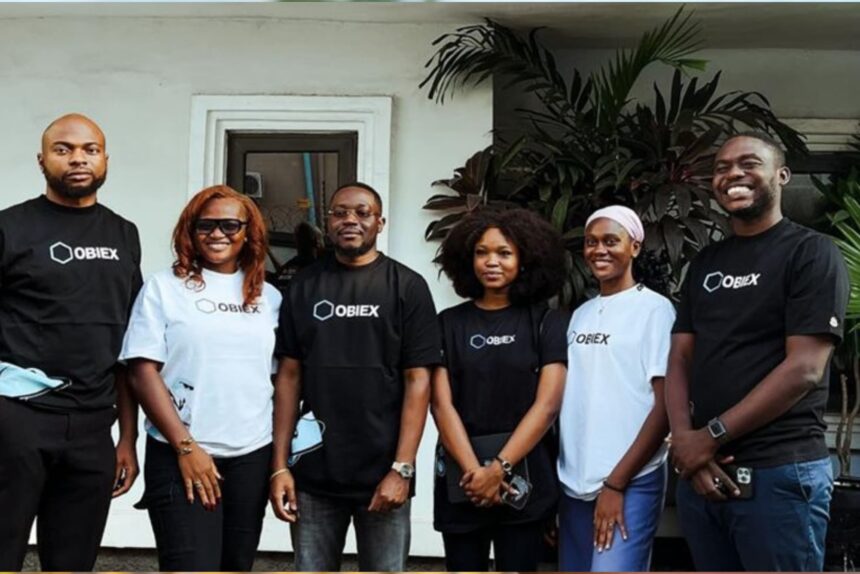
Nigerian cryptocurrency exchange Obiex is setting its sights beyond its home market, with Ghana and South Africa emerging as key expansion targets. This is following what the company describes as “strong and sustained” growth driven by everyday users and high-volume traders.
Founded by Ikechukwu Okeke and Chidozie Ogbo, Obiex has quietly grown into a billion-dollar-scale trading and infrastructure platform by solving one of crypto’s most persistent problems in emerging markets which include speed, trust, and price volatility during blockchain delays.
“We’re best known for our ‘Swap Without Confirmation’ feature, which we built after watching traders lose money due to price swings caused by blockchain delays,” Okeke stated. “It allows users to lock in exchange rates instantly, before blockchain confirmation is complete.”
That single insight, born out of observing how users actually lost money, has helped transform Obiex from a simple off-ramping tool into a platform that has processed over US$20 billion in transactions since 2021, without external funding.
What You Should Know About Obiex
Obiex is a crypto exchange and trading infrastructure platform designed to make converting and trading digital assets fast, predictable, and efficient, particularly in volatile markets. It allows users, from retail customers to professional traders, to move seamlessly between cryptocurrency, fiat currencies, and stablecoins, with minimal friction.
The company’s roots date back to 2016, when Okeke and Ogbo began building a product called Paylot. At the time, Okeke says he noticed a critical gap in Nigeria’s crypto ecosystem.
“There were very few simple, practical ways for people in Nigeria to actually use or convert cryptocurrency,” he explained.
Paylot initially launched as a crypto payment gateway for merchants, but real-world usage quickly told a different story.
“Early user behaviour showed us something different. What people needed most wasn’t merchant payments, but fast, reliable off-ramps,” Okeke said.
In response, the team built a stripped-down tool that allowed users to convert crypto to fiat quickly. That product gained traction far faster than the original idea. By 2021, the pivot was clear, and the company rebranded to Obiex, fully committing to crypto-to-fiat conversion and trading solutions.
In the early days, the challenge wasn’t infrastructure alone, but usability and trust.
“People either didn’t understand crypto or couldn’t easily convert it back to naira, and this made real adoption nearly impossible,” Okeke said.
He added that education by itself was not enough.
“People needed practical tools that made crypto usable in everyday financial life, starting with instant, reliable conversion to naira.”
The Big Innovation: “Swap Without Confirmation”
Obiex’s defining breakthrough came in the aftermath of Nigeria’s evolving regulatory environment. In February 2021, the Central Bank of Nigeria (CBN) barred banks from providing services to crypto exchanges, forcing many companies to rethink their models.
For Obiex, the restriction revealed a deeper pain point among high-volume traders.
“We identified a critical pain point for high-volume P2P traders, slow blockchain confirmations were costing them hundreds of dollars per transaction as prices moved during the wait,” Okeke said.
The solution was the now-signature “Swap Without Confirmation” feature. Instead of forcing users to wait for blockchain confirmation, during which prices can change dramatically, Obiex allows traders to lock in exchange rates instantly.
“This insight led to the creation of our swap without confirmation feature, which allows traders to mitigate losses from price volatility during slow blockchain confirmations,” Okeke explained.
The feature effectively removes confirmation delays from the user experience, turning speed into a competitive advantage.
How Big Is Obiex? Market Size and Competition
Though fully bootstrapped, Obiex has grown rapidly in both volume and reach. According to Okeke, the company’s swap volume grew from US$588 million in 2024 to US$1 billion in 2025, while gross transaction value reached about US$9 billion in 2025 alone.
Since its 2021 pivot, Obiex has processed over US$20 billion in total transactions.
Usage on the platform is driven largely by retail users, who account for 70 per cent of total volume, while business customers make up 28 per cent.
This year, active users traded an average of US$211,000 each, underscoring the platform’s appeal to serious traders. Beyond its direct users, Obiex has also embedded itself within Nigeria’s crypto ecosystem, providing wallet and infrastructure services to around 12 other crypto exchanges.
Despite being Africa-based, Obiex does not see itself competing primarily with regional players.
“Today, Obiex does not position itself against regional African exchanges, but against global platforms, with Binance considered our primary competitor,” Okeke said, showcasing ambitions that extend well beyond the continent.
Expansion Plans: Why Ghana and South Africa
Already active in Cameroon, Obiex is now preparing to deepen its African footprint, with Ghana, South Africa, and Kenya identified as priority markets. Ghana, in particular, stands out as the company’s immediate focus.
“Ghana is our immediate priority, partly because of the Bank of Ghana’s new policy paper on virtual assets released in November, which outlines a path for regulating crypto trading and wallets,” Okeke said.
He noted that over three million Ghanaians already use digital assets, and that emerging regulatory clarity makes the market especially attractive.
Beyond policy, Obiex is guided by data from its own platform.
“We examined the size and activity of our existing user base in Ghana, including active users, average transaction volumes, and crypto-to-crypto trading patterns,” Okeke said. “Once the numbers crossed a certain internal threshold, we began exploring regulatory and partnership requirements.”
South Africa and Kenya are also strategic targets due to their growing adoption of digital assets and relatively open regulatory approaches. In South Africa, Obiex is already engaging directly with regulators.
“We’re already actively engaging with the regulatory process by applying to join the regulatory sandbox,” Okeke said, adding that successful completion typically leads to an operating license. “All required documents have been submitted, and we’re awaiting the next step from the regulators.”
How Obiex Makes Money
Unlike many exchanges that rely on visible transaction fees, Obiex generates revenue through spreads on swap transactions, the difference between buy and sell rates. While the company declined to disclose specific revenue figures, Okeke emphasized sustainability over hype.
“What’s more indicative of the business is that Obiex has been self-sustaining since 2021, without external funding,” he said.
Profits from its Nigerian operations, he added, have been sufficient to support expansion into Ghana, South Africa, Cameroon, and other African markets, positioning Obiex as one of the continent’s few home-grown crypto platforms scaling on its own terms.
Talking Points
Obiex’s trajectory reflects a broader maturation of Africa’s crypto ecosystem, where survival and scale are increasingly driven not by hype but by practical problem-solving and regulatory awareness.
Rather than positioning itself as a speculative trading platform, Obiex identified a concrete market failure, losses caused by blockchain confirmation delays and weak crypto-to-fiat rails, and built infrastructure to neutralise that risk, particularly for everyday users and high-volume traders.
Its ability to remain profitable and self-sustaining since 2021, despite Nigeria’s restrictive banking stance on crypto, suggests a business model rooted in real demand rather than regulatory arbitrage.
However, the company’s ambitious expansion into Ghana and South Africa will test whether this Nigeria-honed model can scale across jurisdictions with different compliance expectations, consumer behaviours, and competitive pressures from well-capitalised global exchanges.
While regulatory clarity in Ghana and sandbox participation in South Africa are positive signals, Obiex’s long-term success will go along with how effectively it balances innovation with compliance, maintains trust at scale, and defends its niche against global players whose resources far exceed its own.
______________________
Bookmark Techparley.com for the most insightful technology news from the African continent.
Follow us on X/Twitter @Techparleynews, on Facebook at Techparley Africa, on LinkedIn at Techparley Africa, or on Instagram at Techparleynews