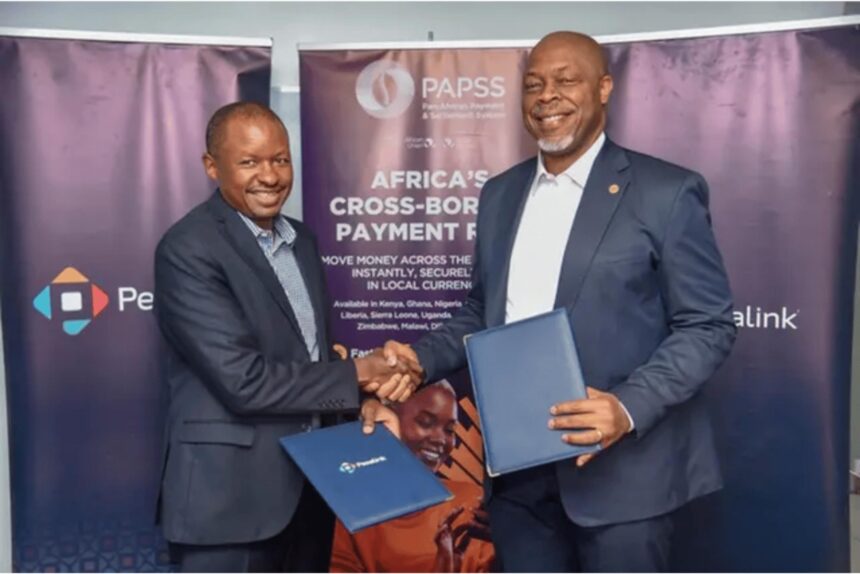
Kenya’s instant payment infrastructure is taking a significant step towards continental financial interoperability after Pesalink, widely regarded as the country’s de facto real-time payment network, announced a partnership with the Pan-African Payment and Settlement System (PAPSS).
The collaboration will enable instant, round-the-clock cross-border payments from PAPSS participants directly into banks and mobile money operators connected to the Pesalink ecosystem in Kenya.
Transactions will be settled in local currencies, reducing dependence on foreign reserve currencies and eliminating multiple layers of correspondent banking.
The move is expected to simplify cross-border money transfers for individuals, small and medium-sized enterprises (SMEs), and corporates, while supporting broader ambitions of regional financial integration under the African Continental Free Trade Area framework.
What you need to know
PAPSS, launched by African Export-Import Bank in collaboration with the African Union and the AfCFTA Secretariat, was designed to facilitate cross-border payments across African markets without routing transactions through overseas clearing systems.
Through the new arrangement, Pesalink will function as a Technical Connectivity Provider, linking more than 80 Kenyan participants, including banks, fintech companies, savings and credit cooperatives (SACCOs), and telecommunications operators to over 160 commercial banks and fintech institutions already integrated into the PAPSS network.
The integration effectively extends PAPSS reach into Kenya’s domestic payment rails, allowing funds originating from across Africa to terminate directly within local financial institutions and mobile wallets.
Mike Ogbalu III, chief executive of PAPSS, said partnerships with national payment switches were critical to achieving scale and impact.
“For PAPSS to deliver true impact, collaboration with national and private switches like Pesalink is essential. Pesalink is the first switch we’ve piloted for transaction termination in Kenya, and we are already seeing greater adoption by opening more channels for seamless, local-currency cross-border payments across Africa,” he said.
Tackling Africa’s persistent cross-border payment challenges
Despite increasing trade and digital commerce across the continent, cross-border payments in Africa remain costly and slow. According to the World Bank’s 2023 Remittance Prices report, intra-African transfers typically cost between 7% and 8% of the amount sent, higher than the global average of 6% to 7%.
Settlement timelines can also extend from three to seven business days, creating liquidity constraints for businesses and friction for consumers.
By enabling real-time payment routing through existing domestic infrastructure, the Pesalink–PAPSS partnership aims to reduce transaction fees, shorten settlement cycles, and improve transparency across cross-border payment flows.
Enabling regional trade and digital economy growth
Industry stakeholders view interoperable payment infrastructure as a prerequisite for unlocking the full potential of intra-African trade, particularly for SMEs that lack access to sophisticated treasury solutions.
Gituku Kirika, chief executive of Pesalink, said the integration would enable Kenyan financial institutions to better support customers engaging in regional commerce.
“Kenyan banks will now be able to offer faster, cheaper cross-border payments. They will be helping their customers grow more regional trading relationships and thrive in a more integrated digital economy,” he said.
The partnership reflects a broader shift across Africa’s financial sector towards interconnected payment systems capable of supporting AfCFTA-driven trade flows. As PAPSS continues to onboard national switches and financial institutions, integrations such as the Pesalink connection could play a central role in building a unified continental payments ecosystem.
For businesses and consumers alike, the initiative signals progress towards a future where moving money across African borders becomes as seamless as domestic transfers, a development long viewed as essential for accelerating the continent’s economic integration.
Talking Points
The partnership between Pesalink and the Pan-African Payment and Settlement System represents a meaningful step towards solving one of Africa’s most persistent financial infrastructure gaps, the complexity of cross-border payments.
By enabling instant, local-currency settlements directly into Kenyan banks and mobile money operators, the integration reduces reliance on correspondent banking networks and foreign reserve currencies. This has the potential to significantly lower costs and settlement delays that have historically constrained intra-African commerce.
At Techparley, we see this collaboration as a practical example of how linking national payment switches with continental rails can accelerate the realisation of the African Continental Free Trade Area objectives. Payments infrastructure remains a critical enabler of trade, and seamless fund movement is essential for SMEs operating across borders.
However, the partnership also highlights broader ecosystem considerations. Sustained impact will depend on continued onboarding of financial institutions across Africa, user awareness, and harmonised regulatory frameworks that support cross-border interoperability without introducing compliance bottlenecks.
As PAPSS expands its integrations with national switches, there is an opportunity for similar collaborations across other African markets. Strategic partnerships of this nature could accelerate adoption, deepen usage, and ultimately move the continent closer to a unified payments landscape.
——————-
Bookmark Techparley.com for the most insightful technology news from the African continent.
Follow us on Twitter @Techparleynews, on Facebook at Techparley Africa, on LinkedIn at Techparley Africa, or on Instagram at Techparleynews.