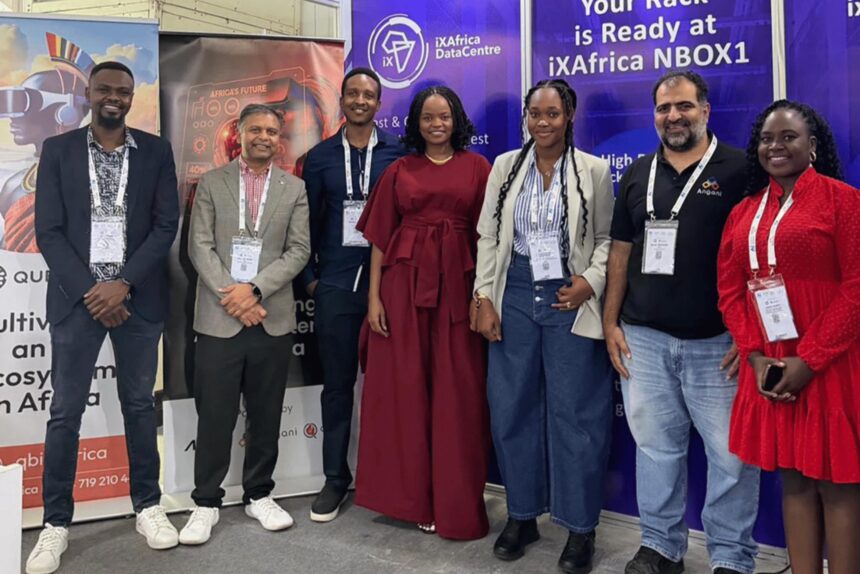
Qhala, Amini AI, Angani and iXAfrica Data Centres have announced a collaboration to host Qubit Hub at iXAfrica’s NBOX1 facility, in a move designed to strengthen Africa’s AI research and digital infrastructure ecosystem.
The partnership was unveiled during AI Everything GITEX Kenya 2026, underscoring Kenya’s growing ambition to position itself as a regional hub for artificial intelligence, cloud computing and digital infrastructure.
Qubit Hub, incubated by Qhala under QTrust, is an African-focused AI research and innovation lab aimed at bringing together researchers, developers, data scientists, policymakers and industry builders to develop practical, locally relevant AI solutions for the continent.
“With this partnership, we are solving for compute, talent and community. iXAfrica is AI-ready, and they are providing the infrastructure we need to ensure we can scale as the continent’s needs grow — which means we can deliver this not just to Kenya, but to researchers across the region,” said Dr. Shikoh Gitau, CEO, Qhala.
Building an integrated AI ecosystem
The collaboration brings together four distinct but complementary capabilities across Africa’s digital stack.
Qhala provides the innovation and ecosystem-building layer behind Qubit Hub, coordinating research and AI development initiatives.
Amini AI contributes sovereign AI, compute and data infrastructure capabilities. Angani provides local cloud services to support testing, deployment and scaling of applications. iXAfrica delivers carrier-neutral, AI-ready data centre infrastructure to host and power the entire ecosystem.
Together, the partners are seeking to bridge a long-standing gap in Africa’s technology landscape, which is the disconnect between AI research ambition and the infrastructure needed to deploy solutions at scale.
From AI ambition to practical deployment
According to the partners, Qubit Hub is designed to bring Africa’s AI builders closer to the infrastructure required to move from experimentation to real-world deployment.
The initiative aims to support a growing community of African technologists working on AI applications in sectors such as agriculture, climate, health, financial services and governance, where access to compute and reliable infrastructure has often been a constraint.
By localising infrastructure within Kenya, the partnership also aims to improve data sovereignty and reduce reliance on external cloud and compute ecosystems.
Dr Shikoh Gitau, Chief Executive Officer of Qhala, said the initiative addresses three critical gaps in Africa’s AI development, which are compute capacity, talent development and ecosystem coordination.
Strengthening Africa’s digital sovereignty agenda
The collaboration reflects a broader shift in Africa’s technology strategy, where attention is moving beyond AI model development toward the underlying infrastructure that powers it.
By anchoring Qubit Hub at iXAfrica’s NBOX1 facility, the partners are positioning Kenya as a strategic launchpad for AI innovation, sovereign cloud services and regional data infrastructure development.
The initiative also highlights increasing coordination between infrastructure providers, cloud platforms and AI research organisations as African countries seek to build more self-sustaining digital economies.
“This is not a Kenya-only construct. It is about providing compute to AI builders and researchers across Africa. This is exciting,” said Dr. Shikoh Gitau.
The partners said the collaboration will support researchers, startups, enterprises and policymakers as they transition from AI experimentation to deployment at scale.
Talking Points
It is significant that the collaboration between Qhala, Amini AI, Angani and iXAfrica Data Centres is anchoring Africa’s AI ambitions directly to physical infrastructure, addressing one of the continent’s most persistent gaps: access to reliable compute and scalable cloud capacity.
By hosting Qubit Hub at iXAfrica’s NBOX1 facility, the initiative moves AI development from abstract discussion into a production-ready environment where researchers and builders can actually deploy, test and scale solutions in real time.
At Techparley, we see this as an important shift in Africa’s technology ecosystem, where innovation is increasingly being tied to sovereign infrastructure rather than dependency on external cloud systems.
The integration of research, cloud services, AI infrastructure and data centre capacity creates a rare full-stack environment that can significantly reduce the friction between idea creation and real-world deployment.
There is also an opportunity to strengthen regional inclusion, ensuring that Qubit Hub evolves into a pan-African platform rather than remaining concentrated within a single geographic hub.
As the partnership develops, deeper collaboration with policymakers, universities and startup ecosystems could accelerate adoption and ensure that Africa’s AI growth is both inclusive and infrastructure-driven.
——————-
Bookmark Techparley.com for the most insightful technology news from the African continent.
Follow us on Twitter @Techparleynews, on Facebook at Techparley Africa, on LinkedIn at Techparley Africa, or on Instagram at Techparleynews.