



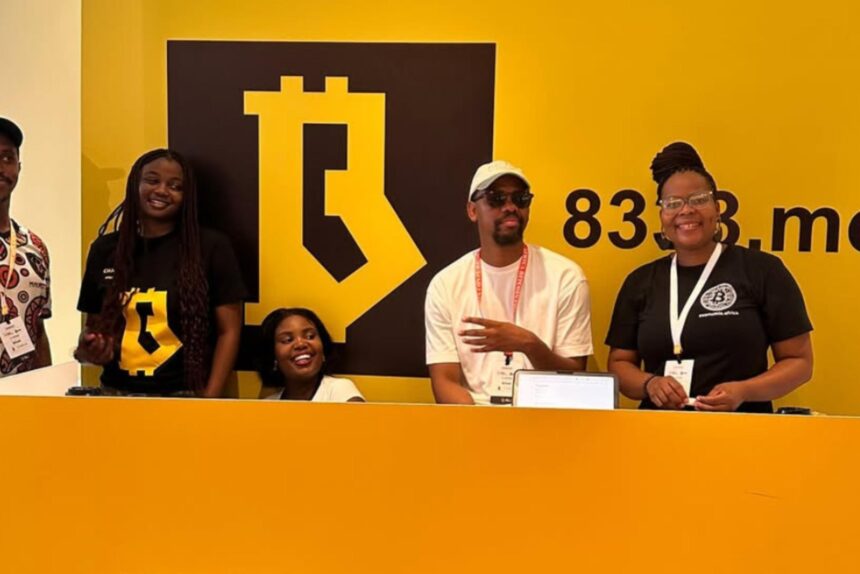
Bitcoin and other digital assets promise fast, low-cost cross-border payments. Yet, in practice, they remain tethered to smartphones and reliable internet access, luxuries still out of reach for hundreds of millions across Africa. Kgothatso Ngako, a South African software engineer founded Machankura to address this.
Ngako believes that design bias has excluded a vast segment of the continent. In 2022, he founded Machankura to address what he sees as a structural flaw in crypto adoption, the assumption that users must be online.
Machankura allows people to send and receive Bitcoin using Unstructured Supplementary Service Data (USSD), the short-code technology widely used across Africa to check airtime, transfer mobile money, and access basic banking services.
By eliminating the need for apps or internet connectivity, the startup aims to bring Bitcoin to feature phones, devices that still account for a significant share of the African market.
“USSD is already familiar,” said Noelyne Sumba, Machankura’s Director of Operations. “People use it every day for financial services. We are extending that to Bitcoin.”
How Machankura Works
Machankura operates at the intersection of telecom infrastructure and the Bitcoin Lightning Network.
On the telecom side, users dial a local USSD code from any phone, feature or smartphone. The request travels through mobile networks to Africa’s Talking, a communications API provider that routes the session to Machankura’s servers. Users interact through a simple text menu, limited to 160 characters per prompt and timed at 20 seconds per response.
In Ghana, Kenya, Malawi, Namibia, Nigeria, and Zambia, Africa’s Talking serves as the aggregator. In Côte d’Ivoire, Tanzania, and Uganda, local providers handle integration due to regulatory constraints.
USSD infrastructure, however, comes at a cost. In Nigeria, securing a USSD code through Africa’s Talking costs ₦200,000 ($145) upfront, with ₦70,000 ($51) in monthly maintenance fees, plus VAT and per-session charges.
In Kenya, Safaricom setup costs reach KES 145,000 ($1,122), with KES 70,000 ($542) monthly maintenance. These fixed costs apply regardless of transaction volume, a significant burden for a startup processing micro-payments.
On the blockchain side, Machankura connects to the Lightning Network, Bitcoin’s second-layer protocol that enables near-instant, low-cost transactions. The company operates its own Lightning nodes, holding approximately 1.6 BTC in liquidity across nearly 20 payment channels.
Each user’s phone number is mapped to a custodial Lightning wallet and a Lightning address (for example, phonenumber@8333.mobi), allowing anyone globally to send them Bitcoin.
Machankura charges a 1% fee on transactions, denominated in Bitcoin, and does not handle fiat currency.
Who Uses Machankura?
Machankura is active in Côte d’Ivoire, South Africa, Kenya, Ghana, Malawi, Zambia, Nigeria, Namibia, Tanzania, and Uganda. It has connected over 39,000 phones to its network.
Adoption, however, is uneven. Usage is concentrated in urban and peri-urban areas, largely among younger, digitally aware users aged 35 and below who understand cryptocurrency but may lack reliable internet access.
“It’s the young people who are mostly tech-savvy, but because either they cannot afford internet connectivity, or most of them have feature phones, it’s very easy for us to onboard them,” said Sumba.
Beyond peer-to-peer transfers, Machankura integrates with partner platforms via the Lightning Network. In Kenya, users can transfer Bitcoin to Tando, which converts it into M-PESA credit. In South Africa, MoneyBadger has integrated Lightning into its point-of-sale system and, through Scan to Pay, reaches over 650,000 merchant locations, including Pick n Pay stores. Users can also purchase airtime and digital vouchers through Bitrefill.
What You Need to Know
Grassroots adoption offers compelling case studies. In Kisii, western Kenya, members of Bitcoin Chama use feature phones for daily transactions.
In Kibera, Nairobi’s largest informal settlement, the Afribit project has onboarded 2,600 residents into a circular Bitcoin economy.
In Mossel Bay, South Africa, Bitcoin Ekasi pays staff salaries entirely in Bitcoin and has onboarded local shops.
Since launch, Machankura has processed over 19 BTC in transaction volume, equivalent to more than $1.2 million at current market prices.
Machankura competes indirectly with M-PESA, which processes billions in fiat transactions annually and enjoys unmatched merchant penetration.
Its most direct competitor is Kotani Pay, a Nairobi-based crypto startup backed by Tether. Kotani also uses USSD but focuses on dollar-pegged stablecoins such as USDT and USDC. Stablecoins eliminate volatility, a critical factor for risk-averse users.
Growth and the Road to Scale
Machankura’s user base has grown from 2,900 connected phones in 2023 to 13,600 in 2024 and 39,000 today. In a continent with over 570 million mobile subscribers, that represents just 0.007% penetration.
The startup is exploring community-based growth through savings circles and has introduced a “Clans” feature for collective savings. It is also developing Machankura 2.0, which would allow users to hold private keys on SIM-based chips, reducing custodial risk.
Machankura’s thesis rests on three assumptions: that feature phones will remain widespread, that USSD is Africa’s most trusted financial interface, and that Bitcoin is the superior monetary technology.
Yet structural tensions remain. Regulatory shifts may require costly compliance measures, including Virtual Asset Service Provider (VASP) licences and enhanced KYC controls. For now, Machankura represents one of the boldest attempts to localise Bitcoin for Africa’s offline majority.
Experts say whether it can grow from tens of thousands of users to hundreds of millions will depend not only on technology, but on regulation, liquidity access, merchant adoption, and the broader trajectory of digital asset acceptance across the continent.
Talking Points
Machankura’s use of USSD to enable Bitcoin transactions is a thoughtful response to one of Africa’s most persistent digital divides, the gap between mobile access and mobile internet access. By building on a technology millions already trust and use daily, the startup removes the smartphone barrier that has limited crypto adoption across the continent.
This mobile-first, offline-friendly approach positions Machankura as a structurally inclusive financial tool, particularly for feature phone users who are often excluded from app-based digital asset platforms. It aligns with the realities of markets where data remains expensive and connectivity inconsistent.
At Techparley, we see how embedding innovation within familiar infrastructure increases the likelihood of behavioural adoption. Rather than forcing users to adapt to new technological habits, Machankura adapts Bitcoin to existing ones. That design philosophy is strategic.
Its integration with the Lightning Network also strengthens its value proposition. Near-instant, low-cost transactions make micro-payments viable, which is critical for informal economies where transaction sizes are small but frequent.
However, scale will depend heavily on solving the on-ramp challenge. If users struggle to acquire Bitcoin easily and consistently, adoption will remain constrained regardless of how accessible the wallet interface is. Strengthening partnerships around fiat-to-crypto access will be key.
Regulatory clarity will also shape Machankura’s trajectory. Its dependence on telecom infrastructure means stability in policy and aggregator relationships is essential for long-term sustainability.
——————-
Bookmark Techparley.com for the most insightful technology news from the African continent.
Follow us on Twitter @Techparleynews, on Facebook at Techparley Africa, on LinkedIn at Techparley Africa, or on Instagram at Techparleynews.