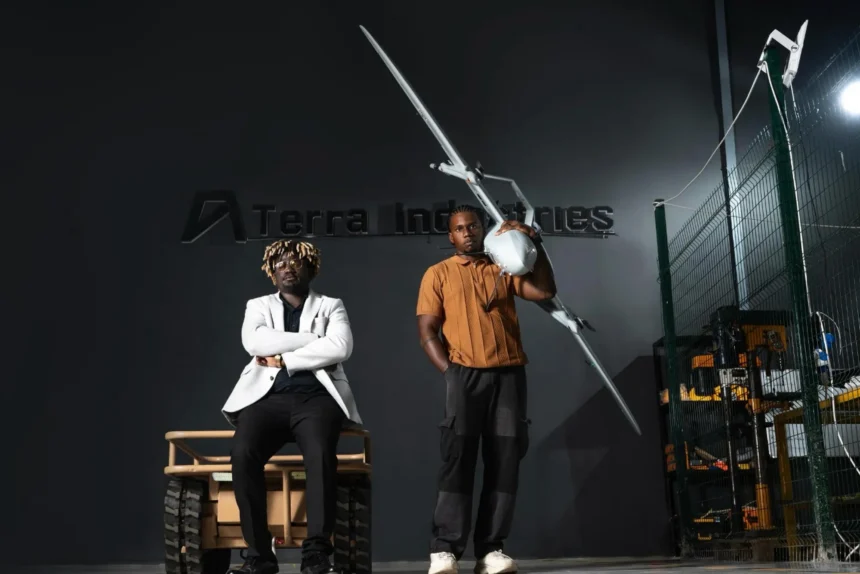
Terra Industries, a Nigerian defence technology company developing autonomous security systems for critical infrastructure, has secured an additional $18 million, bringing its seed funding to $52 million as it prepares for expansion across Africa and the Global South.
The fresh capital will support its first international office in London, manufacturing expansion, wider deployments and recruitment across engineering, operations and business development.
Founded in 2024 by Nathan Nwachuku and Maxwell Maduka, Terra is positioning itself beyond conventional drone manufacturing by combining aerial, ground and maritime systems with proprietary software.
The company says its technology protects critical assets worth about $11 billion across several African countries today, underscoring its ambition to build sovereign security capabilities across Africa and the wider developing world.
What to Know About Terra Industries
Terra Industries was founded in 2024 by Nathan Nwachuku and Maxwell Maduka as a defence technology firm focused on building security systems for Africa and the Global South.
Rather than relying on imported equipment, the company wants to develop and manufacture systems suited to terrain, security threats and realities.
Terra describes itself as a “multi-domain systems and data intelligence company” and seeks to become a defence technology provider for emerging markets.
Its systems are deployed to protect power plants, mines and other critical assets worth approximately $11 billion across African countries.
The company’s wider mission is to develop locally relevant security technology while strengthening African technological and industrial capabilities.
What Does Terra Industries Do?
Terra Industries develops autonomous systems for security operations across air, land and maritime environments.
Its portfolio includes long- and mid-range autonomous drones, interceptor drones, sentry towers and unmanned ground vehicles, creating a network for monitoring large, difficult environments.
The technology helps governments and infrastructure operators detect suspicious activity, monitor vulnerable locations, plan missions and coordinate responses efficiently.
Terra designs for infrastructure sabotage, illegal mining, organised crime and terrorism, where conventional, troop-heavy approaches can be costly or difficult to sustain.
Rather than depending entirely on human patrols, the company’s autonomous systems can provide persistent surveillance and support decision-making across remote and high-risk locations in real-world deployments.
This approach reflects Terra’s ambition to combine hardware, software and intelligence into an integrated security architecture capable of supporting governments and infrastructure operators across Africa and beyond.
What Are They Protecting?
The company is targeting infrastructure whose disruption can cause economic or national-security consequences. These assets include power plants, mining operations, energy facilities, urban infrastructure, maritime assets and border environments.
Terra says its systems are already being used to protect assets worth approximately $11 billion across African countries. The underlying challenge is the scale of many critical facilities, making continuous human surveillance difficult and costly.
Autonomous systems can provide persistent monitoring, gather information and alert operators to threats across difficult areas. The company points to infrastructure sabotage, illegal mining, organised crime and terrorism as major threats across the Global South.
Its objective is therefore to give operators technology capable of detecting, deterring and responding to threats before severe damage occurs, while reducing pressure on human security teams.
The approach combines surveillance, intelligence and autonomous response capabilities.
What Are Terra’s Plans for the Fund?
The new $18 million investment will help Terra move from development towards larger operations.
The company plans to use the money to open its first international office in London, increase manufacturing capacity, accelerate deployments across the Global South and expand its engineering, operations and business development teams.
A major manufacturing project is the planned Pax-2 facility in Ghana, scheduled to open in the fourth quarter of 2026. At 34,000 square feet, the facility is expected to become Africa’s largest drone factory with projected annual capacity of 50,000 units across its aerial portfolio by 2028.
The funding also supports expansion beyond Africa while keeping manufacturing on the continent. Existing investors participated alongside investor Norleo Space Investments and angel investor Grant Gordon.
The expansion is expected to strengthen Terra’s ability to manufacture at scale while building an international commercial footprint.
ArtemisOS: What It Means
ArtemisOS is central because it provides the software layer connecting Terra’s different security systems. Instead of treating drones, towers and ground vehicles separately, the platform is designed to coordinate them through a unified system.
Terra says ArtemisOS enables “real-time threat detection, autonomous mission planning, and coordinated response across vast and difficult environments.”
In simple terms, the software is intended to help operators understand what is happening, determine how systems should respond and coordinate multiple machines during security operations.
This extends Terra beyond hardware into software and data intelligence.
By controlling both physical systems and the software connecting them, the company is seeking to create an integrated security platform that can be adapted to large-scale infrastructure protection at scale and across borders.
That integration is a key part of Terra’s broader technology strategy.
Why the London Office Matters?
Terra’s decision to establish its first global office in London is intended to strengthen its connection to the global defence ecosystem.
According to the company, London will provide access to institutions that influence global defence and infrastructure markets, and a deep pool of AI and operations talent.
The move supports global expansion while keeping manufacturing in Africa.
The company says the office will put it “in the rooms where global defense decisions are made.”
Terra plans to use its global presence to support expansion into the Gulf, South America and South Asia, where it sees similar security and infrastructure challenges.
The strategy separates global commercial and institutional engagement from its African manufacturing base while supporting international partnerships and future partnerships.
This could help Terra build relationships with governments, investors and infrastructure operators as it expands beyond its home market.
Terra’s Focus on the Global South
Terra’s focus on the Global South reflects its view that these countries need technology suited to their environments and economic realities.
The company identifies infrastructure sabotage, illegal mining, organised crime, terrorism and border insecurity among the threats affecting governments and businesses.
It argues that dependence on imported security systems can create high maintenance costs and supply-chain and geopolitical risks. Terra therefore wants countries and infrastructure operators to have greater control over their technology, software and data.
Nwachuku said, “Critical infrastructure across the Global South is best protected by systems designed for these environments and built in the regions they protect.”
With planned expansion into the Gulf, South America and South Asia, Terra is positioning itself as a homegrown provider with international ambitions across emerging economies.
Its strategy ultimately seeks to combine local manufacturing, autonomous technology and data intelligence to strengthen security capabilities across the Global South.
________________________
Bookmark Techparley.com for the most insightful technology news from the African continent.
Follow us on X/Twitter @Techparleynews, on Facebook at Techparley Africa, on LinkedIn at Techparley Africa, or on Instagram at Techparleynews