

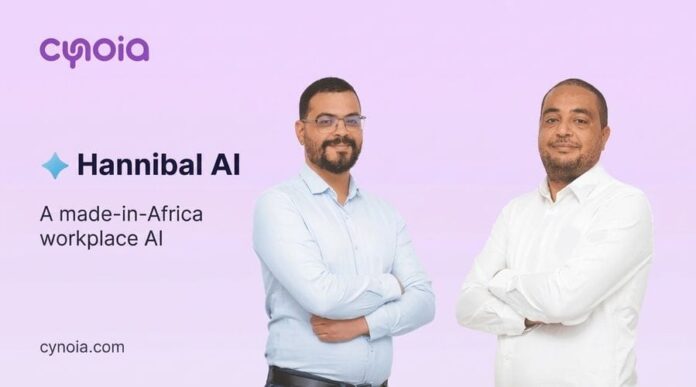
Tunisian software-as-a-service (SaaS) startup, Cynoia, has launched Hannibal AI, an artificial intelligence-powered workplace assistant designed to help African businesses improve productivity, streamline operations and make better-informed decisions.
Integrated into the latest version of its collaboration and work-management platform, the new AI assistant enables organisations to analyse internal business activities, monitor project progress, generate reports and translate workplace information across nine languages, including Hausa, Yoruba, Wolof and Swahili.
The November 12, 2026, product update also introduces support for third-party AI tools, including ChatGPT, Claude and Cursor, allowing users to connect external AI assistants to their workspaces through the Model Context Protocol (MCP).
Founded in 2019, Cynoia is positioning the platform as an African-focused alternative to conventional workplace management solutions, particularly for businesses operating under limited internet connectivity and financial constraints.
Its chief executive, Nasreddine Riahi, said the ambition is to provide teams with AI that understands their actual operations rather than simply generating content.
What is Cynoia and What Does It Do?
Cynoia is a Tunisian technology company that provides an integrated digital workplace where businesses can manage their projects, coordinate employees, communicate, hold virtual meetings, share files and monitor daily activities from a single platform.
Founded by Nasreddine Riahi and Ayoub Rabeh, the company developed its solution to address the difficulties organisations face when using multiple applications to manage different aspects of their operations.
Instead of switching between separate platforms for communication, project management, video conferencing, document sharing and task tracking, employees can perform these activities within Cynoia’s unified workspace.
The company is particularly focused on addressing the operational realities of African businesses, including unreliable internet connectivity, language differences and the cost of accessing international software solutions.
Its platform is designed to operate under low-bandwidth conditions, including its video-calling functionality, and is accessible through Android and iOS applications. It also supports payments in several local currencies and offers payment options through mobile money services such as Wave and conventional bank cards.
Cynoia currently serves more than 7,000 users, primarily across West Africa, with customers including Yas Senegal, Expresso Senegal and MTN Côte d’Ivoire. Its growing geographical presence also covers Nigeria, Benin, Togo, Mali, the Democratic Republic of Congo, Egypt, Tunisia and France.
What to Know About Hannibal AI
Hannibal AI is Cynoia’s newly introduced artificial intelligence assistant, designed to help businesses understand and manage their internal operations using information already available within their digital workspaces.
Unlike conventional AI chatbots that primarily respond to general questions or generate content based on user instructions, Hannibal AI analyses organisational information, including projects, assigned tasks, meeting notes, calendars, discussions and shared files, to provide context-specific answers.
For instance, a business owner can ask the assistant about the progress of ongoing projects, outstanding employee responsibilities, upcoming deadlines or the organisation’s priorities for the week. Rather than manually checking multiple documents and conversations, users can receive relevant information, summaries, tables, charts and direct links to the corresponding tasks.
The assistant can also generate progress reports and weekly work plans to support management decisions and improve coordination among employees.
Hannibal AI supports nine languages, including English, French, Arabic, Wolof, Swahili, Hausa, Yoruba, Zulu and Spanish, making it particularly relevant to organisations with multilingual teams across different African markets.
According to Cynoia, the assistant is named after Hannibal, the ancient Carthaginian military commander remembered for his strategic abilities. The name reflects the company’s ambition to develop intelligence originating from Africa and designed to serve African businesses.
Open Platform to ChatGPT, Claude and Other AI Tools
Beyond introducing its proprietary AI assistant, Cynoia’s latest platform update allows businesses to connect external artificial intelligence applications, including ChatGPT, Claude and Cursor, to their workspaces.
The integration is facilitated through the Model Context Protocol (MCP), an open standard that enables AI applications to communicate with external software platforms and access relevant information.
Through this connection, users can authorise supported AI assistants to read information within their Cynoia workspaces and perform certain activities, including creating tasks. This means businesses are not restricted to using Hannibal AI alone but can also leverage other AI tools they already use for different professional and operational purposes.
For example, an organisation could connect ChatGPT to its Cynoia workspace to examine authorised project information or use another supported assistant to help organise tasks and retrieve relevant workplace details.
However, Cynoia has introduced access controls to protect organisational information. Connecting an external AI application requires explicit permission for each workspace, while individual users can review and revoke their connections. Workspace owners also have the authority to suspend all external AI connections when necessary.
The development represents an important step towards making Cynoia an open AI-enabled workplace ecosystem rather than a platform dependent exclusively on its internally developed assistant.
Data Protection, Security and Privacy Considerations
As artificial intelligence becomes increasingly integrated into business operations, protecting confidential organisational information remains a major concern.
Cynoia’s latest development therefore places considerable emphasis on data governance, access permissions and security controls, particularly because Hannibal AI and connected third-party assistants can interact with internal workplace information.
The company hosts its data on Amazon Web Services (AWS) and local cloud infrastructure providers, including Stellarix in Senegal. It has also appointed a data protection officer working with relevant regulatory authorities, including France’s Commission Nationale de l’Informatique et des Libertés (CNIL), Senegal’s Commission de Protection des Données Personnelles (CDP) and Tunisia’s National Authority for the Protection of Personal Data (INPDP).
Additionally, Cynoia is working towards obtaining three internationally recognised security and governance certifications:
- ISO 27001, which focuses on information security management;
- ISO 42001, which establishes requirements for artificial intelligence management systems; and
- SOC 2, which evaluates organisational controls relating to security and other relevant service commitments.
Although the certifications are still in progress, the company’s approach reflects the growing importance of responsible AI deployment and data protection as businesses increasingly allow intelligent systems to access sensitive operational information.
Cynoia’s Growth, Funding and Expansion Plans for 2027
Since raising €850,000 in 2023 from investors including Digital Africa, Bpifrance, 216 Capital, Go Big Partners, KJ Holding and UGFS, Cynoia has continued expanding its operations, product offerings and geographical presence.
The company reportedly increased its user base from approximately 3,000 to more than 7,000 during this period, opened its Dakar subsidiary in 2024 and launched its Android and iOS applications in May 2026. Its November 2026 release of Hannibal AI and the MCP connector represents another major development in its product strategy.
Cynoia currently employs 15 people, comprising 10 employees in Tunisia, three in Senegal and two in France. Its achievements include being named Best SaaS Startup at AfricArena 2024, winning the Provence Africa Connect award and participating in the TABC programme in Senegal and the Democratic Republic of Congo.
Looking ahead, the company plans to strengthen its distribution partnerships with telecommunications operators across North and West Africa, expand into additional markets, beginning with Egypt, and complete its ongoing international security and AI governance certifications.
It also intends to raise another funding round to support its growth ambitions. Through these initiatives, Cynoia hopes to reach more African businesses and strengthen its position in the continent’s expanding enterprise software and artificial intelligence markets.
________________________________
Bookmark Techparley.com for the most insightful technology news from the African continent.
Follow us on X/Twitter @Techparleynews, on Facebook at Techparley Africa, on LinkedIn at Techparley Africa, or on Instagram at Techparleynews

