



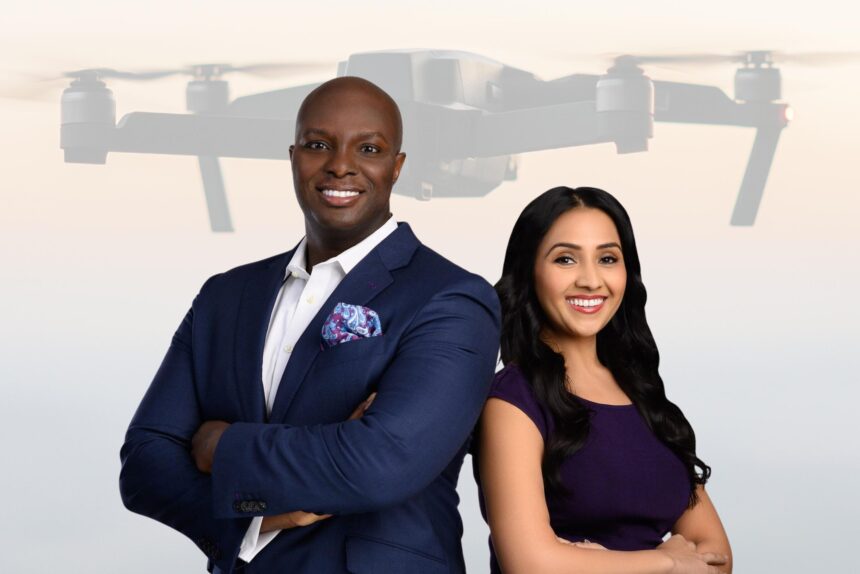
As Nigeria grapples with worsening insecurity and repeated attacks on schools, UrSafe, a U.S.-based technology company is proposing a rethink of how vulnerable communities detect threats, deter attackers, and activate emergency response.
UrSafe says autonomous drones, artificial intelligence, and a security-as-a-service model could help close the country’s widening safety gap, particularly for schoolchildren.
UrSafe was founded in 2019 by Anthony Oyogoa and Ruma S. Patel with an original focus on personal safety software. Today, the company is positioning itself as a full-stack security provider for regions where emergency infrastructure is weak or unreliable, with Nigeria emerging as a key test case.
“Our proposition is the phased introduction and integration of enterprise-grade Unmanned Aerial Systems (UAS) and supporting technology to bolster facility security across Nigeria,” said Oyogoa.
What You Need to Know
Drone surveillance has long been touted as a powerful security tool, but its cost has placed it beyond the reach of many public institutions. UrSafe argues that this procurement-heavy model is fundamentally flawed for countries already struggling with budget constraints and broken security pipelines.
Instead of selling drone fleets outright, the company plans to offer drone surveillance as a service, allowing agencies and institutions to pay for monitoring without owning or maintaining the hardware.
UrSafe’s Nigeria strategy formally took shape when it signed a memorandum of understanding with Klass Security, a private firm that provides security services to the Nigerian Ports Authority, the Nigerian Maritime Administration and Safety Agency (NIMASA), and APM Terminals at the Onne Port in Rivers State.
Under the agreement, UrSafe will supply drone technology to complement Klass Security’s existing workforce of around 150 personnel.
“This initiative will tailor and scale our aerial intelligence platforms to create a robust surveillance network for high-value protection zones. The project is presently in its initial assessment and development phase,” Oyogoa said.
A Crisis That Demands New Thinking
The urgency of such solutions is underscored by Nigeria’s ongoing school safety crisis. Since 2014, more than 1,400 students have been kidnapped nationwide.
The mass abduction of 303 students and 12 school staff in Niger State is the latest in a series of attacks that have also affected Kebbi, Zamfara, and other parts of the North-West.
For many communities, the threat has forced school closures, mass relocations, and daily anxiety for parents. In this context, UrSafe is advocating for what it calls “Safe School Zones”, predefined corridors and perimeters monitored by autonomous, AI-equipped drones.
UrSafe now frames its drone programme as a way to create first-response capability where traditional emergency systems fall short.
Understanding UrSafe’s Business Model
The company says its drones can launch within 90 seconds, fly autonomous patrol routes, detect threats using AI, and stream live video to control centres operated locally or remotely from South Africa or Colombia.
In March 2025, pilot deployments were carried out in Kouga Municipality in South Africa’s Eastern Cape, covering critical infrastructure and municipal policing zones.
For Nigeria, the technology is being adapted to environments where school perimeters are porous and response times slow. Thermal imaging can detect heat signatures at night, vehicle recognition flags unauthorised convoys, and drones can track threats until responders arrive.
In some scenarios, UrSafe envisions drones providing scheduled aerial overwatch for children walking long distances to school.
Regulation, Data, and Sovereignty
Drone surveillance raises legitimate concerns around airspace safety, data protection, and sovereignty. UrSafe says its operations are designed to comply fully with Nigeria’s regulatory framework, including Part 21 of the Nigerian Civil Aviation Authority’s Remotely Piloted Aircraft System (RPAS) regulations, which are aligned with International Civil Aviation Organisation standards.
Each deployment will be led by a certified Nigerian Pilot-in-Command operating from a local “Hive”, a small site equipped with drone docks, batteries, and control systems.
Drones are geo-fenced by default and cannot enter restricted airspace without cryptographic authorisation held by government authorities.
Crucially, UrSafe says it is not seeking blanket nationwide approval. Instead, it will request beyond-visual-line-of-sight clearance only for predefined school corridors and safe zones, making oversight more manageable. On data governance, the company insists schools or government agencies remain the data controllers.
What This Means
Nigeria’s unreliable power and connectivity pose further challenges. UrSafe says it addresses these with Starlink as the primary link, cellular bonding across MTN, Airtel, and 9mobile as a secondary layer, and long-range radio frequency control as a final fallback.
Each Hive is powered by solar inverters and backup lithium-ion batteries, ensuring round-the-clock operation. The company plans to scale through a hub-and-spoke model, with each Hive covering a 10-kilometre radius, roughly 15 to 20 schools.
UrSafe projects deploying up to 50 new Hives per month once supply chains are established, expanding its fleet from 200 to 1,000 drones within two years. It also plans to train more than 100 local drone pilots in Nigeria in its first year of large-scale operations.
If implemented at scale, experts say UrSafe’s model could provide thousands of schools with continuous aerial monitoring without relying solely on overstretched police units. Beyond immediate security gains, the approach could create technical jobs, build domestic drone expertise, and shift Nigeria’s safety architecture from reactive crisis response to proactive threat prevention.
Talking Points
At Techparley, we see UrSafe’s approach as a shift from reactive safety tools to proactive threat detection, particularly in high-risk environments such as schools and community corridors that have become soft targets for attacks.
It is notable that UrSafe is rethinking security delivery in Nigeria by offering drone surveillance as a service, removing the heavy financial and operational burden of owning, maintaining, and staffing full drone fleets.
This service-led model directly addresses a real and persistent challenge in Nigeria’s security ecosystem, where schools and public institutions often lack the budgets and infrastructure required to deploy advanced surveillance technologies.
The integration of autonomous drones, artificial intelligence, and rapid-response monitoring into a single system means institutions can gain real-time situational awareness without building complex control centres or relying solely on overstretched security forces.
With the right oversight and local collaboration, UrSafe has the potential to redefine how safety infrastructure is built and delivered in Nigeria.
——————-
Bookmark Techparley.com for the most insightful technology news from the African continent.
Follow us on Twitter @Techparleynews, on Facebook at Techparley Africa, on LinkedIn at Techparley Africa, or on Instagram at Techparleynews.