



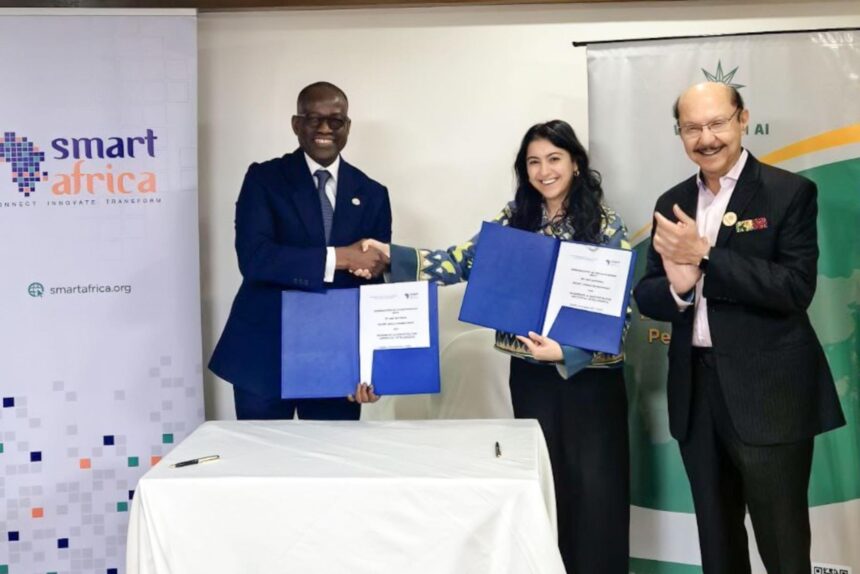
A new partnership between Wadhwani AI Global and Smart Africa aims to accelerate the development and adoption of artificial intelligence across Africa, with a deliberate focus on strengthening public systems rather than disrupting them.
The two institutions signed a Memorandum of Understanding (MoU), signalling a strategic alignment between African governments and India’s growing AI ecosystem. The agreement was formalised by Shalina Wadhwani, Co-Founder of Wadhwani AI Global, and Lacina Koné, Director General and Chief Executive Officer of Smart Africa.
While non-binding, the framework establishes a structured pathway for cooperation across priority sectors including health, agriculture, education, financial services, government services and climate action.
Crucially, both parties have positioned the collaboration within a broader Global South narrative, one that emphasises peer learning, institutional strengthening and long-term sustainability.
Building AI Within Institutions, Not Around Them
At the heart of the agreement is a shared conviction that artificial intelligence can only deliver meaningful public value when embedded within strong institutions and adapted to local contexts.
Under the framework, Wadhwani AI Global and Smart Africa will collaborate to design and scale inclusive, context-led AI use cases tailored to the needs of African countries. Rather than prioritising rapid deployment, the initiative stresses “responsible sequencing”, ensuring that AI systems are governable, trusted and capable of sustained impact.
The areas of cooperation include:
- Developing and scaling AI solutions to improve public service delivery;
- Supporting AI readiness and governance frameworks across Smart Africa’s Member States;
- Strengthening institutional capacity for AI oversight and implementation;
- Establishing an AI Digital Public Goods platform to share adaptable and proven solutions;
- Building technical and policy capacity among policymakers, technologists and innovators;
- Facilitating peer-to-peer collaboration between African governments and India’s AI ecosystem.
This institutional-first approach reflects growing global recognition that AI adoption without governance safeguards can deepen inequalities or undermine public trust. By focusing on readiness and governance in parallel with technical deployment, the partnership seeks to mitigate such risks.
Linking India’s Public-Sector AI Experience with Africa’s Digital Agenda
Wadhwani AI Global has built a track record in deploying AI solutions within India’s public systems, with programmes spanning education, agriculture, public health and service delivery. According to the organisation, its interventions have reached more than 100 million people.
India’s experience, particularly in building digital public infrastructure at scale offers lessons for countries navigating similar challenges of population size, resource constraints and institutional complexity.
Smart Africa, for its part, was established to drive the continent’s digital transformation through policy harmonisation, innovation and coordinated action among its Member States. The alliance brings together African governments committed to leveraging digital technologies for socio-economic development.
“This partnership reflects a shared commitment to building AI that strengthens public systems rather than bypassing them. Africa and India face many of the same questions around scale, governance, and trust and this collaboration creates space for honest, peer-to-peer learning across the Global South,” said Shalina Wadhwani, Co-Founder, Wadhwani AI Global.
“Africa’s AI future will be shaped by collaboration, not imitation. This partnership with Wadhwani AI Global brings valuable experience in building AI within public systems and creates new opportunities for our Member States to learn, adapt, and lead responsibly,” said Lacina Koné, Director General & CEO, Smart Africa.
AI Digital Public Goods
One of the more significant components of the agreement is the proposed establishment of an AI Digital Public Goods (DPG) platform. Such a platform would enable governments to access, adapt and scale AI tools that have already demonstrated effectiveness elsewhere, reducing duplication of effort and accelerating deployment timelines.
The digital public goods model has gained traction globally as governments seek interoperable, open and scalable digital infrastructure.
In the AI context, this approach could support shared standards, ethical guardrails and technical blueprints tailored to developing economies.
For African countries at varying stages of digital maturity, the platform could serve as both a repository of solutions and a community of practice, fostering cross-border collaboration and shared problem-solving.
A Strategic Move for Africa’s AI Readiness
Africa’s AI ecosystem is expanding rapidly, driven by growing investment in start-ups, increasing data availability and rising policy attention. However, disparities in infrastructure, regulatory readiness and technical capacity remain significant across the continent.
By aligning with Smart Africa’s continental mandate, the partnership provides a structured mechanism to support Member States in developing governance frameworks and institutional capacity alongside technical innovation.
This dual emphasis on technology and governance may prove decisive. Experts have consistently warned that without coherent regulatory frameworks, AI adoption can exacerbate bias, compromise privacy or weaken accountability in public administration.
The MoU therefore represents more than a symbolic gesture, it signals a shift towards coordinated, institution-led AI adoption anchored in policy alignment and shared learning across the Global South.
From Intent to Implementation
Although the agreement is non-binding, both organisations have indicated that the coming months will focus on identifying priority opportunities, piloting collaborative initiatives and launching capacity-building programmes aligned with national and regional strategies.
If successfully executed, experts say the partnership could help position African governments not merely as adopters of imported AI tools, but as co-creators of solutions tailored to their socio-economic realities.
As global competition around AI intensifies, the collaboration between Wadhwani AI Global and Smart Africa underscores a broader message that innovation in the Global South need not replicate Western models, but can instead draw on shared experience, institutional pragmatism and collective ambition.
Talking Points
The partnership between Wadhwani AI Global and Smart Africa signals a timely and strategic shift in how artificial intelligence is being positioned across the continent, not as a buzzword, but as infrastructure for public good.
It is particularly significant that this collaboration centres on strengthening public systems rather than bypassing them. Too often, AI initiatives in emerging markets prioritise speed over sustainability. By focusing on governance frameworks, institutional capacity and responsible sequencing, this partnership acknowledges that trust and structure are as important as innovation.
The emphasis on context-led AI use cases across health, agriculture, education, financial services, government services and climate action reflects a pragmatic understanding of Africa’s development priorities. These are sectors where efficiency gains can directly translate into improved livelihoods and economic resilience.
At Techparley, we see strong value in the proposed AI Digital Public Goods platform. A shared repository of adaptable AI solutions could reduce duplication, accelerate implementation and give Member States access to proven models without starting from scratch. This collaborative architecture is essential for scaling impact responsibly across diverse regulatory and infrastructural environments.
If effectively implemented, this partnership could help reposition Africa from being a consumer of imported AI tools to becoming a co-creator of public-interest AI systems.
——————-
Bookmark Techparley.com for the most insightful technology news from the African continent.
Follow us on Twitter @Techparleynews, on Facebook at Techparley Africa, on LinkedIn at Techparley Africa, or on Instagram at Techparleynews.