
As healthcare systems around the world grapple with rising rates of chronic diseases, the conversation is gradually shifting beyond how diseases are treated towards how they can be prevented in the first place. For Precious Ejiba, a digital health leader and Founder of DB Biomedical, that shift represents one of the most important opportunities for digital technology over the next decade.
Speaking with Techparley following her recent work on predictive analytics and preventive healthcare, Precious Ejiba argued that modern healthcare has spent decades operating as a reactive system, intervening only after disease has become clinically apparent. She believes advances in predictive analytics, artificial intelligence and population health data now provide an opportunity to fundamentally rethink that approach.
According to Ejiba, the future of healthcare will not be defined simply by faster diagnosis or more sophisticated treatments, but by the ability to identify risk earlier and intervene before chronic diseases progress.
From Treating Disease to Predicting Risk
Healthcare has traditionally been structured around responding to illness after symptoms appear. While advances in medicine have significantly improved diagnosis and treatment, chronic diseases continue to place unprecedented pressure on healthcare systems worldwide.
Ejiba believes that approach is becoming increasingly unsustainable.
When asked why she believes prevention should become the next major priority, she pointed to a simple observation that has shaped much of her work in digital health.
Many chronic diseases, she explained, begin years before patients receive a diagnosis. During that time, the body often produces measurable biological and metabolic changes that remain largely unnoticed within traditional models of care.
Rather than viewing these changes as isolated clinical measurements, Ejiba believes they should be recognised as opportunities for earlier intervention.
Healthcare, she argued, already collects enormous amounts of health information. The greater challenge is identifying which patients are beginning to move towards disease and acting before complications develop.
The Missing Link Between Data and Prevention
That philosophy has also informed Ejiba’s recent research exploring how predictive analytics can support earlier identification of disease risk.
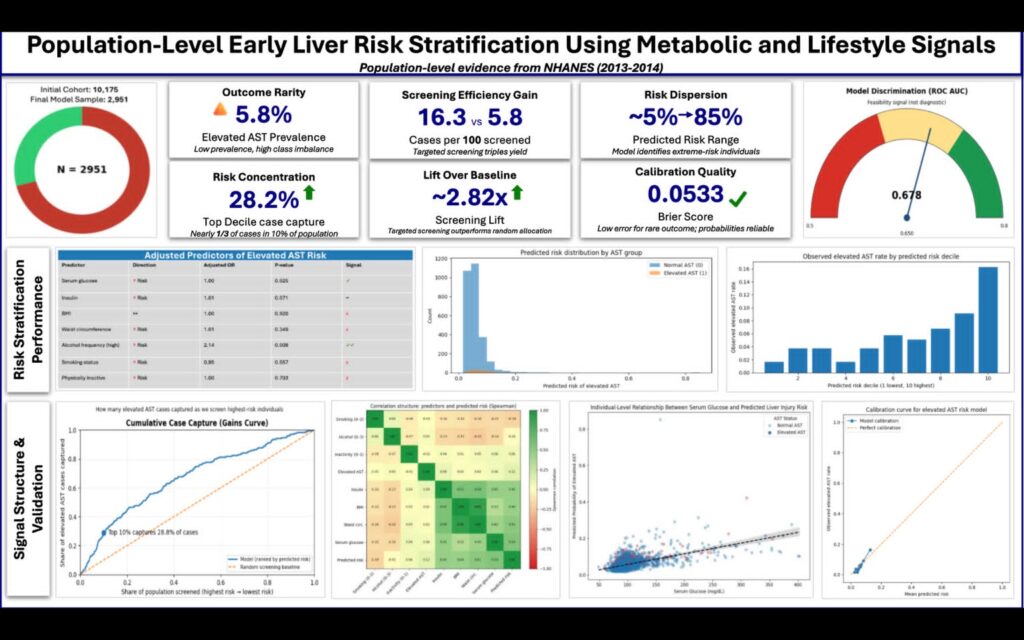
Using data from the United States National Health and Nutrition Examination Survey (NHANES), she investigated whether routinely collected metabolic and lifestyle indicators could be combined to identify individuals at elevated risk of metabolic dysfunction associated steatotic liver disease (MASLD).
Her findings demonstrated that commonly available health indicators (as displayed on the dashboard below) could be used to stratify populations into distinct risk groups, highlighting the potential for digital technologies to support earlier identification of individuals who may benefit from preventive interventions.
For Ejiba, the significance of these findings extends well beyond liver disease.
She believes metabolic dysfunction represents one of the clearest examples of why healthcare must increasingly focus on prediction rather than reaction.
Many of today’s most significant health challenges, including type 2 diabetes, cardiovascular disease, chronic kidney disease and metabolic liver disease, share underlying metabolic risk factors that often develop gradually over many years.
According to Ejiba, recognising those warning signals earlier creates opportunities to intervene before irreversible damage occurs.
Why Predictive Analytics Matters
Rather than describing predictive analytics as another healthcare technology, Ejiba sees it as an entirely different way of thinking about healthcare delivery.
She argues that predictive analytics enables healthcare providers to move beyond simply recording historical events towards anticipating future clinical risk.
By analysing patterns across multiple biomarkers, behavioural indicators and clinical variables, predictive models can identify patients who may require closer monitoring or earlier intervention, even before symptoms become obvious.
This shift, she believes, represents one of the most significant opportunities in modern healthcare.
Instead of treating every patient in the same way, healthcare providers can begin prioritising care based on predicted risk, allowing limited clinical resources to be directed towards those most likely to benefit from early support.
Artificial Intelligence as an Enabler Rather Than a Replacement
Although artificial intelligence has attracted significant attention across healthcare, Ejiba believes discussions often overemphasise automation while overlooking clinical decision support.
In her view, AI delivers its greatest value not by replacing healthcare professionals, but by helping them recognise patterns that would otherwise remain hidden within increasingly complex health datasets.
She argues that predictive analytics becomes particularly powerful when combined with responsible AI, enabling clinicians to translate data into meaningful, personalised preventive action while retaining full responsibility for clinical judgement.
This, she believes, is where digital technology has the greatest opportunity to transform healthcare over the coming years.
A Broader Vision for Digital Health
While much of the public discussion surrounding AI continues to focus on diagnosis and treatment, Ejiba believes the next phase of digital health innovation will be defined by prevention.
She envisions healthcare systems that continuously learn from patient data, identify emerging health risks, personalise interventions and support individuals long before serious illness develops.
For Ejiba, predictive analytics is not simply another analytical tool. It represents the foundation for a healthcare model that is more proactive, more personalised and ultimately more sustainable.
As governments, healthcare providers and technology companies continue investing in digital transformation, she believes the question is no longer whether predictive technologies will influence healthcare, but how quickly healthcare systems can adapt to using them responsibly.
If that transition succeeds, Ejiba argues, healthcare’s greatest technological achievement may not be developing better treatments for disease, but preventing more people from needing them in the first place.