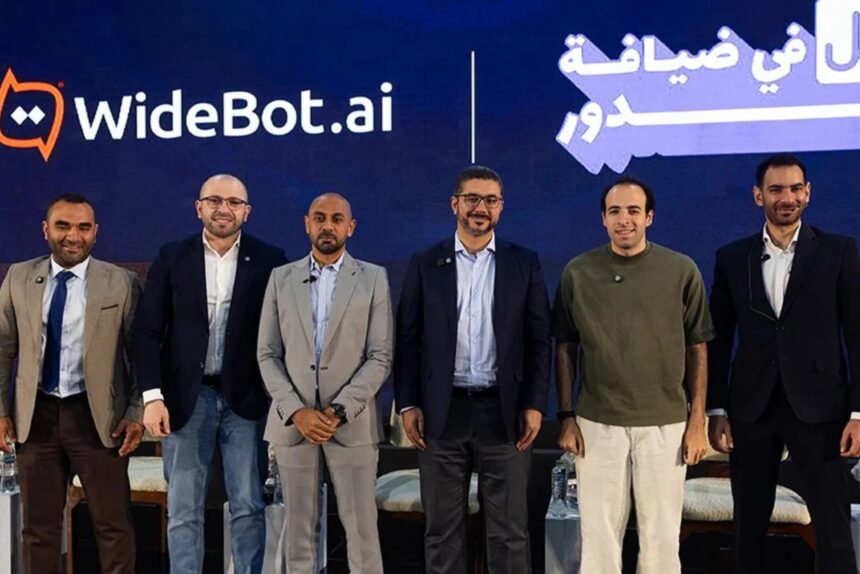
With a significant move poised to reshape artificial intelligence literacy in the Arab world, Egypt-based AI startup WideBot AI has partnered with renowned science communicator Ahmed El-Ghandour to launch a new Arabic-language public education series on artificial intelligence.
Announced during the AI Everything MEA summit in Egypt, the collaboration marks a strategic shift from enterprise-focused AI deployment toward mainstream societal engagement.
The initiative, titled AQL with Ghandour, seeks to simplify complex AI concepts for general audiences, address ethical and workforce implications, and narrow the long-standing Arabic content gap in global AI systems.
By leveraging El-Ghandour’s mass appeal and WideBot’s technical expertise, the project aims to make artificial intelligence not just accessible, but culturally relevant and responsibly understood across the region.
From Enterprise AI to Mainstream Education
For years, WideBot AI has built its reputation within enterprise and institutional circles, developing Arabic-first AI solutions tailored to businesses and government entities. However, this new partnership signifies a deliberate expansion of scope.
Rather than confining AI conversations to boardrooms and technical conferences, the company is stepping into public discourse.
The announcement at AI Everything MEA underscores the company’s recognition that sustainable AI ecosystems require informed societies, not just advanced tools.
Public literacy in artificial intelligence shapes everything from regulatory frameworks and policy development to workforce preparedness and institutional readiness. By investing in education, WideBot AI is positioning awareness as a foundational pillar of long-term AI adoption.
This approach reflects a maturing regional tech landscape, one that understands technological advancement must be matched by societal understanding.
“AQL with Ghandour”: Simplifying AI for Everyday Life
At the heart of the initiative is AQL with Ghandour, a series designed to demystify artificial intelligence through storytelling and practical examples. Rather than technical jargon or developer-centric explanations, the program will focus on real-world applications that resonate with everyday viewers.
The series will explore topics such as large language models, human-AI interaction, and sector-specific applications across healthcare, education, finance, business operations, and government services.
By grounding AI discussions in relatable contexts, the show aims to answer the questions most citizens are asking:
- How does AI affect my job?
- Can it improve public services?
- What risks should I be aware of?
Equally important is the ethical dimension. The program will address issues of automation, job transformation, algorithmic bias, and responsible innovation. This balanced framing, highlighting both opportunities and risks, positions the series as a platform for informed dialogue rather than promotional messaging.
Leveraging the Reach of Al-Daheeh
Ahmed El-Ghandour brings unmatched audience penetration to the project. Through his flagship program Al-Daheeh, he has accumulated billions of views and cultivated a vast Arabic-speaking audience across digital platforms.
His signature style, combining humor, storytelling, and scientific rigor, has consistently transformed complex subjects into widely consumable content.
This communicative strength is central to the partnership’s strategy. Artificial intelligence, often perceived as abstract or intimidating, requires translation into accessible language without diluting intellectual substance. El-Ghandour’s ability to bridge that gap could significantly expand AI discourse beyond traditional tech audiences.
By embedding AI education within a familiar and trusted content format, the initiative lowers the psychological barrier to engagement, inviting participation from students, professionals, policymakers, and families alike.
Addressing the Arabic Content Gap in AI Systems
Beyond public awareness, the partnership tackles a deeper structural issue: the limited representation of Arabic content in global AI training datasets. Arabic constitutes a small fraction of the data used to train many large-scale AI models.
This imbalance can reduce contextual accuracy, linguistic nuance, and cultural relevance in AI systems serving Arabic-speaking users. High-quality Arabic educational material contributes to a broader ecosystem of localized data.
Over time, increased content production in Arabic enhances model performance, strengthens contextual understanding, and improves user trust. In this sense, the series is not only educational, it is infrastructural.
By encouraging regional participation and content creation, the initiative supports a more inclusive digital environment. It reinforces the idea that language equity is central to technological fairness and effectiveness.
Public Literacy as the Foundation of a Sustainable AI Economy
WideBot AI’s leadership frames the initiative as a strategic investment in the future of the regional AI economy. Public literacy influences adoption speed, ethical oversight, and institutional integration.
Citizens who understand AI are better equipped to demand accountability, policymakers can legislate more effectively, and organizations can implement solutions with greater confidence.
In emerging markets particularly, technological transformation must be accompanied by cultural adaptation. Awareness is not optional, it is a prerequisite for sustainable growth.
By aligning technical innovation with public education, WideBot AI and Ahmed El-Ghandour are attempting to build a bottom-up AI movement rather than a top-down deployment strategy.
If successful, AQL with Ghandour could redefine how artificial intelligence enters mainstream Arabic discourse, shifting it from a specialized domain into a shared societal conversation. In doing so, the initiative may well become a blueprint for inclusive AI development across the Global South.
Talking Points
The partnership between WideBot AI and Ahmed El-Ghandour represents a strategically intelligent move that extends beyond public relations into ecosystem-building, but its long-term impact will depend on execution depth rather than audience reach alone.
On one hand, leveraging the mass appeal of Al-Daheeh to mainstream AI literacy addresses a structural bottleneck in the Arab tech landscape: low public understanding paired with accelerating AI adoption.
This alignment of technical expertise and narrative influence could meaningfully narrow the Arabic content deficit in global AI training data while shaping more informed public discourse around ethics, labor disruption, and policy readiness.
However, the initiative risks becoming surface-level edutainment if it prioritizes simplified storytelling without sustained engagement mechanisms such as curriculum integration, institutional partnerships, or measurable literacy outcomes.
Moreover, awareness alone does not automatically translate into improved model performance unless content production reaches scale and quality thresholds sufficient to influence training datasets.
Ultimately, the collaboration is a forward-looking intervention in digital inclusion, but its transformative potential will hinge on whether it evolves into a systemic educational framework rather than remaining a high-visibility media campaign.
_______________________
Bookmark Techparley.com for the most insightful technology news from the African continent.
Follow us on X/Twitter @Techparleynews, on Facebook at Techparley Africa, on LinkedIn at Techparley Africa, or on Instagram at Techparleynews